
March 2026 Update | Discipline in a Complex Environment
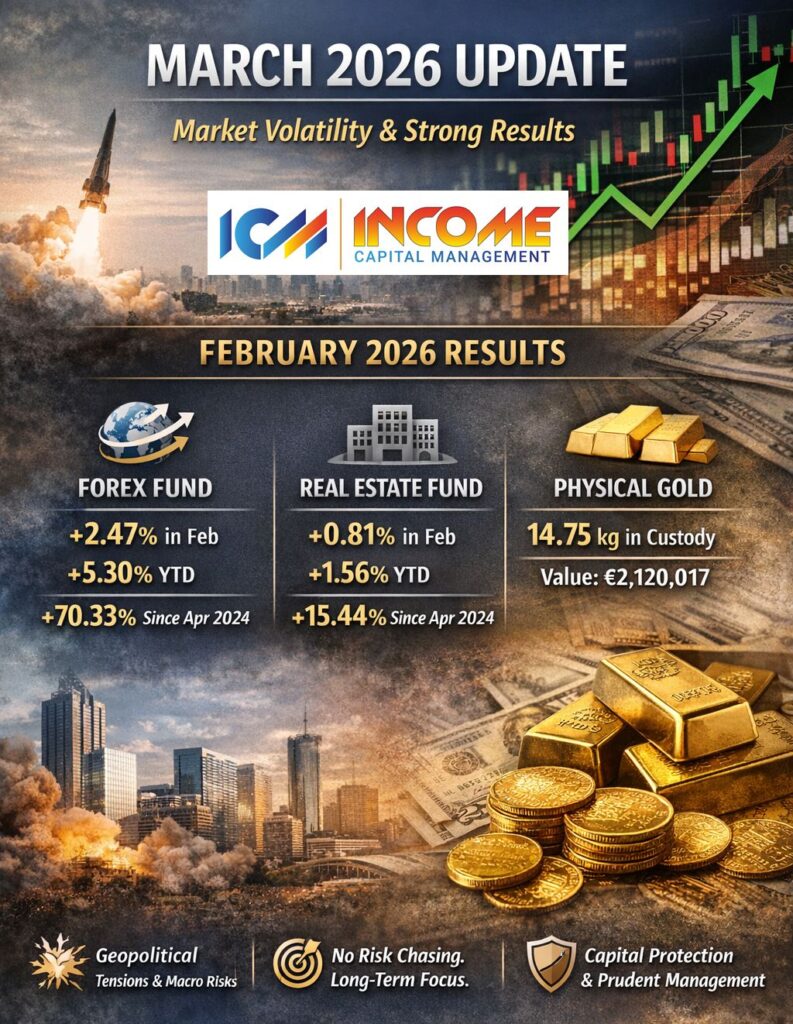
March 2026 Update | Discipline in a Complex Environment The first months of 2026 confirmed what experienced investors already understand: volatility does not disappear — it transforms. Markets remain highly sensitive to monetary policy signals, macroeconomic data releases and geopolitical developments. The ongoing conflict in the Middle East and renewed tensions involving the United States, Israel and Iran have reintroduced structural uncertainty into global capital markets. Interest rate expectations continue to fluctuate. Inflation remains a debated variable. Liquidity conditions are uneven across regions. Currency volatility is elevated. In this context, active and prudent portfolio management remains essential. Macro Environment: Fragility Beneath Stability While headline equity indices have shown resilience in early 2026, underlying cross-asset dispersion tells a more nuanced story. Currency markets are reacting sharply to central bank tone shifts. Energy and commodity pricing reflects geopolitical risk premium. Bond markets are recalibrating inflation expectations. Emerging markets face capital flow volatility. Volatility has not disappeared. It has become selective. In such an environment, discipline becomes more valuable than prediction. Income Capital Management – February 2026 Results FOREX FUND February 2026: +2.47% 2026 YTD: +5.30% Since April 2024: +70.33% The Forex strategy continues to benefit from structured positioning in high-volatility currency environments. Central bank divergence remains a core driver. Tactical adjustments were implemented in response to policy signals and risk sentiment oscillations. Risk exposure was actively calibrated to avoid excessive directional bias during geopolitical escalation phases. The strategy remains rule-based, disciplined and aligned with predefined risk thresholds. REAL ESTATE FUND February 2026: +0.81% 2026 YTD: +1.56% Since April 2024: +15.44% The Real Estate Fund continues to deliver stable income characteristics within a diversified allocation framework. In a context where financing costs remain elevated compared to previous years, careful asset selection and tenant quality analysis remain fundamental. The role of real estate within the broader portfolio is not high acceleration. It is income stability and partial inflation mitigation. PHYSICAL GOLD 1.30 kg purchased in February Total custody: 14.75 kg Market value (28/02/2026): €2,120,017 Gold continues to function as a structural hedge within our allocation model. Heightened geopolitical tensions, combined with uncertainty around real interest rate trajectories, support ongoing demand for physical allocation. Our approach remains physical custody based, transparent and integrated into overall portfolio design — not speculative. No Structural Change in Philosophy In volatile environments, investors often seek dramatic tactical shifts. Our framework remains unchanged: No short-term speculation No risk chasing Structured exposure aligned with macro conditions Focus on capital protection and long-term consistency Consistency is not rigidity. It is disciplined adaptability. Active Management in 2026: Why It Matters Passive allocation assumes stable structural regimes. The current environment is defined by: Geopolitical fragmentation Inflation regime uncertainty Currency realignment risks Liquidity divergence between regions In such an environment, active oversight enhances: Risk calibration Exposure control Correlation monitoring Scenario responsiveness Capital Protection as Strategic Priority Long-term wealth accumulation depends on minimizing severe drawdowns. A 30% loss requires a 43% recovery. A 40% loss requires a 67% recovery. Capital preservation discipline reduces recovery burden. Our allocation decisions remain aligned with this principle. Looking Ahead As we move deeper into 2026, three variables remain central: Monetary policy trajectory Geopolitical escalation or stabilization Global growth sustainability We continue to monitor macro data and liquidity indicators closely, maintaining flexibility while preserving structural discipline. In uncertain environments, structure, discipline and risk control make the difference. Full monthly report available here: https://lnkd.in/d72udys4 LinkedIn Post: https://www.linkedin.com/posts/paolovolpicelli_discipline-complex-markets-activity-7434212609194737665-9dDW
The Hidden Costs of Investing: Understanding Total Portfolio Expenses

The Hidden Costs of Investing: Understanding Total Portfolio Expenses Most investors believe they understand what they pay for investing. They look at the management fee, perhaps the performance fee, and assume that number represents the full cost of owning their portfolio. In reality, the visible fee is only one component of total portfolio expenses. The true cost of investing includes hidden layers that, over time, can erode returns far more significantly than investors expect. Understanding these hidden costs is not about obsessing over basis points. It is about protecting long-term compounding. The Illusion of the “Single Fee” When reviewing an investment product, investors often see: Management fee (e.g., 1%) Performance fee (e.g., 10–20% over hurdle) Expense ratio (for funds or ETFs) These are transparent and documented. However, the real impact on portfolio growth often comes from less visible elements. 1. Trading Costs and Bid-Ask Spreads Every time a security is bought or sold, there is a spread between the bid and ask price. In liquid markets this may be minimal. In less liquid markets — small caps, high yield credit, emerging currencies — spreads can widen significantly. Frequent turnover magnifies this effect. For example: A 0.30% average trading friction applied across multiple rebalances per year can silently reduce annual performance by 1% or more. Over 10–15 years, that compounds meaningfully. 2. Market Impact Costs Large orders move markets. Institutional investors are acutely aware of this. If portfolio adjustments are executed without discipline, the very act of trading can push prices unfavorably. This is rarely disclosed explicitly but materially affects execution quality. 3. Opportunity Cost One of the least discussed costs in investing is opportunity cost. Holding underperforming assets for too long due to emotional bias or inertia can be more damaging than explicit fees. Likewise, excessive cash allocation during prolonged growth cycles can reduce compounding. Opportunity cost is invisible — but real. 4. Tax Inefficiency Tax drag is one of the most underestimated long-term performance reducers. Consider: Short-term capital gains vs long-term gains Dividend taxation structures Cross-border withholding taxes Currency realization timing Poor tax structuring can reduce effective returns by 1–3% annually depending on jurisdiction. Over decades, this difference compounds exponentially. 5. Layered Fee Structures Some portfolios embed multiple layers: Fund-of-funds structures Platform fees Custodian fees Advisory overlays Each layer individually appears reasonable. Combined, they may result in total cost exceeding investor expectations. 6. Behavioral Costs Frequent switching driven by fear or greed creates transaction costs and performance dispersion. Studies repeatedly show that investor returns often trail fund returns due to timing decisions. Behavioral discipline is a cost management tool. Why Costs Matter So Much Compounding magnifies small differences. Example: €1,000,000 invested at 7% annually for 20 years grows to ~€3.87 million. Reduce effective return to 5.5% due to hidden costs and tax drag. Final value: ~€2.92 million. Difference: nearly €1 million. Cost control is wealth control. Total Expense Analysis: Our Approach At Income Capital Management, we evaluate total expense impact across: Direct management fees Turnover-related friction Tax efficiency alignment Custody and structural costs Execution discipline Transparency is central. Clients must understand: What they pay Why they pay it What value they receive in return Value vs Cost Low cost is not always optimal. The correct framework is value-for-money: Does the strategy justify its cost? Does active management add risk-adjusted benefit? Does advisory input prevent costly mistakes? A transparent 1% fee that protects against structural errors may be cheaper than a 0.2% passive product poorly allocated. Transparency as Trust Fee opacity damages long-term advisory relationships. Clear disclosure strengthens trust. Trust strengthens behavioral stability. Behavioral stability enhances performance. Reducing Hidden Costs in Practice We apply: Turnover discipline Tax-aware allocation Currency exposure management Liquidity analysis before execution Cost benchmarking Every percentage point saved without compromising strategy increases compounding power. Financial Awareness as Empowerment Investors who understand costs make better decisions. Awareness reduces emotional reactions. Clarity prevents disappointment. And informed clients become long-term partners. Conclusion Fees matter. Hidden costs matter even more. True portfolio performance is not defined only by gross returns, but by what remains after all expenses — visible and invisible. At Income Capital Management, we believe transparency is not a marketing slogan. It is a structural commitment. Because protecting wealth begins with understanding its erosion. LinkedIn Post: https://www.linkedin.com/feed/update/urn:li:activity:7431616318816182272
Scenario Planning: Preparing Portfolios for Multiple Futures

Scenario Planning: Preparing Portfolios for Multiple Futures Uncertainty is not an exception in financial markets. It is the baseline condition. What changes from one decade to another is not whether volatility will occur, but what form it will take: inflationary spirals, deflationary recessions, geopolitical fragmentation, technological disruption, liquidity shocks or unexpected growth acceleration. At Income Capital Management, we do not attempt to predict a single future. Instead, we prepare portfolios for multiple plausible futures through structured scenario planning. Preparedness is not pessimism. It is discipline. Why Scenario Planning Matters More Today Over the past twenty years, global markets have experienced: Financial crises and banking collapses Zero interest rate regimes Quantitative easing cycles Inflation resurgence Geopolitical realignments Commodity supercycles Digital asset emergence Traditional static allocation models assume historical averages will repeat. Scenario planning acknowledges structural shifts. Instead of asking “What will happen?”, we ask: “If this happens, how exposed are we?” The Core Scenarios We Model 1. Inflationary Expansion Persistent inflation driven by supply constraints, wage growth or fiscal stimulus. Key stress points: Duration risk in bonds Margin compression in equities Currency depreciation pressure Portfolio response: Selective real assets exposure Shorter duration credit positioning Currency diversification via Forex strategies Gold allocation as inflation hedge 2. Deflationary Slowdown Demand contraction, falling prices, tightening credit. Stress points: Corporate earnings compression High-yield default risk Commodity weakness Portfolio response: Quality bias in equities Higher liquidity buffers Selective sovereign duration exposure Reduced cyclical positioning 3. Geopolitical Fragmentation Trade barriers, capital controls, currency volatility. Stress points: Emerging market capital flows Commodity supply disruption FX volatility spikes Portfolio response: Active currency management Physical gold allocation Diversified regional exposure Reduced concentration risk 4. Growth Acceleration and Technological Expansion Productivity gains, capital expenditure cycle, innovation-driven growth. Stress points: Overvaluation risk Liquidity mispricing Speculative excess Portfolio response: Disciplined growth allocation Profit-taking rules Rebalancing discipline Scenario Planning Is Not Forecasting Forecasting attempts to identify the most likely outcome. Scenario planning accepts that multiple outcomes are plausible. The difference is philosophical: Forecasting seeks precision. Scenario planning builds resilience. Markets punish overconfidence more than uncertainty. Stress Testing in Practice For each client portfolio, we simulate: Interest rate shocks Equity drawdowns Credit spread widening Currency realignments Commodity spikes We measure: Expected drawdown Liquidity resilience Recovery time estimates Correlation shifts This transforms abstract risk into tangible visibility. Multi-Asset Integration Scenario planning only works when portfolios are genuinely diversified. Our framework integrates: Forex strategies for currency adaptability Real Estate exposure for income stability High Yield for calibrated income generation Global Growth for capital appreciation Physical Gold for tail-risk mitigation Each engine behaves differently under stress. The objective is not perfection in any single environment. It is durability across environments. The Psychological Advantage of Preparedness Investors often panic when markets fall because they have not visualized downside scenarios beforehand. When clients have already seen modeled stress cases, volatility becomes contextual, not catastrophic. Confidence grows from preparation. Adaptive Rebalancing Scenario planning is dynamic. As macro signals shift: Inflation expectations adjust Central bank trajectories evolve Growth indicators accelerate or contract We recalibrate exposure incrementally, not reactively. Why This Matters for Long-Term Wealth Long-term compounding depends more on avoiding large losses than chasing maximum gains. A 40% drawdown requires a 67% recovery. Scenario discipline reduces catastrophic exposure. Flexibility as a Strategic Asset Flexibility does not mean constant change. It means optionality: Liquidity to act Currency hedging tools Asset allocation agility Rigid portfolios break under structural change. Adaptive portfolios adjust. Preparing for What We Cannot See The next crisis will not look like the previous one. But structural preparation remains consistent: Diversification Liquidity discipline Risk transparency Scenario modeling Conclusion Uncertainty is constant. Preparedness is a choice. Scenario planning transforms fear of the unknown into structured readiness. At Income Capital Management, we do not attempt to control the future. We prepare portfolios to survive and adapt within it. LinkedIn Post: https://www.linkedin.com/feed/update/urn:li:activity:7431616318816182272
Women in Finance: Leadership, Governance and the Future of Capital Allocation

Women in Finance: Leadership, Governance and the Future of Capital Allocation The financial industry has always been a reflection of broader economic power structures. For decades, leadership in banking, asset management and investment advisory remained concentrated within relatively homogeneous profiles. That structure is now evolving. The growing presence of women in finance is not a symbolic adjustment. It represents a structural shift in how capital is allocated, how risk is interpreted, and how governance is executed. From Representation to Responsibility The conversation around women in finance often begins with representation statistics. How many female portfolio managers? How many board members? How many CEOs? While representation matters, it is only the surface. The deeper transformation occurs when women are not merely present, but responsible for strategic decisions — asset allocation, risk oversight, investment committee leadership, regulatory supervision and client advisory frameworks. Responsibility changes outcomes. Leadership Styles and Risk Perception Academic research across multiple financial institutions has observed meaningful differences in risk calibration and governance discipline when leadership teams are diversified. This does not imply that one gender is inherently more prudent or more aggressive. It suggests that cognitive diversity enhances decision-making quality. In asset management, groupthink is a silent risk. Homogeneous teams may underestimate downside scenarios or overestimate conviction. Diverse leadership structures introduce broader scenario analysis, alternative viewpoints and more robust internal debate. Governance as Competitive Advantage Strong governance is not visible during bull markets. It becomes critical during stress. Institutions with diverse boards and leadership structures often demonstrate: Higher transparency standards Stronger compliance culture Improved crisis response mechanisms More disciplined capital allocation These characteristics translate directly into investor protection and long-term resilience. The Evolution of Wealth Advisory Modern wealth management is no longer purely transactional. It is relational and intergenerational. Women increasingly play central roles not only as advisors but also as primary decision-makers within families and family offices. This shift changes the advisory dynamic. Conversations move beyond returns toward: Legacy planning Philanthropic structuring Education funding Business succession Values-based investing Empathy and analytical precision are not opposites. The most effective advisory relationships integrate both. Performance Is the Ultimate Metric Diversity initiatives must not become marketing exercises detached from performance. True excellence in finance remains defined by: Risk-adjusted returns Capital preservation discipline Regulatory integrity Long-term wealth outcomes Women in finance are not advancing because of symbolism. They are advancing because competence, expertise and measurable contribution are undeniable. Entrepreneurship and Female Leadership In asset management startups and boutique advisory firms, female entrepreneurs are increasingly launching funds, advisory platforms and fintech innovations. Entrepreneurship in finance demands: Regulatory navigation Capital raising capability Operational discipline Client trust development These competencies are gender-neutral, but the inclusion of diverse leadership accelerates innovation. Beyond Gender: Toward Structural Inclusion The ultimate goal is not gender emphasis. It is structural excellence. When leadership diversity becomes normalized, discussions shift away from labels and toward performance metrics. At that stage, inclusion is no longer an initiative. It is embedded governance. Capital Allocation in a Changing World As capital increasingly flows into sustainable finance, ESG integration and impact-driven frameworks, leadership diversity contributes to evaluating long-term societal and economic externalities. Investors are no longer isolated from social realities. Climate risk, demographic shifts and technological transformation require multidimensional analysis. Diverse leadership teams enhance that analytical breadth. Why This Matters for Investors For clients, the relevance is simple: Stronger governance reduces operational risk. Broader perspectives reduce blind spots. Inclusive leadership supports long-term stability. Investing is ultimately about trust. Trust is reinforced when institutions reflect the diversity of the clients they serve. The Future of Finance Finance is evolving from transactional systems toward integrated advisory ecosystems. Technology, AI and quantitative modeling are accelerating. Yet human leadership remains central. The presence of women in strategic financial roles strengthens governance, enhances resilience and elevates institutional credibility. True excellence knows no gender. It is built on expertise, integrity and measurable impact. LinkedIn Post: https://www.linkedin.com/posts/paolovolpicelli_women-finance-leadership-activity-7430642393940389889-uUoR
Quantitative Analysis Meets Qualitative Insight: The Income Capital Management Framework

Quantitative Analysis Meets Qualitative Insight: The Income Capital Management Framework Financial markets are often presented as a battle between two camps. On one side stand quantitative analysts, armed with data, algorithms, factor models and statistical rigor. On the other side are discretionary investors, relying on macro narratives, structural trends, political judgment and experience. In reality, neither approach is sufficient alone. At Income Capital Management, our competitive advantage does not lie in choosing between quantitative and qualitative analysis. It lies in integrating them into a disciplined, repeatable framework. The Rise of Quantitative Dominance Over the past two decades, access to data has expanded dramatically. Real-time pricing, economic indicators, sentiment measures, alternative datasets and machine learning tools have reshaped the analytical landscape. Quantitative models provide measurable advantages: Objectivity and consistency Large-scale pattern recognition Backtesting across multiple regimes Risk parameterization Elimination of emotional bias In Forex markets, for example, signal detection through momentum, volatility clustering and carry spreads can enhance entry and exit precision. In credit markets, spread compression and duration sensitivity can be modeled quantitatively. Yet data alone has limitations. The Limits of Pure Quantitative Models Models are based on historical relationships. Markets evolve. Structural breaks occur. Consider: Regulatory regime changes Unexpected geopolitical conflict Central bank credibility shocks Technological disruption Liquidity withdrawal events Purely statistical systems can fail when the underlying regime shifts. Quantitative signals may remain valid technically while macro context has changed fundamentally. Blind faith in data can be as dangerous as blind faith in intuition. The Role of Qualitative Insight Qualitative analysis interprets context. It evaluates: Political direction and policy intent Central bank communication tone Structural economic transformation Corporate governance dynamics Supply chain shifts Qualitative judgment allows investors to anticipate regime transitions before they are fully visible in data. However, qualitative insight without quantitative validation can devolve into narrative bias. Building a Dual-Layer Investment Process Our framework operates in two layers: Layer 1: Quantitative Screening All asset classes undergo systematic screening based on: Valuation dispersion Momentum factors Volatility structure Correlation matrices Liquidity metrics This creates a risk-adjusted opportunity map. Layer 2: Qualitative Confirmation Before capital allocation, qualitative filters assess: Macro alignment Policy risk Struc
Time in the market beats timing the market

Market Timing Myth vs. Time in Market Reality “Time in the market beats timing the market.” Few phrases in finance are quoted more frequently. It appears in books, investor presentations, and advisory conversations. The message is simple: stay invested, ignore noise, and allow compounding to do its work. The principle contains substantial truth. Yet, like many popular maxims, it oversimplifies reality. The real question is not whether timing works or whether patience wins. The real question is how disciplined positioning differs from emotional market timing. The Psychological Appeal of Market Timing Human beings are wired to avoid loss. Behavioral finance has repeatedly demonstrated that loss aversion is stronger than the pleasure derived from equivalent gains. When markets decline sharply, the impulse to “step aside” feels rational. When markets surge, the urge to “enter before it’s too late” feels prudent. Both impulses are emotional responses masquerading as strategy. Market timing in its popular form is reactive. It assumes that future turning points can be consistently identified with precision. Empirical Evidence: The Cost of Missing Key Days Long-term data from equity markets show that missing just a handful of the strongest recovery days significantly reduces compounded returns. These recovery days often occur immediately after severe declines, when investor sentiment is most pessimistic. Attempting to exit and re-enter frequently leads to missing the very moments that drive long-term performance. This empirical reality supports the “time in market” argument. Where the Maxim Fails However, the slogan becomes dangerous when interpreted as “never adjust exposure.” Markets are not static. Valuations expand and contract. Monetary regimes shift. Liquidity conditions tighten and loosen. Blind passivity ignores structural change. Distinguishing Timing from Positioning The key distinction lies between emotional timing and strategic positioning. Emotional timing: Is reactive to headlines. Lacks predefined criteria. Is driven by fear or euphoria. Often increases transaction costs. Strategic positioning: Relies on valuation metrics. Incorporates macroeconomic data. Uses predefined rebalancing rules. Adjusts exposure gradually. Valuation Matters Long-term returns are influenced by entry valuation. Buying assets at extreme multiples reduces forward expected return. Strategic allocation frameworks consider valuation dispersion across sectors and geographies. This is not “timing the top.” It is risk-adjusted positioning. Liquidity Cycles and Monetary Regimes Central bank policy influences asset pricing across classes. Periods of aggressive liquidity expansion support risk assets. Tightening cycles increase volatility and compress valuations. Ignoring these cycles in the name of “always stay invested” can distort risk management. Rebalancing as Structured Timing Rebalancing is often overlooked as a disciplined timing mechanism. By trimming assets that outperform and reallocating to those that underperform, investors systematically buy lower and sell higher without attempting prediction. This approach embeds rational timing within structure. Behavioral Discipline as Competitive Advantage The greatest advantage long-term investors possess is behavioral consistency. Avoiding panic selling during downturns and resisting euphoria during rallies contributes more to performance than tactical precision. Multi-Asset Implications In a diversified framework that includes Forex, Real Estate, Physical Gold, Global Growth and High Yield, positioning decisions occur across multiple axes. Currency exposure may be adjusted based on policy divergence. Real asset allocation may increase under inflation pressure. Credit exposure may be reduced during spread compression. These adjustments are not speculative timing. They are risk calibration. The Compounding Effect Compounding is sensitive to interruption. Extended periods out of markets can materially reduce terminal wealth. Thus, remaining structurally invested while adjusting risk weights is superior to binary exit-entry decisions. Conclusion: Nuance Over Slogans Time in the market remains the foundation of long-term wealth creation. But disciplined positioning enhances that foundation. The myth is not that timing fails. The myth is that all forms of timing are equal. Emotional timing destroys capital. Strategic positioning protects it. In investing, nuance is strength. LinkedIn Post: https://www.linkedin.com/posts/activity-7429072244330446848-thR5
Love Your Investments: Building Lasting Relationships with Your Portfolio

Love Your Investments: Building Lasting Relationships with Your Portfolio Valentine’s Day is often associated with romantic symbolism — flowers, promises, and grand gestures. In finance, the word “love” may seem misplaced. Yet the concept of lasting commitment, patience, and mutual understanding has surprising relevance in the world of long-term investing. Portfolios, like relationships, thrive not because of intensity, but because of consistency. The Myth of Instant Attraction in Investing Many investment decisions begin with excitement. A new fund, a promising sector, an emerging market opportunity — each carries the appeal of novelty. Just as in relationships, initial enthusiasm can create a powerful emotional pull. However, history repeatedly shows that sustainable wealth is not built on short-term excitement. It is built on structured commitment. Markets reward patience more reliably than impulsiveness. A portfolio that constantly changes direction in pursuit of the next opportunity rarely develops depth or resilience. Commitment as Strategic Discipline Commitment in investing does not mean blind loyalty to underperforming assets. It means adhering to a structured allocation framework through market cycles. At Income Capital Management, disciplined commitment manifests in: Defined asset allocation ranges. Regular review processes. Transparent communication during volatility. Measured rebalancing rather than emotional repositioning. This approach mirrors a long-term partnership. Both sides understand that fluctuations occur, but structure provides stability. Trust Between Advisor and Client In relationships, trust is cumulative. It develops through transparency and shared expectations. The same principle governs advisor-client dynamics. Clients who understand the purpose of each allocation — Forex, Real Estate, Physical Gold, Global Growth, High Yield — are less vulnerable to fear-driven decisions. Trust reduces reactive behavior. It creates psychological resilience. Regular Engagement Prevents Drift Relationships deteriorate when communication fades. Portfolios suffer similarly when left unattended. Periodic portfolio reviews serve multiple purposes: Reaffirming long-term goals. Adjusting for life changes. Rebalancing allocations to maintain strategic alignment. Reassessing risk tolerance. Without engagement, portfolios drift from original objectives — not because markets fail, but because circumstances evolve. Understanding Volatility as Emotional Testing Volatility is the emotional test of every investor. Market drawdowns feel personal. Headlines amplify uncertainty. Yet volatility is not betrayal. It is a structural feature of capital markets. When investors internalize this reality, they stop perceiving temporary underperformance as failure. Instead, they evaluate whether the original thesis remains intact. Mutual Responsibility Successful advisory relationships are collaborative. Advisors provide structure, analysis, and risk frameworks. Clients provide clarity regarding goals, time horizon, and liquidity needs. When both roles are respected, outcomes improve. Long-Term Wealth Is Emotional Stability Beyond financial metrics, disciplined portfolio relationships cultivate psychological stability. Investors who trust their framework experience less anxiety during market turbulence. Emotional stability enhances decision quality. Love the Process, Not the Outcome Focusing exclusively on short-term performance is analogous to evaluating a relationship solely on daily mood fluctuations. Long-term investing requires appreciation of process — risk management, diversification, scenario analysis — rather than obsession with quarterly returns. The Role of Patience Compounding requires time. Time requires patience. Patience requires conviction. Conviction arises from understanding. When investors fully understand their portfolio structure, patience becomes rational rather than forced. Conclusion: Stability Through Commitment Lasting wealth is built through sustained engagement, structured discipline, and trusted partnership. Just as enduring relationships are grounded in respect and shared values, enduring portfolios are grounded in clarity, risk awareness, and long-term alignment. In investing, as in life, love is not intensity. It is commitment sustained over time. LinkedIn Post: https://www.linkedin.com/posts/incomecapital_portfolio-commitment-investments-activity-7427985167228579840-Pg5d
Entrepreneurship and Finance: Lessons from Building Income Capital Management

Entrepreneurship and Finance: Lessons from Building Income Capital Management When people think about finance, they often imagine numbers, models, and capital markets. When they think about entrepreneurship, they imagine innovation, ambition, and risk-taking. In reality, these two disciplines are deeply interconnected. Building Income Capital Management has reinforced a conviction I now hold with certainty: serious investing is an entrepreneurial act. An investment firm is not simply a vehicle for deploying capital. It is an enterprise built on vision, execution, regulatory structure, human relationships, and disciplined risk management. The parallels between launching a company and constructing resilient portfolios are more profound than they appear at first glance. Vision Is the First Allocation Decision Every entrepreneurial journey begins with a vision. In finance, that vision must extend beyond returns. It must define purpose. When we designed the foundations of Income Capital Management, the initial question was not “How do we outperform this year?” but rather “What type of institution do we want to be ten or twenty years from now?” That framing changed every subsequent decision. Vision in finance determines: The type of clients you serve. The jurisdictions you operate in. The level of regulatory compliance you adopt. The risk profile you are willing to manage. The balance between innovation and prudence. Without a long-term institutional vision, short-term performance can become dangerously seductive. Entrepreneurs learn that misaligned growth can destroy stability. Investors face the same reality. Execution Is Where Trust Is Built Ideas are abundant in financial markets. Execution is scarce. Launching a Forex strategy, structuring a Real Estate vehicle, integrating Physical Gold custody, implementing High Yield allocations, building Global Growth frameworks — none of these are inherently complex ideas. What differentiates sustainable institutions from temporary ones is execution discipline. Execution in finance includes: Risk management protocols. Transparent reporting. Regulatory adherence. Liquidity monitoring. Client communication standards. Entrepreneurship taught me that credibility is operational. In wealth management, operational weakness translates directly into reputational risk. Regulatory Expansion as Strategic Maturity One of the most underestimated lessons in financial entrepreneurship is the importance of regulatory evolution. Expanding into new jurisdictions, adapting to cross-border frameworks, and strengthening compliance infrastructure are not bureaucratic burdens — they are strategic investments. Each regulatory milestone required capital, time, and organizational adaptation. But every expansion strengthened the institutional foundation and enhanced client confidence. Entrepreneurship in finance is not about avoiding structure. It is about building robust structure. Adaptability Without Instability Markets evolve. Economic regimes shift. Monetary cycles reverse. Technology transforms distribution channels. Regulation tightens. An investment firm must adapt — but adaptation must not compromise identity. Over time, we adjusted risk limits, refined asset allocation models, expanded into additional strategies and improved data integration. Yet the core philosophy remained intact: disciplined diversification, transparent advisory, and long-term alignment. Entrepreneurs face a similar tension: adapt to survive, but do not drift without direction. Client Obsession as Institutional Strategy In many industries, “customer focus” is a marketing phrase. In wealth management, it is existential. Capital is mobile. Trust is fragile. Performance alone does not secure loyalty. Clients remain committed when they understand what they own, why they own it, and how it behaves under stress. This requires: Clear risk explanation. Scenario transparency. Alignment between portfolio design and life goals. Honest communication during drawdowns. Entrepreneurial growth followed when clients felt understood, not impressed. Resilience as a Core Asset No serious entrepreneur avoids downturns. Likewise, no serious investor avoids volatility. The early years of building an investment firm are characterized by limited margin for error. Every drawdown feels amplified. Every operational challenge tests conviction. Resilience became not just a psychological trait, but a structural design principle. Diversification across strategies was not simply a client benefit — it was an institutional safeguard. Timing and Optionality Entrepreneurs rarely possess perfect information. Decisions are made under uncertainty. The same is true in investing. Waiting for perfect clarity often results in missed opportunity. Acting without preparation leads to unnecessary risk. The balance lies in optionality — maintaining liquidity, flexible structures, and scenario-tested frameworks that allow participation without overcommitment. Growth as a Controlled Process Scaling an investment firm resembles scaling a business. Rapid expansion without infrastructure can destabilize operations. We deliberately prioritized controlled growth. Technology upgrades preceded distribution expansion. Risk systems evolved before asset size increased materially. In investing, position sizing plays the same role. Growth must be proportionate to risk capacity. The Entrepreneurial Mindset in Portfolio Construction Every investor is, in effect, managing a financial enterprise. Asset allocation mirrors strategic planning. Liquidity resembles operational cash flow. Risk tolerance parallels competitive positioning. When investors begin to see their portfolio as a business rather than a collection of products, decision quality improves. Long-Term Value Creation Over Excitement Financial markets reward patience more reliably than excitement. Entrepreneurship reinforced that sustainable institutions are built quietly. Similarly, sustainable portfolios are constructed through disciplined processes rather than dramatic moves. The lessons from building Income Capital Management extend beyond corporate structure. They reveal that finance, at its highest level, is entrepreneurship applied to capital. Vision, execution, adaptability, discipline, and client alignment — these principles govern both worlds. And in both worlds, longevity is the ultimate measure of success. LinkedIn Post: https://www.linkedin.com/posts/paolovolpicelli_finance-investment-vision-activity-7427282770026070016-4rkS
Building Resilient Portfolios: Real Assets, Global Structures, and Disciplined Innovation

Building Resilient Portfolios: Real Assets, Global Structures, and Disciplined Innovation In a financial environment defined by volatility, regulatory fragmentation, and rapid technological change, long-term wealth creation increasingly depends on structure rather than speculation. At Income Capital Management, portfolio construction is guided by a multi-dimensional framework that combines real assets, cross-border efficiency, and measured innovation. This approach reflects a simple principle: diversification today is not just about asset classes, but about economic function, legal structure, and risk governance. Infrastructure Investing: Real Assets at the Core of Long-Term Wealth Infrastructure investments — from toll roads and logistics networks to renewable energy grids and utilities — represent some of the most tangible components of the global economy. These assets typically generate predictable cash flows, benefit from long-term contracts, and often provide a natural hedge against inflation. Income Capital Management accesses infrastructure primarily through institutional-grade investment vehicles, allowing clients to participate in assets traditionally reserved for large institutions. Unlike traditional equities, infrastructure returns are driven by usage, regulation, and economic necessity rather than market sentiment alone. Within a diversified portfolio, infrastructure plays a stabilizing role, complementing growth-oriented strategies while anchoring long-term capital in real economic activity. Cross-Border Investment and Tax Optimization: Structure Matters As portfolios become increasingly global, investment performance can no longer be evaluated independently from tax efficiency and regulatory structure. Cross-border investing introduces complexity — but also opportunity — when managed correctly. Income Capital Management supports international investors through careful fund domiciliation, treaty-aware structuring, and disciplined compliance frameworks. The objective is not aggressive tax avoidance, but the legitimate reduction of tax drag through alignment with international agreements and transparent reporting standards. A well-structured investment can materially improve net returns over time, particularly for long-term investors. In this sense, tax optimization becomes a strategic component of portfolio construction rather than an afterthought. Cryptocurrency and Digital Assets: Innovation with Discipline Digital assets and cryptocurrencies continue to attract attention due to their volatility and technological promise. While blockchain technology is reshaping financial infrastructure, cryptocurrencies themselves remain speculative instruments that require careful risk assessment. Income Capital Management approaches digital assets with a clear distinction between innovation and exposure. Rather than pursuing momentum-driven allocations, we evaluate blockchain-related opportunities through a rigorous risk–return lens, focusing on regulated environments, tokenized securities, and infrastructure-level innovation. This measured approach allows participation in technological evolution without compromising portfolio stability or risk discipline. An Integrated Framework for Modern Investors Real assets such as infrastructure provide stability and inflation protection. Cross-border structuring enhances efficiency and transparency. Selective exposure to digital innovation ensures portfolios remain forward-looking without becoming speculative. Together, these elements form a resilient investment framework designed to perform across market cycles, regulatory regimes, and economic conditions. In a world where complexity is unavoidable, clarity of structure becomes a competitive advantage. Conclusion Sustainable wealth is built through disciplined allocation, structural awareness, and prudent innovation. By combining real assets, global investment efficiency, and controlled exposure to emerging technologies, Income Capital Management aims to deliver portfolios that are not only diversified, but structurally resilient. This philosophy reflects our long-term commitment to transparency, risk management, and investor-centric asset management. Related LinkedIn posts: Infrastructure Investing: https://www.linkedin.com/posts/activity-7425274527376375808-skVv Cross-Border Investment Tax Optimization: https://www.linkedin.com/posts/incomecapital_investment-optimization-investing-activity-7422292422941978624-QmKw Cryptocurrency and Digital Assets: https://www.linkedin.com/posts/incomecapital_cryptocurrency-volatile-speculative-activity-7420389889122193408-RvO2
Cryptocurrency and Digital Assets: Income Capital Management’s Measured Approach

Cryptocurrency and Digital Assets: Income Capital Management’s Measured Approach Cryptocurrencies and digital assets continue to attract global attention, oscillating between innovation-driven enthusiasm and periods of extreme volatility. While the sector remains highly speculative, the underlying blockchain technology is undeniably reshaping financial infrastructure, asset ownership models, and transaction efficiency. At Income Capital Management, we approach cryptocurrencies and digital assets with a clear distinction between technological innovation and investable opportunity. Our philosophy is not driven by hype or short-term price movements, but by a disciplined risk–return framework designed to protect capital while selectively capturing long-term value. Volatility and Speculation: Understanding the Risk Profile Digital assets are characterized by sharp price fluctuations, regulatory uncertainty, and evolving market structures. These factors make cryptocurrencies unsuitable as core holdings for many portfolios, particularly when risk tolerance and capital preservation are primary objectives. For this reason, Income Capital Management avoids excessive or unstructured exposure to cryptocurrencies. Instead, we analyze digital assets within the broader context of portfolio construction, assessing their impact on volatility, correlation, liquidity, and drawdown risk. Blockchain Beyond Cryptocurrencies While cryptocurrencies themselves remain speculative, blockchain technology represents a structural innovation with tangible applications. Tokenized securities, decentralized settlement systems, and distributed ledger infrastructure are already influencing how financial markets operate. Our focus extends beyond individual digital currencies to the ecosystem that supports them. This includes evaluating opportunities linked to blockchain infrastructure, regulated tokenization frameworks, and institutional-grade digital asset solutions where transparency, governance, and compliance are clearly defined. A Selective and Disciplined Allocation Income Capital Management integrates digital assets only where they enhance diversification without compromising portfolio stability. Any exposure is carefully sized, continuously monitored, and aligned with each client’s risk profile and long-term objectives. This measured approach allows us to remain engaged with innovation while maintaining strict control over downside risk. Innovation is valuable only when it is supported by structure, discipline, and clear investment rationale. Innovation with Responsibility The future of finance will undoubtedly include digital assets and blockchain-based solutions. However, sustainable wealth creation requires more than technological enthusiasm. It demands robust risk management, regulatory awareness, and a long-term perspective. At Income Capital Management, we believe that innovation and prudence are not opposites — they are complementary pillars of responsible asset management. LinkedIn post: https://www.linkedin.com/feed/update/urn:li:activity:7420389889122193408

