Position Sizing: The Decision That Comes Before the Trade
Position Sizing: The Decision That Comes Before the Trade Ask ten investors what makes a good trade and nine will talk about direction: where the market is going, and why. It is the glamorous half of investing, the part that fills interviews and headlines. Yet when portfolios fail, the autopsy rarely points to a wrong opinion about direction. It points to a defensible opinion held in indefensible size. Position sizing is the decision that comes before the trade: how much capital a single idea is allowed to put at risk, defined before the position exists and independent of how confident the idea feels. In professional currency management it is not an afterthought of the analysis. It is a policy, and in our experience it separates portfolios that survive their mistakes from portfolios that are defined by them. Why sizing errors hurt more than direction errors Every manager is wrong about direction regularly. That is not a flaw in the process; it is a property of markets. Decades of evidence show that even excellent currency strategies are wrong on a large share of their individual positions, and we have built our entire approach around that fact, as we described in why process beats prediction. Being wrong is survivable when the loss is bounded. What is not survivable is the combination of a wrong view and an oversized position, because losses do not scale linearly with recovery effort. A portfolio that loses ten percent needs roughly eleven percent to recover. One that loses forty percent needs sixty-seven. The arithmetic of drawdowns, which we examined in detail in our article on drawdown management, is the reason sizing is a survival discipline rather than an optimization exercise: the damage of being wrong grows faster than the benefit of being right. This is also why sizing cannot be left to conviction. Conviction is highest exactly where caution matters most, at the moments when a view feels obvious, the evidence seems overwhelming and the temptation to scale up is strongest. A sizing rule written in calm conditions exists precisely to overrule that feeling, because the feeling is not information about the future. It is information about the trader. What a sizing framework actually decides A disciplined framework answers three questions before any position is opened. The first is the maximum loss a single idea may inflict on the portfolio. Not the expected loss, and not the loss if things go mildly wrong: the loss if the position is stopped out at its predefined exit. That number is set as a fraction of capital small enough that no individual mistake, or short sequence of mistakes, threatens the portfolio’s ability to keep operating. The second is how positions combine. Two trades that look independent on a screen can be the same bet wearing different clothes: long one dollar pair and short another may both be, in substance, a single view on the dollar. Sizing limits that ignore correlation are limits in name only, which is why we treat this as part of the same discipline we described in our work on correlation risk: the unit being sized is the exposure, not the ticket. The third is how size responds to conditions. Volatility changes what a position of a given notional actually risks: the same size that is conservative in a quiet market is aggressive in a stressed one. A framework that holds risk constant must therefore let notional vary, trimming positions as volatility expands rather than discovering, after the fact, that the portfolio had grown without anyone adding a trade. Size as policy, not opinion The common thread in all three answers is that none of them depends on how good the idea looks. That is deliberate. Direction is an opinion, and opinions should compete, be challenged and sometimes be wrong. Size is a policy, and policies exist to be applied uniformly, especially when applying them is uncomfortable. In practice this means the sizing rule is decided at the level of the investment process, documented, and applied to every position without exception: not renegotiated trade by trade, not suspended for high-conviction ideas, not loosened after a good run. The moments when a manager most wants to make an exception are reliably the moments when the exception is most expensive, because overconfidence and risk concentration arrive together. There is a quieter benefit as well. When size is fixed by rule, the quality of decisions becomes measurable. A portfolio where every idea risks a comparable fraction of capital produces a track record that reflects judgment rather than courage, and errors become data instead of events. Over the many decisions that make up a year of currency management, that feedback loop is worth more than any single trade. The question that protects the next hundred decisions The practical test of a sizing discipline is a single question, asked before every trade: how much is this position allowed to lose if it is wrong? Not how much it should make, and not how likely it is to work. If the answer is a number fixed in advance by policy, sizing is doing its job. If the answer depends on how the idea feels, the portfolio is one streak of confidence away from a problem. Direction decides whether a trade makes money. Size decides whether the portfolio survives being wrong long enough for the process to work. Of the two decisions, only one can be fully controlled in advance, and professional management is, above all, the discipline of controlling what can be controlled. This article is provided for informational and educational purposes only. It does not constitute investment advice, an offer, or a solicitation to invest in any product or service. Income Capital Management s.r.o. is registered under §15 of the Czech Act on Investment Companies and Investment Funds (ZISIF). Past performance is not indicative of future results. Investing involves risk, including the possible loss of capital.
What Happens When Liquidity Disappears

What Happens When Liquidity Disappears Liquidity is the risk investors think about least, because in normal conditions it never announces itself. Positions can be opened and closed at quoted prices, spreads stay tight, and the ability to transact feels like a property of the market itself, permanent and free. Then conditions change, and the property turns out to have been a privilege. Liquidity risk is invisible until it is not, and by the time it becomes visible it is already expensive. This article looks at what liquidity actually is, why it vanishes precisely when it is needed most, what that does to a portfolio, and how professional liquidity planning turns an invisible risk into a managed one. What liquidity actually is Liquidity is usually defined as the ability to buy or sell an asset quickly without moving its price. That definition hides two separate things worth keeping apart. The first is market liquidity: the depth of the market for what you hold, the size that can be transacted near the quoted price, and how quickly. The second is funding liquidity: your own ability to meet obligations, margin calls, redemptions, and expenses without being forced to sell assets at a bad moment. The two interact viciously in a crisis, because funding pressure forces selling exactly when market depth has thinned, but they are managed differently, and a portfolio can be strong on one and fragile on the other. Both share a property that makes them treacherous: they are conditions of the environment, not attributes of the asset. An instrument that trades effortlessly in calm markets can become nearly unsellable at a fair price during stress. Measuring liquidity in normal times and assuming the measurement holds is one of the most common structural mistakes in portfolio construction. Why liquidity vanishes exactly when it matters Liquidity does not fade gradually. It disappears in a self-reinforcing spiral, and the mechanism is worth understanding because it explains why the disappearance always feels sudden. Stress begins with falling prices somewhere in the system. Falling prices trigger margin calls on leveraged holders, who must sell to raise cash. Their selling pushes prices down further, widening losses and triggering more calls. Market makers, facing the same volatility, reduce the size they are willing to quote or step away entirely. Buyers who might provide support wait, rationally, for lower prices. Within days, a market that comfortably absorbed large flows can only absorb small ones, at prices that gap rather than glide. The Bank for International Settlements documented this margin spiral in detail during the March 2020 dash for cash, when even US Treasuries, the most liquid instruments in the world, briefly traded like scarce assets as leveraged positions unwound. The uncomfortable conclusion is that liquidity is used up by the people who need it first. Whoever plans for stress in advance transacts near the old prices; whoever discovers the need during stress pays whatever the spiral demands. What it does to a portfolio When liquidity thins, three things happen to a portfolio at once, and together they explain much of the damage in every market crisis. Prices move faster. With less depth to absorb flows, the same selling pressure produces larger moves, so volatility rises mechanically even before sentiment deteriorates further. Correlations increase. Assets that normally move independently begin falling together, because the common driver is no longer fundamentals but the shared need for cash. Diversification measured in calm conditions quietly stops working, a dynamic we examined at length in our article on correlation risk and diversification. Execution becomes difficult and expensive. Spreads widen, order sizes shrink, and repositioning, hedging, or simply raising cash costs multiples of what it did weeks earlier. The portfolio’s crisis plan, if it assumed normal transaction costs, is now a document about a different market. The combined effect is the one that matters: options disappear. A portfolio facing stress with thin liquidity is pushed toward forced decisions, selling what can be sold rather than what should be sold, at the worst prices of the cycle. Forced selling is how temporary drawdowns become permanent losses, which is why liquidity failure sits underneath so many of the disasters that look, from outside, like something else. Liquidity planning as a process Because liquidity cannot be bought during stress at any reasonable price, it has to be built beforehand, and building it is a process with concrete components rather than a vague preference for caution. It starts with honest measurement: classifying every holding by how much could realistically be sold, how fast, and at what cost, under stressed conditions rather than average ones. It continues with structure: position sizes set relative to the market’s stressed depth, not its calm depth, so that exits remain possible at the scale the portfolio actually holds. It includes a funding buffer sized to survive margin calls and obligations without forced sales, held not as idle capital but as optionality, the ability to act while others are forced to react. And it is one reason market choice itself is a risk decision: the depth of the foreign exchange market, which remains functional when many markets thin out, is a structural input to how we approach the design of a professional forex fund. None of this shows up in returns during calm years, which is exactly why undisciplined portfolios skip it. The value of liquidity planning is realized entirely in the weeks when it is too late to start. The risk that hides in plain sight Liquidity risk earns so little attention because it presents no symptoms between crises. Volatility is visible daily; concentration shows up in any report; leverage is a number on a page. Liquidity sits quietly in the background, costing nothing, until the environment changes and it becomes the only thing that matters. The professional stance is to treat it accordingly: as a core dimension of portfolio construction, measured under stress, planned in advance, and reviewed as markets evolve, never as an afterthought to be handled when needed. We have
When Diversification Fails: Correlation, Stress, and the Architecture of Capital Protection

When Diversification Fails: Correlation, Stress, and the Architecture of Capital Protection Most portfolios are designed in calm markets and tested in difficult ones. The gap between those two environments is where most investment damage happens, and it rarely comes from a single bad position. It comes from structure: assets that were supposed to behave independently start moving together, liquidity that was supposed to be available disappears, and decisions that were supposed to be optional become forced. This article looks at portfolio construction through the lens of correlation risk: what risk actually is, which signals tend to precede market moves, how risk budgets discipline allocation, why currency exposure has to be managed, and why capital protection is a structural choice before anything else. It complements our complete guide to portfolio risk management. What risk really means inside a portfolio Risk is often treated as a synonym for volatility. Volatility is visible, easy to measure and easy to report, so it dominates the conversation. But volatility is a symptom, and a portfolio can have low volatility while carrying serious risk underneath. Real risk takes three main forms. The first is permanent loss of capital: a drawdown from which the portfolio cannot recover within the investor’s time horizon. The second is liquidity stress: positions that cannot be exited at a reasonable price when exit becomes necessary. The third is forced decisions at the wrong time: situations where margin calls, redemption pressure or cash flow needs push the investor to sell exactly when prices are worst. A portfolio should be analyzed less for its short-term movement and more for its structural weaknesses under stress. A fund can post smooth monthly returns for years while holding concentrated, illiquid or highly correlated exposures. When conditions turn, the structure decides the outcome, and the smoothness of the past says very little about it. Managing risk, in practice, means controlling how exposure behaves rather than avoiding exposure altogether: knowing in advance what each position can do to the portfolio in an adverse scenario, and making sure that no single scenario can force decisions the strategy was never designed to take. Correlation risk: the hidden structure beneath diversification Diversification is the most repeated idea in portfolio construction and one of the most misunderstood. The number of assets you own matters far less than whether those assets behave differently under stress. During stable markets, almost any collection of assets looks diversified. Prices move for idiosyncratic reasons, correlations stay moderate, and the portfolio’s aggregate volatility sits comfortably below the sum of its parts. The problem is that this picture describes exactly the environment in which diversification is least needed. Under stress, correlations rise. Equities, credit and many alternatives that seemed independent begin responding to the same variables: liquidity conditions, risk appetite, forced selling. The protection that diversification was supposed to provide shrinks precisely when it is needed most. The practical consequence is that correlation analysis has to be done on stressed data. What matters in risk management are the extremes, not the averages. The relevant question for any pair of exposures is how they moved together in the worst months of the last fifteen years, not how they moved together on average over the last three. Real diversification is built before stress appears. It cannot be improvised during it. This is also why managing correlation risk is a process rather than a checklist. Correlation structure changes with the macro environment, with rate regimes, inflation dynamics and liquidity cycles, so the analysis has to be repeated over time rather than archived. Three stress episodes and what they revealed The abstract argument becomes concrete when tested against the last two decades of market history. Three episodes in particular show, each in a different way, how portfolio structure decided the outcome. In 2008, a typical institutional allocation went into the crisis holding equities across regions, corporate credit, commodities, listed real estate and a layer of hedge fund strategies. On paper, five or six asset classes; in the crisis, essentially one position. As leverage unwound and liquidity vanished, correlations across risk assets converged toward one. Global equities fell together regardless of region, credit spreads blew out alongside them, commodities collapsed in the second half of the year, and many hedge fund strategies that had marketed themselves as uncorrelated turned out to be short liquidity, the very factor driving everything else. The assets that actually protected capital, principally government bonds, were the ones many portfolios had reduced because their expected returns looked unattractive. The lesson was structural: those portfolios had diversified their line items, but they had never diversified their risk. March 2020 compressed a full cycle of stress into three weeks and added a harsher lesson. In the most acute phase, the dash for cash was so violent that even long-dated US Treasuries and gold, the textbook safe havens, sold off alongside equities for several sessions, as leveraged holders liquidated whatever still had a bid. Market depth in instruments normally considered among the most liquid in the world deteriorated sharply, and bid-ask spreads widened to levels that made repositioning expensive at precisely the moment repositioning was most needed. The episode demonstrated that liquidity is a property of the environment, not of the asset, and that a crisis plan cannot assume the ability to transact anywhere near last quoted prices. The third episode, 2022, involved no crash and no panic, which makes it the most instructive. For two decades, the negative correlation between equities and government bonds had been the load-bearing assumption of the classic 60/40 portfolio: when stocks fell, bonds rallied, and the blend smoothed the ride. In 2022, an inflation-driven tightening cycle broke that relationship. Stocks and bonds fell together. US equities lost roughly a fifth of their value while aggregate bond indices posted double-digit losses, producing one of the worst years for balanced portfolios in half a century. Nothing exotic failed; the correlation regime simply changed with the macro environment, exactly as it had in earlier inflationary decades. Investors whose risk models
Long Term Investing in 2026: Why Simplicity, Diversification and Risk Discipline Matter More Than Ever

Long Term Investing in 2026: Why Discipline and Simplicity Matter More Than Ever One of the easiest mistakes investors can make is believing that good investing should feel exciting all the time. Financial markets today move inside a constant flow of information where every inflation release, political statement, central bank meeting or geopolitical tension immediately becomes urgent news. The speed of information creates the impression that portfolios constantly need to be adjusted and that successful investing depends on reacting faster than everyone else. In reality, long term investing usually works very differently. Most of the time, strong results do not come from dramatic decisions. They come from consistency, discipline and the ability to remain rational while markets become emotional. That sounds simple in theory, but in practice it becomes surprisingly difficult when volatility increases and uncertainty dominates headlines for weeks or months. This has been particularly visible throughout 2026. Inflation concerns, changing interest rate expectations, geopolitical instability and uneven global growth have created an environment where many investors feel permanently uncomfortable. Markets continue moving between optimism and caution, often reacting aggressively even to relatively small economic surprises. In this type of environment, investors naturally begin asking themselves difficult questions. Should exposure be reduced. Should more cash be held. Is diversification still working. Are markets becoming too risky. Is this temporary volatility or the beginning of a larger structural shift. These are legitimate concerns. But they also highlight an important reality about investing. The biggest challenge is often not the market itself. The biggest challenge is how investors behave while markets become uncertain. Why Investors Often Overreact to Macro Data Modern markets react instantly to economic information. Inflation numbers, employment data, GDP revisions and central bank comments are immediately reflected across bonds, currencies and equities. The problem is that investors sometimes interpret every data release as if it completely changes the long term outlook. Good macro analysis does not work that way. A single inflation report rarely tells the full story. A single weak economic number does not automatically signal recession. Strong markets are not built on isolated data points. They are built on trends, consistency and broader economic conditions. One of the most dangerous habits in investing is emotional interpretation of short term information. Investors see a negative headline and immediately feel pressure to act. The reality is that markets frequently overreact before finding balance again once more context becomes available. This is why serious macro analysis focuses less on isolated numbers and more on direction. The real objective is understanding whether the broader environment is improving, deteriorating or simply moving through temporary noise. When investors lose that perspective, portfolios become reactive instead of strategic. Diversification Is More Important Than Most Investors Realize Diversification is one of the most repeated concepts in finance, but it is also one of the least understood. Many people think diversification simply means owning more positions. In reality, owning many assets that all react the same way during stress is not true diversification. It only creates the illusion of safety. Real diversification comes from combining exposures that behave differently under changing market conditions. Currencies react differently to inflation and rates compared to equities. Real assets respond differently to liquidity conditions compared to credit markets. Gold behaves differently during geopolitical uncertainty than growth-oriented sectors. The objective is not to own more things. The objective is to avoid depending too heavily on one single outcome. This is particularly important during periods like 2026 where markets continue shifting rapidly between different macro narratives. Some weeks inflation dominates attention. Other weeks investors focus on growth concerns, geopolitical risk or liquidity expectations. A concentrated portfolio becomes vulnerable very quickly when the dominant narrative changes unexpectedly. A diversified portfolio does not eliminate volatility completely. That would be impossible. What it does is create resilience. It reduces fragility and gives investors more flexibility to navigate uncertainty without making emotional decisions every time conditions change. Why Simplicity Often Leads to Better Decisions One of the more interesting patterns in wealth management is that investors often associate complexity with sophistication. There is a tendency to believe that a complicated portfolio must automatically be more advanced or more intelligent. In practice, complexity often creates confusion rather than quality. Portfolios overloaded with unnecessary structures, excessive overlapping exposures or products that investors do not fully understand usually become difficult to manage emotionally during volatile periods. This matters much more than people realize. When markets become unstable, investors naturally search for clarity. If a portfolio feels confusing, every market movement starts generating anxiety. Investors become more vulnerable to impulsive decisions because they are no longer fully confident about what they own or why they own it. The strongest portfolios are often surprisingly simple. Not simplistic, but simple. Every exposure has a purpose. Every asset class plays a role. The investor understands how different components behave and why they are present inside the allocation. That clarity becomes extremely valuable during stressful environments because it supports discipline when emotions begin dominating the market narrative. Risk Management Is About Preparation, Not Prediction Many investors think risk management means predicting market crashes before they happen. In reality, prediction is only a very small part of effective portfolio management. Good risk management is mostly about preparation. Market stress rarely appears all at once. It usually develops gradually through smaller signals that become visible beneath the surface before volatility fully explodes. Credit conditions begin tightening. Market breadth weakens. Liquidity becomes less abundant. Leadership narrows. Prices start disconnecting from fundamentals. These signals matter because they help investors understand whether fragility inside the market is increasing. The objective is not to predict every correction perfectly. Nobody can do that consistently. The objective is to avoid being completely surprised when conditions deteriorate meaningfully. This approach changes the way portfolios are managed. Instead of reacting emotionally after volatility becomes obvious to everyone, disciplined investors gradually adjust exposure when evidence starts accumulating. Sometimes that means reducing concentration. Sometimes it means increasing liquidity. Sometimes it simply means becoming more
Cryptocurrency and Digital Assets: Income Capital Management’s Measured Approach

Cryptocurrency and Digital Assets: Income Capital Management’s Measured Approach Cryptocurrencies and digital assets continue to attract global attention, oscillating between innovation-driven enthusiasm and periods of extreme volatility. While the sector remains highly speculative, the underlying blockchain technology is undeniably reshaping financial infrastructure, asset ownership models, and transaction efficiency. At Income Capital Management, we approach cryptocurrencies and digital assets with a clear distinction between technological innovation and investable opportunity. Our philosophy is not driven by hype or short-term price movements, but by a disciplined risk–return framework designed to protect capital while selectively capturing long-term value. Volatility and Speculation: Understanding the Risk Profile Digital assets are characterized by sharp price fluctuations, regulatory uncertainty, and evolving market structures. These factors make cryptocurrencies unsuitable as core holdings for many portfolios, particularly when risk tolerance and capital preservation are primary objectives. For this reason, Income Capital Management avoids excessive or unstructured exposure to cryptocurrencies. Instead, we analyze digital assets within the broader context of portfolio construction, assessing their impact on volatility, correlation, liquidity, and drawdown risk. Blockchain Beyond Cryptocurrencies While cryptocurrencies themselves remain speculative, blockchain technology represents a structural innovation with tangible applications. Tokenized securities, decentralized settlement systems, and distributed ledger infrastructure are already influencing how financial markets operate. Our focus extends beyond individual digital currencies to the ecosystem that supports them. This includes evaluating opportunities linked to blockchain infrastructure, regulated tokenization frameworks, and institutional-grade digital asset solutions where transparency, governance, and compliance are clearly defined. A Selective and Disciplined Allocation Income Capital Management integrates digital assets only where they enhance diversification without compromising portfolio stability. Any exposure is carefully sized, continuously monitored, and aligned with each client’s risk profile and long-term objectives. This measured approach allows us to remain engaged with innovation while maintaining strict control over downside risk. Innovation is valuable only when it is supported by structure, discipline, and clear investment rationale. Innovation with Responsibility The future of finance will undoubtedly include digital assets and blockchain-based solutions. However, sustainable wealth creation requires more than technological enthusiasm. It demands robust risk management, regulatory awareness, and a long-term perspective. At Income Capital Management, we believe that innovation and prudence are not opposites — they are complementary pillars of responsible asset management. LinkedIn post: https://www.linkedin.com/feed/update/urn:li:activity:7420389889122193408
High Yield = High Risk? Myth vs. Reality
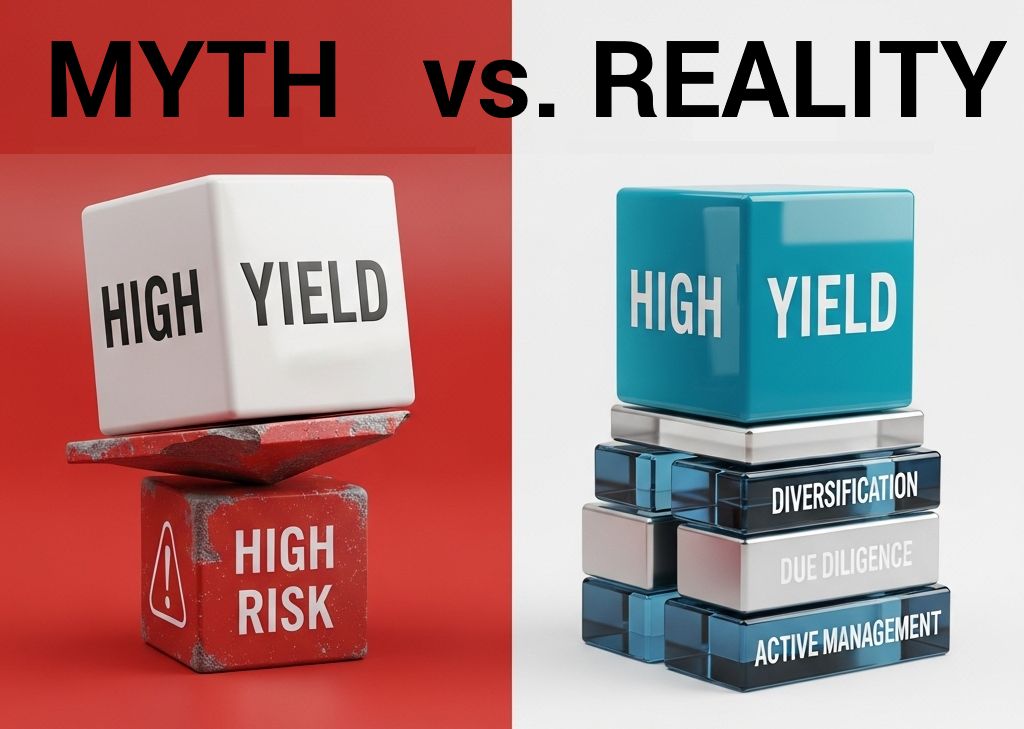
High Yield = High Risk? Myth vs. Reality The idea that higher yield automatically implies higher risk is deeply rooted in financial thinking. While this relationship can hold true in certain situations, it is often oversimplified and, in many cases, misleading. Yield and risk are connected, but not in a linear or absolute way. Understanding how income is generated, how portfolios are constructed, and how risk is managed is far more important than focusing on yield alone. Where the Myth Comes From The perception that “high yield equals high risk” typically originates from poorly structured investment strategies. Excessive leverage, lack of diversification, weak due diligence, or speculative positioning can indeed amplify risk. In such cases, yield becomes a byproduct of fragility rather than a result of disciplined construction. However, these examples reflect flawed implementation—not an inherent property of income-generating strategies. Yield as a Component, Not a Strategy Yield should never be pursued in isolation. In well-designed portfolios, income generation is one component of a broader allocation framework that considers liquidity, diversification, and risk limits. Professional portfolio construction evaluates the sustainability of cash flows, the quality of underlying assets, and the interaction between income-producing instruments and other portfolio elements. This approach transforms yield from a risk amplifier into a stabilizing element. The Role of Risk Management Risk is not eliminated through income strategies—it is managed. Diversification across instruments, issuers, and structures plays a central role in controlling downside exposure. Active monitoring, stress testing, and predefined risk parameters further reduce the likelihood that income generation becomes a source of instability. When these controls are in place, income-oriented allocations can coexist with capital preservation objectives. Income Across Market Cycles Different market environments influence how yield behaves. During periods of volatility, structured income strategies may contribute to portfolio resilience, provided risks are properly assessed and controlled. The distinction lies between disciplined income allocation and uncontrolled yield chasing. Reframing the Question The relevant question is not whether high yield is risky, but whether the strategy generating that yield is robust. Risk emerges from poor structure, not from yield itself. Conclusion High yield does not inherently mean high risk. When supported by diversification, due diligence, and active oversight, income strategies can play a constructive role within balanced portfolios. Understanding the source of yield—and the framework surrounding it—is essential to separating myth from reality. Originally published on LinkedIn: Read the original post on LinkedIn This content is provided for informational purposes only and does not constitute investment advice or a solicitation to the public. Past performance is not indicative of future results.
The Rise of Private Markets: Opportunities Beyond Public Exchanges

The Rise of Private Markets: Opportunities Beyond Public Exchanges Public markets have long represented the primary access point for investors seeking growth, liquidity, and transparency. However, in recent years, private markets have increasingly emerged as a strategic complement within diversified portfolios. This shift is not driven by fashion or short-term trends, but by structural changes in how companies grow, how capital is deployed, and how value is created over time. Why Private Markets Are Gaining Relevance Many of today’s most dynamic businesses remain private for longer periods. As a result, a significant portion of economic growth now takes place outside traditional public exchanges. Private markets allow investors to access these growth dynamics earlier, often with return drivers that differ from those of listed assets. This does not imply that private markets are superior to public ones, but rather that they offer exposure to different phases of the value-creation process. Diversification Beyond Listed Assets One of the primary advantages of private markets lies in diversification. Private equity, private debt, and real estate strategies introduce exposures that are often less correlated with public equities and bonds. This structural diversification can help smooth portfolio behavior across market cycles when allocations are calibrated thoughtfully. Private equity focuses on long-term operational and strategic value creation Private debt may offer predictable cash flows supported by contractual structures Real estate provides exposure to tangible assets with income-generating potential Liquidity, Horizon, and Discipline Accessing private markets requires a clear understanding of liquidity constraints and investment horizons. These strategies are not designed for short-term trading, but for investors willing to commit capital over defined periods. Discipline, due diligence, and alignment with investor objectives are therefore essential. When integrated correctly, private assets can enhance portfolio robustness without compromising strategic coherence. Balancing Public and Private Exposure At Income Capital Management, we view private markets as a complement to public investments rather than a replacement. The objective is to balance liquidity, transparency, and flexibility from public markets with the differentiated return drivers offered by private assets. This integrated approach allows portfolios to benefit from multiple sources of value creation. Private Markets as a Strategic Allocation Private markets are not tactical instruments. They require careful planning, ongoing monitoring, and realistic expectations. When approached with structure and discipline, private assets can represent a meaningful component of long-term portfolio strategy. Conclusion The growing relevance of private markets reflects a broader evolution in global finance. For investors willing to engage with longer horizons and diversified structures, opportunities beyond public exchanges continue to expand. Originally published on LinkedIn: Read the original post on LinkedIn This content is provided for informational purposes only and does not constitute investment advice or a solicitation to the public. Past performance is not indicative of future results.
Managing Volatility in Forex Markets: A Disciplined Investment Framework

Managing Volatility in Forex Markets: A Disciplined Investment Framework Volatility has become a structural feature of global financial markets. In 2025, currency markets in particular have reflected a complex mix of monetary policy divergence, geopolitical tension, and shifting capital flows. For investors, this environment reinforces a simple truth: performance is not driven by prediction, but by process. At INCOME CAPITAL MANAGEMENT, our approach to Forex investing is built around this principle. Rather than reacting to short-term noise, we focus on structured execution, controlled exposure, and continuous risk assessment. The Forex Market in 2025: Complexity, Not Chaos Foreign exchange markets are often perceived as purely speculative. In reality, they are among the most liquid and information-rich markets globally. However, in periods of heightened uncertainty, liquidity alone is not enough. Throughout 2025, FX markets have been influenced by: Diverging interest rate expectations across major economies Persistent geopolitical risk affecting capital allocation Increased correlation between currencies and broader risk assets This backdrop rewards strategies that are adaptive, disciplined, and grounded in measurable risk parameters. A Structured Approach to Forex Exposure Our Forex strategy does not rely on directional bets or discretionary timing. Instead, it is designed to operate through a defined framework that emphasizes: Risk-adjusted positioning, with predefined exposure limits Active management based on evolving market conditions Capital preservation as a core objective, not a secondary consideration Consistency of execution, reducing emotional decision-making This structure allows the strategy to remain operational even when market conditions become less predictable. Why Discipline Matters More Than Direction In volatile markets, attempting to forecast every move often leads to overexposure and inconsistent outcomes. A disciplined framework, by contrast, focuses on managing what can be controlled: risk, position sizing, and execution quality. Our experience confirms that sustainable performance in Forex investing is achieved not by maximizing exposure, but by maintaining flexibility while respecting defined risk constraints. Transparency and Investor Alignment Transparency remains a central pillar of our investment philosophy. Clear reporting, measurable performance, and a well-defined strategy allow investors to understand not only what results are achieved, but how they are generated. In an environment where volatility is likely to persist, clarity and structure become competitive advantages. LinkedIn Source This article is based on the original update published on LinkedIn: View the original LinkedIn post → Looking Forward As global markets continue to evolve, our focus remains unchanged: disciplined execution, robust risk management, and consistent alignment with investor objectives. In Forex markets especially, the ability to navigate volatility with structure—not speculation—will continue to define long-term success. INCOME CAPITAL MANAGEMENT

