Cryptocurrency and Digital Assets: Income Capital Management’s Measured Approach

Cryptocurrency and Digital Assets: Income Capital Management’s Measured Approach Cryptocurrencies and digital assets continue to attract global attention, oscillating between innovation-driven enthusiasm and periods of extreme volatility. While the sector remains highly speculative, the underlying blockchain technology is undeniably reshaping financial infrastructure, asset ownership models, and transaction efficiency. At Income Capital Management, we approach cryptocurrencies and digital assets with a clear distinction between technological innovation and investable opportunity. Our philosophy is not driven by hype or short-term price movements, but by a disciplined risk–return framework designed to protect capital while selectively capturing long-term value. Volatility and Speculation: Understanding the Risk Profile Digital assets are characterized by sharp price fluctuations, regulatory uncertainty, and evolving market structures. These factors make cryptocurrencies unsuitable as core holdings for many portfolios, particularly when risk tolerance and capital preservation are primary objectives. For this reason, Income Capital Management avoids excessive or unstructured exposure to cryptocurrencies. Instead, we analyze digital assets within the broader context of portfolio construction, assessing their impact on volatility, correlation, liquidity, and drawdown risk. Blockchain Beyond Cryptocurrencies While cryptocurrencies themselves remain speculative, blockchain technology represents a structural innovation with tangible applications. Tokenized securities, decentralized settlement systems, and distributed ledger infrastructure are already influencing how financial markets operate. Our focus extends beyond individual digital currencies to the ecosystem that supports them. This includes evaluating opportunities linked to blockchain infrastructure, regulated tokenization frameworks, and institutional-grade digital asset solutions where transparency, governance, and compliance are clearly defined. A Selective and Disciplined Allocation Income Capital Management integrates digital assets only where they enhance diversification without compromising portfolio stability. Any exposure is carefully sized, continuously monitored, and aligned with each client’s risk profile and long-term objectives. This measured approach allows us to remain engaged with innovation while maintaining strict control over downside risk. Innovation is valuable only when it is supported by structure, discipline, and clear investment rationale. Innovation with Responsibility The future of finance will undoubtedly include digital assets and blockchain-based solutions. However, sustainable wealth creation requires more than technological enthusiasm. It demands robust risk management, regulatory awareness, and a long-term perspective. At Income Capital Management, we believe that innovation and prudence are not opposites — they are complementary pillars of responsible asset management. LinkedIn post: https://www.linkedin.com/feed/update/urn:li:activity:7420389889122193408
High Yield = High Risk? Myth vs. Reality
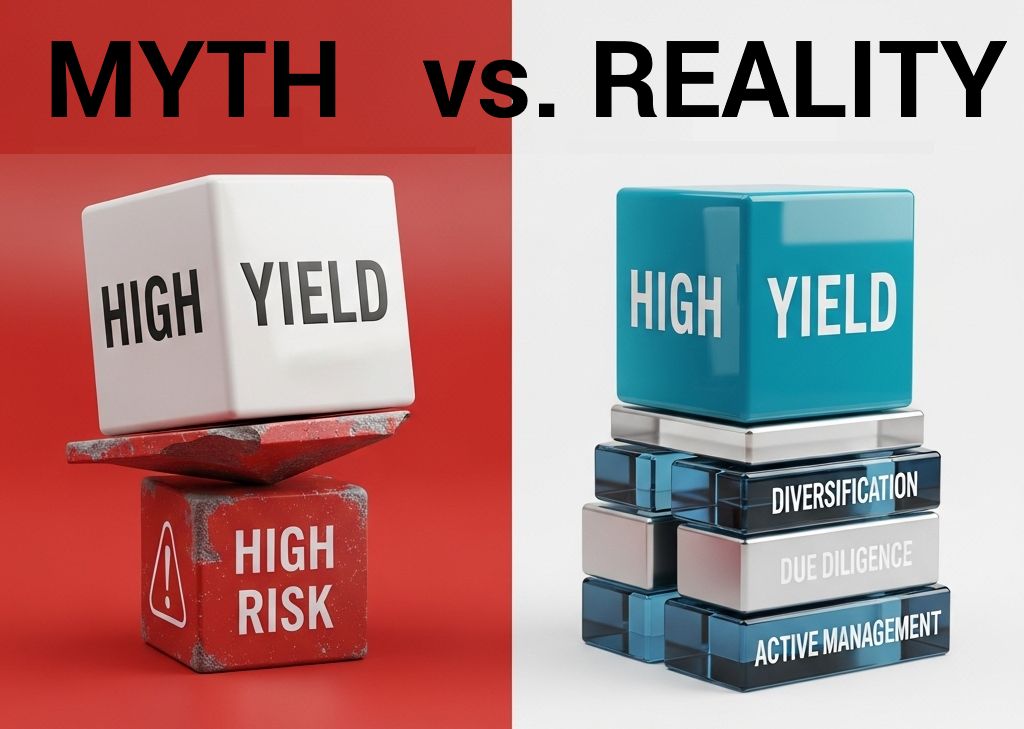
High Yield = High Risk? Myth vs. Reality The idea that higher yield automatically implies higher risk is deeply rooted in financial thinking. While this relationship can hold true in certain situations, it is often oversimplified and, in many cases, misleading. Yield and risk are connected, but not in a linear or absolute way. Understanding how income is generated, how portfolios are constructed, and how risk is managed is far more important than focusing on yield alone. Where the Myth Comes From The perception that “high yield equals high risk” typically originates from poorly structured investment strategies. Excessive leverage, lack of diversification, weak due diligence, or speculative positioning can indeed amplify risk. In such cases, yield becomes a byproduct of fragility rather than a result of disciplined construction. However, these examples reflect flawed implementation—not an inherent property of income-generating strategies. Yield as a Component, Not a Strategy Yield should never be pursued in isolation. In well-designed portfolios, income generation is one component of a broader allocation framework that considers liquidity, diversification, and risk limits. Professional portfolio construction evaluates the sustainability of cash flows, the quality of underlying assets, and the interaction between income-producing instruments and other portfolio elements. This approach transforms yield from a risk amplifier into a stabilizing element. The Role of Risk Management Risk is not eliminated through income strategies—it is managed. Diversification across instruments, issuers, and structures plays a central role in controlling downside exposure. Active monitoring, stress testing, and predefined risk parameters further reduce the likelihood that income generation becomes a source of instability. When these controls are in place, income-oriented allocations can coexist with capital preservation objectives. Income Across Market Cycles Different market environments influence how yield behaves. During periods of volatility, structured income strategies may contribute to portfolio resilience, provided risks are properly assessed and controlled. The distinction lies between disciplined income allocation and uncontrolled yield chasing. Reframing the Question The relevant question is not whether high yield is risky, but whether the strategy generating that yield is robust. Risk emerges from poor structure, not from yield itself. Conclusion High yield does not inherently mean high risk. When supported by diversification, due diligence, and active oversight, income strategies can play a constructive role within balanced portfolios. Understanding the source of yield—and the framework surrounding it—is essential to separating myth from reality. Originally published on LinkedIn: Read the original post on LinkedIn This content is provided for informational purposes only and does not constitute investment advice or a solicitation to the public. Past performance is not indicative of future results.
The Rise of Private Markets: Opportunities Beyond Public Exchanges

The Rise of Private Markets: Opportunities Beyond Public Exchanges Public markets have long represented the primary access point for investors seeking growth, liquidity, and transparency. However, in recent years, private markets have increasingly emerged as a strategic complement within diversified portfolios. This shift is not driven by fashion or short-term trends, but by structural changes in how companies grow, how capital is deployed, and how value is created over time. Why Private Markets Are Gaining Relevance Many of today’s most dynamic businesses remain private for longer periods. As a result, a significant portion of economic growth now takes place outside traditional public exchanges. Private markets allow investors to access these growth dynamics earlier, often with return drivers that differ from those of listed assets. This does not imply that private markets are superior to public ones, but rather that they offer exposure to different phases of the value-creation process. Diversification Beyond Listed Assets One of the primary advantages of private markets lies in diversification. Private equity, private debt, and real estate strategies introduce exposures that are often less correlated with public equities and bonds. This structural diversification can help smooth portfolio behavior across market cycles when allocations are calibrated thoughtfully. Private equity focuses on long-term operational and strategic value creation Private debt may offer predictable cash flows supported by contractual structures Real estate provides exposure to tangible assets with income-generating potential Liquidity, Horizon, and Discipline Accessing private markets requires a clear understanding of liquidity constraints and investment horizons. These strategies are not designed for short-term trading, but for investors willing to commit capital over defined periods. Discipline, due diligence, and alignment with investor objectives are therefore essential. When integrated correctly, private assets can enhance portfolio robustness without compromising strategic coherence. Balancing Public and Private Exposure At Income Capital Management, we view private markets as a complement to public investments rather than a replacement. The objective is to balance liquidity, transparency, and flexibility from public markets with the differentiated return drivers offered by private assets. This integrated approach allows portfolios to benefit from multiple sources of value creation. Private Markets as a Strategic Allocation Private markets are not tactical instruments. They require careful planning, ongoing monitoring, and realistic expectations. When approached with structure and discipline, private assets can represent a meaningful component of long-term portfolio strategy. Conclusion The growing relevance of private markets reflects a broader evolution in global finance. For investors willing to engage with longer horizons and diversified structures, opportunities beyond public exchanges continue to expand. Originally published on LinkedIn: Read the original post on LinkedIn This content is provided for informational purposes only and does not constitute investment advice or a solicitation to the public. Past performance is not indicative of future results.
Managing Volatility in Forex Markets: A Disciplined Investment Framework

Managing Volatility in Forex Markets: A Disciplined Investment Framework Volatility has become a structural feature of global financial markets. In 2025, currency markets in particular have reflected a complex mix of monetary policy divergence, geopolitical tension, and shifting capital flows. For investors, this environment reinforces a simple truth: performance is not driven by prediction, but by process. At INCOME CAPITAL MANAGEMENT, our approach to Forex investing is built around this principle. Rather than reacting to short-term noise, we focus on structured execution, controlled exposure, and continuous risk assessment. The Forex Market in 2025: Complexity, Not Chaos Foreign exchange markets are often perceived as purely speculative. In reality, they are among the most liquid and information-rich markets globally. However, in periods of heightened uncertainty, liquidity alone is not enough. Throughout 2025, FX markets have been influenced by: Diverging interest rate expectations across major economies Persistent geopolitical risk affecting capital allocation Increased correlation between currencies and broader risk assets This backdrop rewards strategies that are adaptive, disciplined, and grounded in measurable risk parameters. A Structured Approach to Forex Exposure Our Forex strategy does not rely on directional bets or discretionary timing. Instead, it is designed to operate through a defined framework that emphasizes: Risk-adjusted positioning, with predefined exposure limits Active management based on evolving market conditions Capital preservation as a core objective, not a secondary consideration Consistency of execution, reducing emotional decision-making This structure allows the strategy to remain operational even when market conditions become less predictable. Why Discipline Matters More Than Direction In volatile markets, attempting to forecast every move often leads to overexposure and inconsistent outcomes. A disciplined framework, by contrast, focuses on managing what can be controlled: risk, position sizing, and execution quality. Our experience confirms that sustainable performance in Forex investing is achieved not by maximizing exposure, but by maintaining flexibility while respecting defined risk constraints. Transparency and Investor Alignment Transparency remains a central pillar of our investment philosophy. Clear reporting, measurable performance, and a well-defined strategy allow investors to understand not only what results are achieved, but how they are generated. In an environment where volatility is likely to persist, clarity and structure become competitive advantages. LinkedIn Source This article is based on the original update published on LinkedIn: View the original LinkedIn post → Looking Forward As global markets continue to evolve, our focus remains unchanged: disciplined execution, robust risk management, and consistent alignment with investor objectives. In Forex markets especially, the ability to navigate volatility with structure—not speculation—will continue to define long-term success. INCOME CAPITAL MANAGEMENT

