What Clients Really Ask About Investing: Trust, Clarity and Financial Decisions
What Clients Really Ask About Investing After many years working with international investors, entrepreneurs, and families managing significant financial assets, one observation becomes very clear: the questions clients ask are rarely about financial products themselves. Most people assume that conversations with investment professionals revolve around technical topics such as portfolio allocation, specific funds, derivatives, or market forecasts. In reality, the questions that truly matter are much deeper and more personal. Clients are not primarily concerned with the mechanics of a Forex strategy, the duration of a bond portfolio, or the precise structure of a real estate fund. Instead, their questions revolve around three fundamental themes: trust, clarity, and outcomes. Behind every portfolio discussion lies a much more important conversation about financial security, life goals, and long-term peace of mind. After working with investors across Europe, the United States, and the Middle East through Income Capital Management, certain questions appear again and again. They reflect universal concerns that transcend markets, asset classes, and economic cycles. The Real Questions Behind Investment Decisions When clients begin a conversation about investing, they rarely start with technical language. Instead, they ask questions like: “Will I be able to retire comfortably?” “Can I protect my family if markets turn?” “Am I making the right financial choices today?” These questions may appear simple, but they carry enormous weight. They reflect the responsibility investors feel toward their families, their future lifestyle, and the legacy they hope to build. Investing, at its core, is not about beating an index or chasing the highest possible returns. It is about designing a financial strategy that allows individuals to live the lives they want while maintaining confidence that their capital is being managed responsibly. This is why the role of a financial advisor is far broader than simply selecting investments. It involves translating complexity into clarity. Trust: The Foundation of Every Investment Relationship Trust is the single most important element in wealth management. Markets fluctuate, strategies evolve, and economic environments change. However, trust between an investor and their advisor must remain constant. Without it, even the most sophisticated portfolio structure becomes meaningless. Investors trust advisors with more than just capital. They entrust them with years of hard work, entrepreneurial success, family inheritance, and future financial stability. This responsibility requires transparency, discipline, and intellectual honesty. At Income Capital Management, building trust means maintaining clear communication about both opportunities and risks. It means avoiding unrealistic promises and focusing instead on structured, long-term strategies. Clients should always understand not only what they are investing in, but why. Clarity in a Complex Financial World The modern financial landscape is more complex than ever. Investors are confronted daily with an overwhelming flow of information: market commentary, social media speculation, economic predictions, and endless financial products promising superior returns. While access to information has increased dramatically, true clarity has become more difficult to achieve. Many investors feel overwhelmed by financial jargon and technical terminology. They encounter discussions about derivatives, volatility structures, algorithmic strategies, or macroeconomic hedging mechanisms that seem unnecessarily complicated. In many cases, complexity is mistaken for sophistication. However, successful investing does not require confusion. It requires understanding. The role of a professional advisor is therefore to simplify financial decision-making without oversimplifying the underlying risks. Clarity means explaining how each component of a portfolio contributes to an investor’s long-term goals. Translating Financial Tools into Real Decisions At Income Capital Management, we work with a diversified framework that includes several asset classes and strategies: Forex investment strategies Real estate income opportunities High yield and global growth allocations Physical gold holdings Non-discretionary advisory portfolio structures Each of these tools serves a specific purpose within a broader portfolio architecture. Forex strategies can provide return potential through disciplined trading models and systematic execution. Real estate investments often provide stability and recurring income, acting as a foundation within the portfolio. High yield and global growth strategies introduce exposure to broader economic expansion and credit opportunities. Physical gold adds an element of tangible asset protection and often performs differently from traditional financial markets during periods of macroeconomic stress. However, none of these strategies are meaningful if they remain abstract financial concepts. The real objective is to translate them into clear, practical decisions that investors understand and feel comfortable implementing. The Emotional Dimension of Investing Financial markets are often described in mathematical or economic terms. Yet the emotional dimension of investing is equally important. Fear, uncertainty, and overconfidence can influence investor behavior far more than data or analysis. During periods of market volatility, even experienced investors can feel tempted to abandon long-term strategies in favor of reactive decisions. This is why disciplined portfolio construction is essential. A well-structured portfolio does not attempt to predict every market movement. Instead, it prepares for a wide range of possible outcomes. Investors who understand the role of each asset class within their portfolio are less likely to make emotional decisions during periods of stress. Confidence in the strategy reduces the temptation to react impulsively. Outcomes Matter More Than Products Ultimately, investors do not measure success based on how sophisticated their portfolios appear. They measure success through outcomes. Can the portfolio support long-term financial independence? Does it provide sufficient protection during economic downturns? Is it structured to generate consistent growth while controlling risk? These questions are far more meaningful than discussions about specific financial instruments. For this reason, the conversation with clients always returns to the same central theme: aligning investment strategy with life objectives. The Role of the Advisor: Partner, Not Provider The relationship between an investor and an advisor should not resemble a simple commercial transaction. An advisor should not act merely as a provider of financial products. Instead, the advisor should serve as a long-term partner in financial decision-making. This partnership involves ongoing dialogue, periodic portfolio review, and continuous adaptation to changing economic conditions. Markets evolve, regulations change, and personal circumstances develop over time. A portfolio strategy must evolve accordingly. By maintaining a disciplined advisory approach, investors gain the benefit of professional insight without surrendering
PRESS RELEASE – TEARLY RESULTS 2025
Income Capital Management Reports Strong 2025 Performance in a Year of Divergent Global Markets FOR IMMEDIATE RELEASE Date: January 27, 2026 Prague, Czech Republic — Income Capital Management closed 2025 with solid results across its diversified investment strategies, successfully navigating a year marked by sharp divergences between asset classes. The firm enters 2026 with a disciplined, multi-asset approach focused on delivering consistent value to its investors. Market Environment Global markets in 2025 were characterized by pronounced dispersion. Gold emerged as the top-performing major asset class, posting gains of +65.87% and reinforcing its role as a safe-haven asset. Major equity indices, including DAX, NASDAQ, FTSE 100, Euro Stoxx 50, S&P 500, and Dow Jones, recorded positive performances, while Bitcoin declined by -6.35%, reflecting increased volatility and speculative risk. Italy’s FTSE MIB underperformed relative to broader international benchmarks. Key Strategy Performance Income Capital Management’s Forex strategy delivered a standout performance, achieving an annual return of +34.98%. Active currency trading combined with strict risk management allowed the strategy to outperform major traditional benchmarks. The firm’s Real Estate strategy generated stable income-driven returns of +7.71%, supported by premium property assets and consistent cash flow, outperforming several weaker regional equity markets. Additional allocations to global growth and high-yield strategies contributed to overall portfolio diversification and balance. Management Commentary “2025 confirmed that active and diversified strategies are essential in fragmented market conditions,” said Paolo Volpicelli, CEO of Income Capital Management. “Our Forex strategy’s 34.98% return demonstrates how disciplined execution and controlled risk can translate into meaningful performance for our investors.” Nicola Pinchi, CTO of Income Capital Management, added: “By combining high-conviction Forex strategies with stable real estate income and physical gold exposure, we have built portfolios designed to perform across different market cycles rather than simply follow short-term trends.” Strategic Positioning for 2026 Income Capital Management’s multi-asset framework — encompassing Forex for growth, real estate for income, global growth and high-yield strategies for diversification, and physical gold for capital protection — is designed to provide resilience and flexibility in an evolving macroeconomic environment. As the firm enters 2026, this structure aims to balance opportunity and risk, supporting long-term portfolio stability in periods of heightened volatility. About Income Capital Management Income Capital Management is an independent asset management firm specializing in diversified investment solutions across Forex, real estate, global growth, high-yield strategies, and physical asset exposure. The firm focuses on active management, disciplined risk control, and long-term capital preservation and growth. For more information, please visit www.incomecapital.biz or contact the Income Capital Management team directly. LinkedIn press release: https://www.linkedin.com/posts/paolovolpicelli_press-release-tearly-results-2025-activity-7421816797093494784-NoVd
Annual Investment Report – 2025
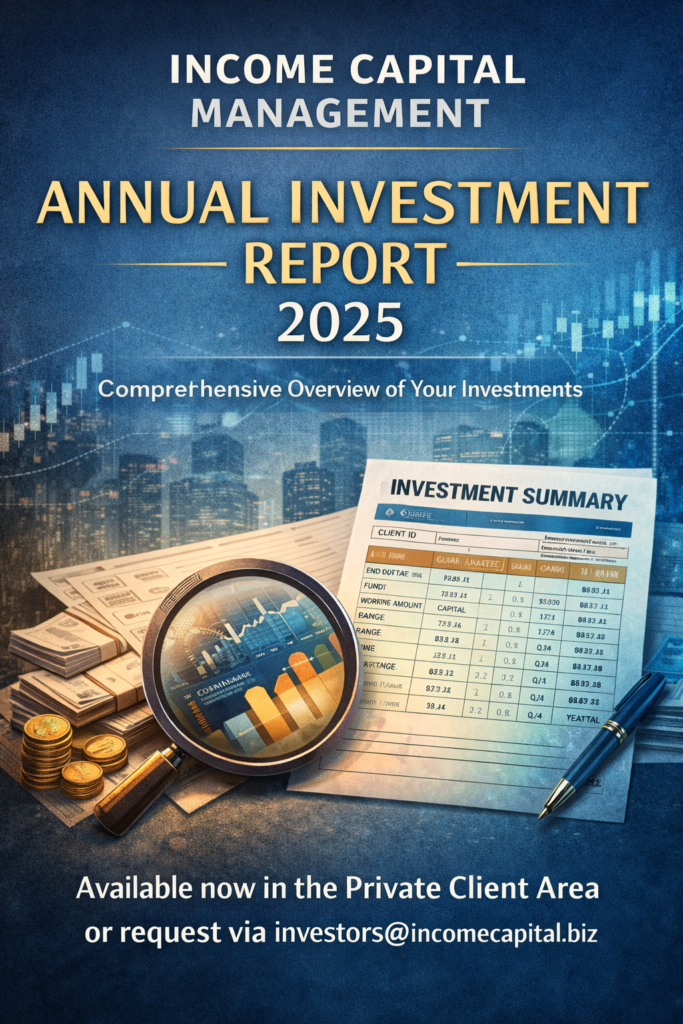
Annual Investment Report – 2025 INCOME CAPITAL MANAGEMENT informs all clients that the Annual Investment Report for the year 2025 is available for consultation and printing directly from the Private Client Area. Within the dedicated investment section, each client can view a comprehensive overview of their positions, including performance data, invested capital, and operational configurations, with information updated according to the reporting frequency applicable to each fund. Formal Annual Report Request Clients who wish to receive the official Annual Investment Report for 2025, formally issued by Income Capital Management s.r.o., are kindly requested to submit their request by email to: 📧 investors@incomecapital.biz Please ensure that the email includes the relevant Client ID (or Client IDs, in the case of multiple investments) for which the report is requested. The document will be prepared and delivered in accordance with internal verification and compliance procedures. Return Update Frequency Investment returns displayed on the investment page are updated according to the following schedule: Weekly for the FOREX FUND Monthly for all other funds (typically by the 4th day of the following month) If an investment did not start at the beginning of a standard quarter (January, April, July, October), returns are calculated and displayed on a pro-rata basis. Explanation of Table Fields Below is a description of the main fields displayed in the investment summary table: CLIENT ID: The client identification number assigned by Income Capital Management s.r.o. Clients with multiple investments will have multiple Client IDs. END DATE: The maturity or expiration date of the investment. FUND: The type of investment subscribed. GUARANTEED CAPITAL: The percentage of capital guaranteed, where applicable. WORKING AMOUNT: The operating capital on which returns are calculated. This amount does not include any reinvested profits. RANGE: The indicative annual return range, reflecting the risk level of the selected investment. Q1, Q2, Q3, Q4: Percentage and monetary value of any profit generated in the respective quarter, if applicable. YEARLY TOTAL: Total annual profit expressed as both a percentage and an amount in EUR. For clients who do not reinvest profits quarterly, this figure is shown only for the current quarter. CAPITAL + INVESTMENT: The total amount in EUR consisting of invested capital plus any profits generated during the year. REINVESTED PROFITS ON QUARTERLY BASIS: Indicates whether quarterly profit reinvestment has been selected. PAC AMOUNT ON QUARTERLY BASIS: Indicates whether a quarterly Capital Accumulation Plan (PAC) is active and the selected contribution amount. Support and Clarifications The team at INCOME CAPITAL MANAGEMENT remains fully available for any clarification or additional information regarding the annual report, investment data, or portfolio configurations. Kind regards, INCOME CAPITAL MANAGEMENT s.r.o.
The New Gold Rush: Performance, Protection, and the Role of Gold in Modern Portfolios

The New Gold Rush: Performance, Protection, and the Role of Gold in Modern Portfolios Between April and August 2025, gold once again demonstrated why it has served as a store of value for thousands of years. In a market environment characterized by uncertainty, geopolitical tension, and fluctuating monetary expectations, the precious metal delivered solid and measurable returns while many investors remained hesitant. Gold Performance: April–August 2025 From April 1st to August 8th, 2025, gold prices increased from $100.74 to $109.11 per ounce. Price increase: +8.31% Timeframe: 4 months This performance was achieved during a period in which financial markets were grappling with elevated volatility, geopolitical risks, and ongoing debates around inflation and monetary policy. To put this into perspective, an investment of $10,000 in gold at the beginning of April would have grown to approximately $10,831 by early August—reflecting tangible wealth creation over a relatively short period. More Than a Commodity Cycle Gold’s recent performance should not be viewed as a short-term anomaly or a speculative rally. Historically, gold has fulfilled a consistent role across economic cycles: preserving purchasing power when confidence in financial systems or paper currencies weakens. This role is once again evident as: Central banks continue to accumulate gold reserves at a sustained pace Institutional investors increase allocations to precious metals Gold reasserts its function as a portfolio stabilizer during uncertainty These dynamics reinforce gold’s position not merely as a commodity, but as a strategic asset within diversified portfolios. Opportunity Cost and Investor Hesitation One of the most common investor challenges during periods of market uncertainty is indecision. Waiting for a “perfect” entry point often results in missed opportunities. The +8.31% return achieved over the past four months represents real gains that were accessible to investors willing to act within a disciplined allocation framework. Opportunity cost, while less visible than market losses, can be equally damaging to long-term portfolio outcomes. Gold’s Strategic Role in Portfolio Construction Beyond recent performance, gold continues to play a fundamental role in investment strategy: Inflation hedge: preserving value as purchasing power erodes Diversification tool: reducing correlation with traditional financial assets Tangible asset: offering resilience during currency and systemic stress With ongoing geopolitical tensions, monetary uncertainty, and inflationary pressures, the structural case for gold remains intact. Looking Ahead The question for investors is not whether gold has historically proven its value—history has already answered that. The more relevant consideration is whether portfolios are adequately positioned to benefit from its stabilizing and protective characteristics. As recent months have shown, gold continues to perform its role quietly and consistently, often while broader markets remain distracted by short-term noise. LinkedIn Source This article is based on the original LinkedIn update published here: Read the original LinkedIn post → INCOME CAPITAL MANAGEMENT

