
March 2026 Update | Discipline in a Complex Environment
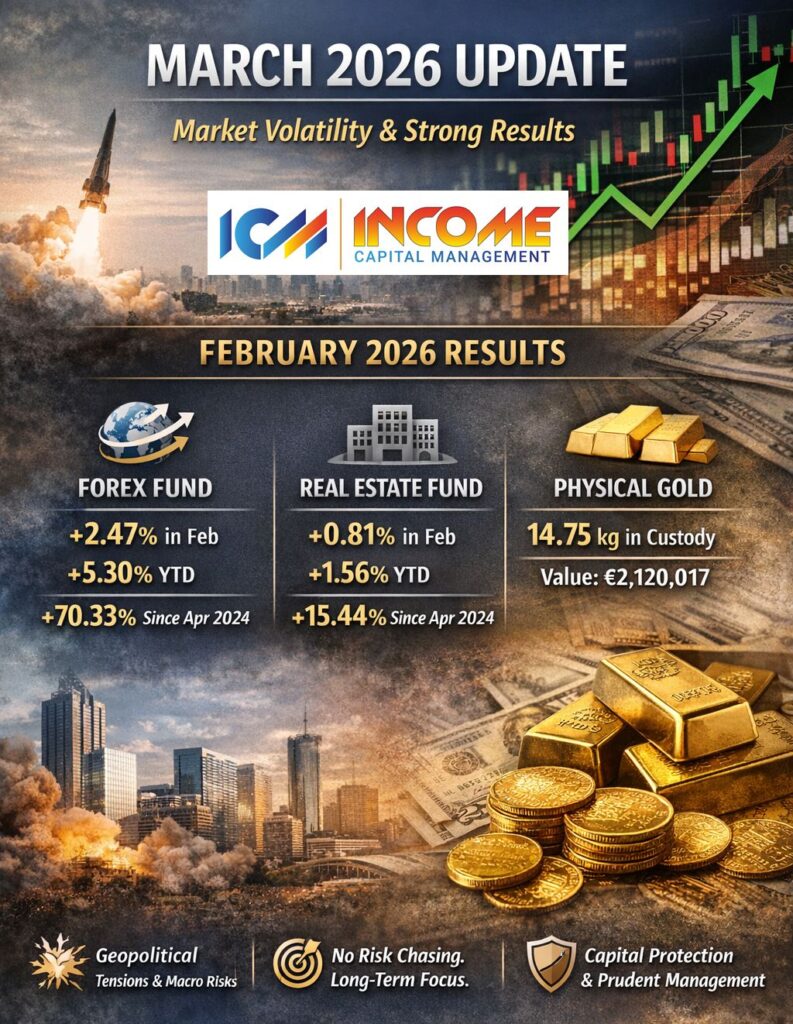
March 2026 Update | Discipline in a Complex Environment The first months of 2026 confirmed what experienced investors already understand: volatility does not disappear — it transforms. Markets remain highly sensitive to monetary policy signals, macroeconomic data releases and geopolitical developments. The ongoing conflict in the Middle East and renewed tensions involving the United States, Israel and Iran have reintroduced structural uncertainty into global capital markets. Interest rate expectations continue to fluctuate. Inflation remains a debated variable. Liquidity conditions are uneven across regions. Currency volatility is elevated. In this context, active and prudent portfolio management remains essential. Macro Environment: Fragility Beneath Stability While headline equity indices have shown resilience in early 2026, underlying cross-asset dispersion tells a more nuanced story. Currency markets are reacting sharply to central bank tone shifts. Energy and commodity pricing reflects geopolitical risk premium. Bond markets are recalibrating inflation expectations. Emerging markets face capital flow volatility. Volatility has not disappeared. It has become selective. In such an environment, discipline becomes more valuable than prediction. Income Capital Management – February 2026 Results FOREX FUND February 2026: +2.47% 2026 YTD: +5.30% Since April 2024: +70.33% The Forex strategy continues to benefit from structured positioning in high-volatility currency environments. Central bank divergence remains a core driver. Tactical adjustments were implemented in response to policy signals and risk sentiment oscillations. Risk exposure was actively calibrated to avoid excessive directional bias during geopolitical escalation phases. The strategy remains rule-based, disciplined and aligned with predefined risk thresholds. REAL ESTATE FUND February 2026: +0.81% 2026 YTD: +1.56% Since April 2024: +15.44% The Real Estate Fund continues to deliver stable income characteristics within a diversified allocation framework. In a context where financing costs remain elevated compared to previous years, careful asset selection and tenant quality analysis remain fundamental. The role of real estate within the broader portfolio is not high acceleration. It is income stability and partial inflation mitigation. PHYSICAL GOLD 1.30 kg purchased in February Total custody: 14.75 kg Market value (28/02/2026): €2,120,017 Gold continues to function as a structural hedge within our allocation model. Heightened geopolitical tensions, combined with uncertainty around real interest rate trajectories, support ongoing demand for physical allocation. Our approach remains physical custody based, transparent and integrated into overall portfolio design — not speculative. No Structural Change in Philosophy In volatile environments, investors often seek dramatic tactical shifts. Our framework remains unchanged: No short-term speculation No risk chasing Structured exposure aligned with macro conditions Focus on capital protection and long-term consistency Consistency is not rigidity. It is disciplined adaptability. Active Management in 2026: Why It Matters Passive allocation assumes stable structural regimes. The current environment is defined by: Geopolitical fragmentation Inflation regime uncertainty Currency realignment risks Liquidity divergence between regions In such an environment, active oversight enhances: Risk calibration Exposure control Correlation monitoring Scenario responsiveness Capital Protection as Strategic Priority Long-term wealth accumulation depends on minimizing severe drawdowns. A 30% loss requires a 43% recovery. A 40% loss requires a 67% recovery. Capital preservation discipline reduces recovery burden. Our allocation decisions remain aligned with this principle. Looking Ahead As we move deeper into 2026, three variables remain central: Monetary policy trajectory Geopolitical escalation or stabilization Global growth sustainability We continue to monitor macro data and liquidity indicators closely, maintaining flexibility while preserving structural discipline. In uncertain environments, structure, discipline and risk control make the difference. Full monthly report available here: https://lnkd.in/d72udys4 LinkedIn Post: https://www.linkedin.com/posts/paolovolpicelli_discipline-complex-markets-activity-7434212609194737665-9dDW
Scenario Planning: Preparing Portfolios for Multiple Futures

Scenario Planning: Preparing Portfolios for Multiple Futures Uncertainty is not an exception in financial markets. It is the baseline condition. What changes from one decade to another is not whether volatility will occur, but what form it will take: inflationary spirals, deflationary recessions, geopolitical fragmentation, technological disruption, liquidity shocks or unexpected growth acceleration. At Income Capital Management, we do not attempt to predict a single future. Instead, we prepare portfolios for multiple plausible futures through structured scenario planning. Preparedness is not pessimism. It is discipline. Why Scenario Planning Matters More Today Over the past twenty years, global markets have experienced: Financial crises and banking collapses Zero interest rate regimes Quantitative easing cycles Inflation resurgence Geopolitical realignments Commodity supercycles Digital asset emergence Traditional static allocation models assume historical averages will repeat. Scenario planning acknowledges structural shifts. Instead of asking “What will happen?”, we ask: “If this happens, how exposed are we?” The Core Scenarios We Model 1. Inflationary Expansion Persistent inflation driven by supply constraints, wage growth or fiscal stimulus. Key stress points: Duration risk in bonds Margin compression in equities Currency depreciation pressure Portfolio response: Selective real assets exposure Shorter duration credit positioning Currency diversification via Forex strategies Gold allocation as inflation hedge 2. Deflationary Slowdown Demand contraction, falling prices, tightening credit. Stress points: Corporate earnings compression High-yield default risk Commodity weakness Portfolio response: Quality bias in equities Higher liquidity buffers Selective sovereign duration exposure Reduced cyclical positioning 3. Geopolitical Fragmentation Trade barriers, capital controls, currency volatility. Stress points: Emerging market capital flows Commodity supply disruption FX volatility spikes Portfolio response: Active currency management Physical gold allocation Diversified regional exposure Reduced concentration risk 4. Growth Acceleration and Technological Expansion Productivity gains, capital expenditure cycle, innovation-driven growth. Stress points: Overvaluation risk Liquidity mispricing Speculative excess Portfolio response: Disciplined growth allocation Profit-taking rules Rebalancing discipline Scenario Planning Is Not Forecasting Forecasting attempts to identify the most likely outcome. Scenario planning accepts that multiple outcomes are plausible. The difference is philosophical: Forecasting seeks precision. Scenario planning builds resilience. Markets punish overconfidence more than uncertainty. Stress Testing in Practice For each client portfolio, we simulate: Interest rate shocks Equity drawdowns Credit spread widening Currency realignments Commodity spikes We measure: Expected drawdown Liquidity resilience Recovery time estimates Correlation shifts This transforms abstract risk into tangible visibility. Multi-Asset Integration Scenario planning only works when portfolios are genuinely diversified. Our framework integrates: Forex strategies for currency adaptability Real Estate exposure for income stability High Yield for calibrated income generation Global Growth for capital appreciation Physical Gold for tail-risk mitigation Each engine behaves differently under stress. The objective is not perfection in any single environment. It is durability across environments. The Psychological Advantage of Preparedness Investors often panic when markets fall because they have not visualized downside scenarios beforehand. When clients have already seen modeled stress cases, volatility becomes contextual, not catastrophic. Confidence grows from preparation. Adaptive Rebalancing Scenario planning is dynamic. As macro signals shift: Inflation expectations adjust Central bank trajectories evolve Growth indicators accelerate or contract We recalibrate exposure incrementally, not reactively. Why This Matters for Long-Term Wealth Long-term compounding depends more on avoiding large losses than chasing maximum gains. A 40% drawdown requires a 67% recovery. Scenario discipline reduces catastrophic exposure. Flexibility as a Strategic Asset Flexibility does not mean constant change. It means optionality: Liquidity to act Currency hedging tools Asset allocation agility Rigid portfolios break under structural change. Adaptive portfolios adjust. Preparing for What We Cannot See The next crisis will not look like the previous one. But structural preparation remains consistent: Diversification Liquidity discipline Risk transparency Scenario modeling Conclusion Uncertainty is constant. Preparedness is a choice. Scenario planning transforms fear of the unknown into structured readiness. At Income Capital Management, we do not attempt to control the future. We prepare portfolios to survive and adapt within it. LinkedIn Post: https://www.linkedin.com/feed/update/urn:li:activity:7431616318816182272

