AI in Portfolio Management: Will It Replace Portfolio Managers?
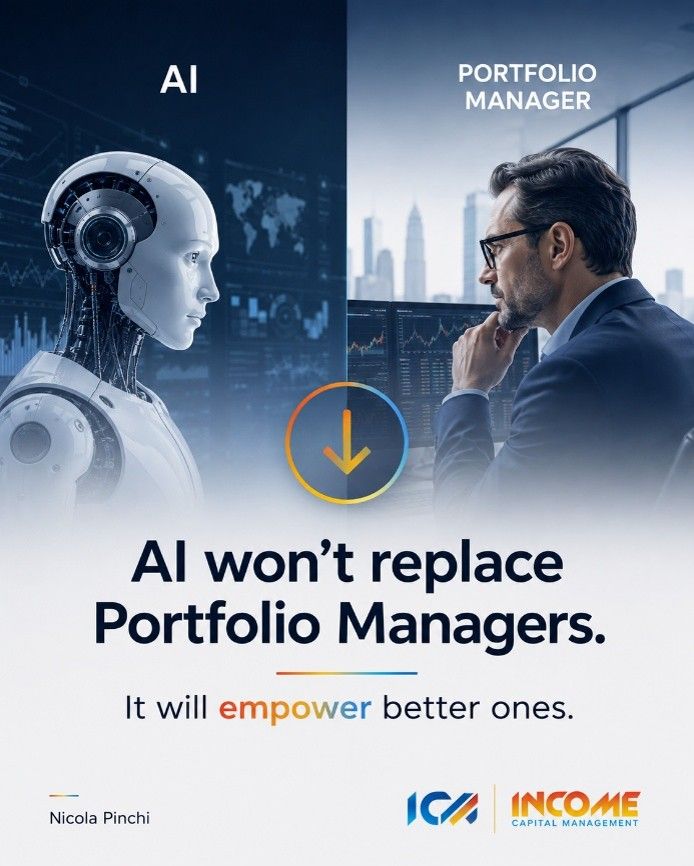
AI in portfolio management is no longer a future scenario. It is already part of how serious investment teams process data, test ideas and monitor risk. That raises a question we hear more and more often: will artificial intelligence replace portfolio managers? Our answer is no. But it will replace the professionals who refuse to adapt, and that distinction matters more than the headline question itself.
At TradeTech FX Europe 2026 in Amsterdam, which we covered in our conference review, the same view came up again and again: AI is becoming a decision-support tool, not a decision-maker. This article explains what that means in practice, where the technology adds real value and where responsibility has to stay human.
What AI in portfolio management already does well
The strongest use cases are not glamorous. They are the tasks where scale, speed and consistency beat human attention:
- Processing enormous datasets. Prices, macro releases, positioning data, news flow and transaction records arrive faster than any team can read them. Models can ingest, clean and structure them continuously.
- Identifying patterns. Statistical relationships, regime shifts and anomalies that would take an analyst days to find can be surfaced in minutes.
- Automating repetitive analysis. Reporting, reconciliation, exposure checks and routine monitoring should not consume a portfolio manager’s time.
- Improving research efficiency. Summarising documents, comparing scenarios and testing hypotheses becomes faster, so more questions can be asked before a decision is taken.
None of this is speculative. Industry bodies such as the CFA Institute have been studying how machine learning is changing investment workflows for years, and the gap between teams that use these tools well and teams that ignore them keeps widening.
Where the models stop
Markets are not driven only by numbers. They are driven by people: central bankers choosing their words, investors reacting to uncertainty, liquidity that appears and disappears depending on confidence. Models learn from the past, and the moments that matter most for a portfolio are often the ones that do not resemble the past.
A model can tell you that a pattern has historically preceded a move. It cannot tell you whether the context is different this time, whether the data itself has become unreliable, or whether the cost of being wrong is acceptable for the specific capital you manage. We explored the same blind spot in what happens when liquidity disappears: the conditions that hurt portfolios most are rarely well represented in historical data.
Three limits every investor should keep in mind
- Regime change. Relationships that held for years can break in weeks, and a model trained on the old regime will not notice until losses do.
- Data quality. AI amplifies whatever it is given. Biased, incomplete or delayed data produces confident but wrong output.
- Accountability. A model cannot explain a loss to an investor, and it cannot carry responsibility for one.
Judgment is a process, not an instinct
Saying that judgment remains human does not mean relying on gut feeling. In a professional setting judgment is structured: it operates inside defined risk limits, documented rules and a clear investment process. The role of AI in portfolio management is to make that process better informed and faster, not to replace it.
The practical test is simple. For every decision, someone must be able to explain why it was taken, what risk it introduced and what would make it wrong. If the answer is “the model said so”, the process has a gap. If the answer combines what the data shows with a reasoned view on context and risk, technology is doing exactly what it should.
What changes for professionals who adapt
The professionals who benefit most from AI are not the ones who hand it their decisions. They are the ones who use it to remove noise, check their assumptions and spend more time on the questions that actually require experience. Their advantage is not the tool itself, which is increasingly available to everyone, but the discipline with which they use it.
Those who resist the change face a different problem. Their work becomes slower, their analysis narrower and their costs higher, while competitors cover more ground with the same resources. That is how AI will replace people in this industry: not by taking their seat, but by making their way of working uncompetitive. The same logic applies to execution quality, where small, measurable improvements compound into a real edge.
How we approach AI in portfolio management
At Income Capital Management we treat technology as an enabler of discipline. Data processing, monitoring and research benefit from automation and AI; decisions, risk limits and accountability remain with people. Technology will continue to evolve. Trust, governance and disciplined investment processes remain the real differentiators.
Frequently asked questions
Will AI replace portfolio managers?
No. AI replaces tasks, not responsibility. It will, however, replace professionals who do not learn to use it, because their work becomes slower and more expensive than that of their peers.
What is the main benefit of AI in portfolio management?
Speed and breadth of analysis: processing large datasets, spotting patterns and automating routine checks, which frees time for the decisions that require judgment.
What is the main risk?
Over-reliance. Models trained on historical data can fail when market regimes change, which is why human oversight and clear risk limits remain essential.
How are you using AI in your daily work? We discussed this question on LinkedIn and we are always interested in hearing how other professionals are approaching it.


