Lessons in Crisis Management from 2025 Markets

Lessons in Crisis Management from 2025 Markets Periods of market stress are often remembered for their volatility, but their true value lies in the lessons they reveal. The market dynamics experienced throughout 2025 once again demonstrated how crises test not only portfolios, but also decision-making frameworks, risk discipline, and investor behavior. While every market cycle has its own characteristics, the underlying principles of effective crisis management remain remarkably consistent. Volatility as a Stress Test Market volatility is not an anomaly, it is an intrinsic feature of financial systems. During calmer phases, structural weaknesses may remain hidden. In contrast, periods of stress expose how portfolios are constructed and how risk is truly managed. The volatility observed in 2025 served as a real-time stress test, highlighting the importance of diversification, liquidity awareness, and predefined risk controls. Discipline Over Reaction One of the most common challenges during market turbulence is the temptation to react emotionally. Sudden price movements can lead to decisions driven by fear or urgency rather than analysis. Effective crisis management relies on discipline: the ability to adhere to established frameworks even when market signals appear contradictory or unsettling. Portfolios guided by structured allocation rules and risk parameters are better positioned to absorb shocks without compromising long-term objectives. Preparation Happens Before the Crisis Crises are rarely managed successfully in real time without prior preparation. Portfolio resilience is built during stable periods, through thoughtful asset allocation, scenario analysis, and continuous monitoring. Risk management tools, diversification strategies, and liquidity planning play a critical role long before volatility materializes. When uncertainty rises, preparation allows investors to respond with clarity rather than urgency. The Role of Communication During market stress, communication becomes as important as portfolio construction. Transparent and timely dialogue helps align expectations and reduce the risk of reactive decisions. Clear explanations of portfolio positioning, risk exposure, and strategic intent support investor confidence, even in challenging conditions. Adaptability Within a Framework Discipline does not imply rigidity. Effective crisis management balances adherence to core principles with the flexibility to adapt when structural conditions change. Adjustments made within a coherent framework—rather than impulsive shifts—allow portfolios to remain aligned with long-term goals while responding to evolving market dynamics. Conclusion The lessons from the 2025 markets reinforce a fundamental truth: crisis management is not about predicting the next disruption, but about being prepared when it occurs. Structure, discipline, and clear communication remain the cornerstones of resilient investment management across market cycles. Originally published on LinkedIn: Read the original post on LinkedIn This content is provided for informational purposes only and does not constitute investment advice or a solicitation to the public. Past performance is not indicative of future results.
November 2025 – Portfolio Performance Overview
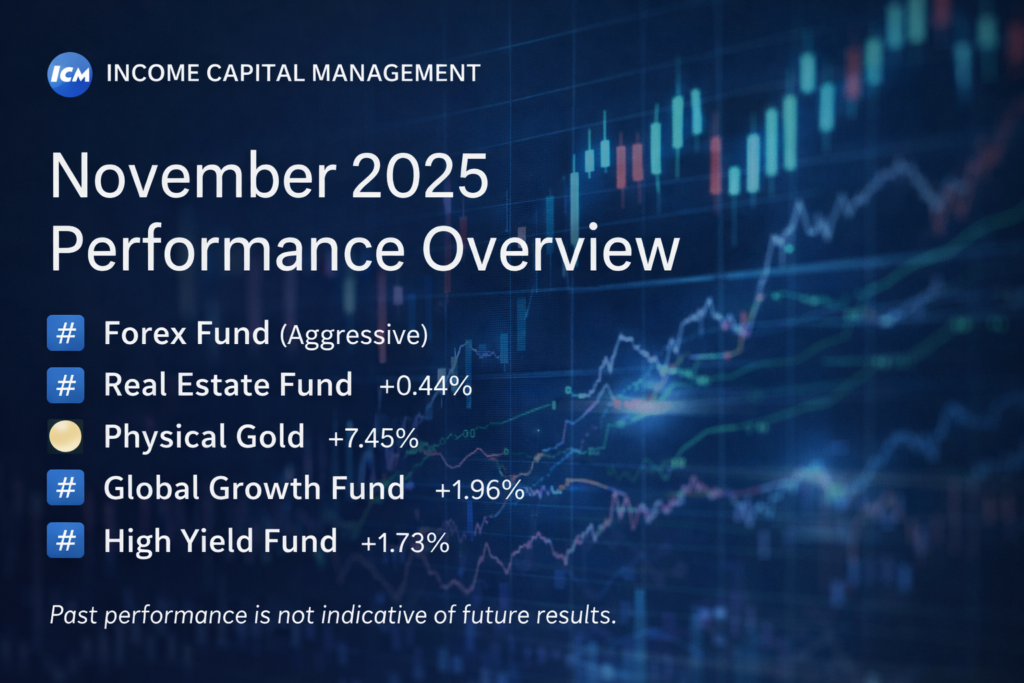
November 2025 – Portfolio Performance Overview Monthly performance reporting is not just about numbers. It is about understanding how different asset classes behave across varying market conditions and how disciplined portfolio construction supports consistency over time. Below is an overview of the performances of the main funds and assets managed by INCOME CAPITAL MANAGEMENT for November 2025, contextualized within the broader market environment. Forex Fund (Aggressive) November 2025: +2.00% January–November 2025: +32.71% Since April 2024: +62.76% In the final part of the year, a prudent and adaptive approach continued to support performance. Exposure was selectively reduced during more delicate market phases, allowing the strategy to remain responsive while protecting accumulated gains. This balance between opportunity and risk control remains a core element of the fund’s positioning. Real Estate Fund November 2025: +0.44% January–November 2025: +7.43% Since April 2024: +13.63% During November, the real estate market experienced a slight slowdown, a dynamic that is typical in periods characterized by reduced tourism and lower transactional activity. Despite this seasonal deceleration, the fund maintained stability thanks to sustained demand for quality properties located in prime areas, confirming the defensive characteristics of well-selected real estate exposure. Physical Gold Gold in custody: 13.45 Kg Market value as of 30/11/2025: €1,556,972 (€115.76 per gram) In November, gold recorded a strong appreciation, rising by more than 7% during the month. Since the beginning of 2025, cumulative growth exceeds 60%, reflecting persistent demand for defensive assets and the role of gold as a long-term store of value during periods of macroeconomic uncertainty. Global Growth Fund Total performance since 15/09/2025: +1.96% The initial months of activity have been positive, supported by selective exposure to innovative companies and high-potential sectors. The strategy focuses on long-term growth drivers while maintaining disciplined allocation criteria. High Yield Fund Total performance since 15/09/2025: +1.73% The fund’s launch phase has been supported by exposure to high-yield corporate bonds and REIT ETFs. Income generation is pursued within a diversified and risk-aware framework, aiming to balance yield opportunities with structural resilience. Final Considerations November’s results reflect a diversified portfolio structure designed to adapt across asset classes and market conditions. Consistency, selective exposure, and disciplined risk management continue to guide portfolio construction and execution. Full details are available in the private area under RESULTS: Access the private results area This content is provided for informational purposes only and does not constitute investment advice or a solicitation to the public. Past performance is not indicative of future results.
High Yield = High Risk? Myth vs. Reality
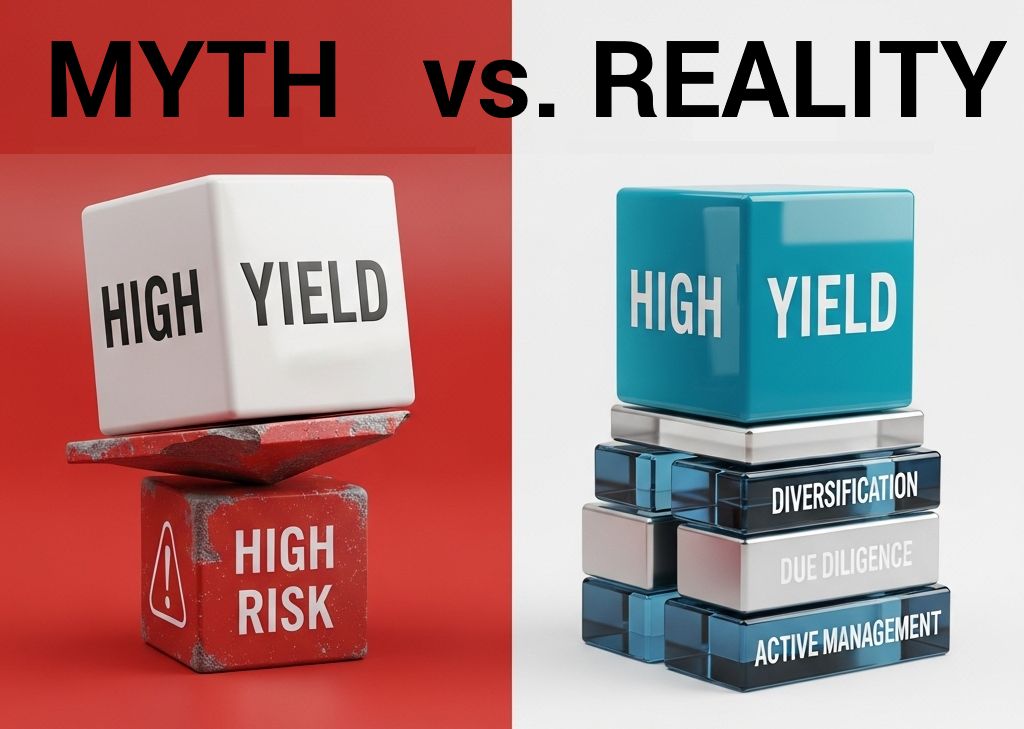
High Yield = High Risk? Myth vs. Reality The idea that higher yield automatically implies higher risk is deeply rooted in financial thinking. While this relationship can hold true in certain situations, it is often oversimplified and, in many cases, misleading. Yield and risk are connected, but not in a linear or absolute way. Understanding how income is generated, how portfolios are constructed, and how risk is managed is far more important than focusing on yield alone. Where the Myth Comes From The perception that “high yield equals high risk” typically originates from poorly structured investment strategies. Excessive leverage, lack of diversification, weak due diligence, or speculative positioning can indeed amplify risk. In such cases, yield becomes a byproduct of fragility rather than a result of disciplined construction. However, these examples reflect flawed implementation—not an inherent property of income-generating strategies. Yield as a Component, Not a Strategy Yield should never be pursued in isolation. In well-designed portfolios, income generation is one component of a broader allocation framework that considers liquidity, diversification, and risk limits. Professional portfolio construction evaluates the sustainability of cash flows, the quality of underlying assets, and the interaction between income-producing instruments and other portfolio elements. This approach transforms yield from a risk amplifier into a stabilizing element. The Role of Risk Management Risk is not eliminated through income strategies—it is managed. Diversification across instruments, issuers, and structures plays a central role in controlling downside exposure. Active monitoring, stress testing, and predefined risk parameters further reduce the likelihood that income generation becomes a source of instability. When these controls are in place, income-oriented allocations can coexist with capital preservation objectives. Income Across Market Cycles Different market environments influence how yield behaves. During periods of volatility, structured income strategies may contribute to portfolio resilience, provided risks are properly assessed and controlled. The distinction lies between disciplined income allocation and uncontrolled yield chasing. Reframing the Question The relevant question is not whether high yield is risky, but whether the strategy generating that yield is robust. Risk emerges from poor structure, not from yield itself. Conclusion High yield does not inherently mean high risk. When supported by diversification, due diligence, and active oversight, income strategies can play a constructive role within balanced portfolios. Understanding the source of yield—and the framework surrounding it—is essential to separating myth from reality. Originally published on LinkedIn: Read the original post on LinkedIn This content is provided for informational purposes only and does not constitute investment advice or a solicitation to the public. Past performance is not indicative of future results.
The Rise of Private Markets: Opportunities Beyond Public Exchanges

The Rise of Private Markets: Opportunities Beyond Public Exchanges Public markets have long represented the primary access point for investors seeking growth, liquidity, and transparency. However, in recent years, private markets have increasingly emerged as a strategic complement within diversified portfolios. This shift is not driven by fashion or short-term trends, but by structural changes in how companies grow, how capital is deployed, and how value is created over time. Why Private Markets Are Gaining Relevance Many of today’s most dynamic businesses remain private for longer periods. As a result, a significant portion of economic growth now takes place outside traditional public exchanges. Private markets allow investors to access these growth dynamics earlier, often with return drivers that differ from those of listed assets. This does not imply that private markets are superior to public ones, but rather that they offer exposure to different phases of the value-creation process. Diversification Beyond Listed Assets One of the primary advantages of private markets lies in diversification. Private equity, private debt, and real estate strategies introduce exposures that are often less correlated with public equities and bonds. This structural diversification can help smooth portfolio behavior across market cycles when allocations are calibrated thoughtfully. Private equity focuses on long-term operational and strategic value creation Private debt may offer predictable cash flows supported by contractual structures Real estate provides exposure to tangible assets with income-generating potential Liquidity, Horizon, and Discipline Accessing private markets requires a clear understanding of liquidity constraints and investment horizons. These strategies are not designed for short-term trading, but for investors willing to commit capital over defined periods. Discipline, due diligence, and alignment with investor objectives are therefore essential. When integrated correctly, private assets can enhance portfolio robustness without compromising strategic coherence. Balancing Public and Private Exposure At Income Capital Management, we view private markets as a complement to public investments rather than a replacement. The objective is to balance liquidity, transparency, and flexibility from public markets with the differentiated return drivers offered by private assets. This integrated approach allows portfolios to benefit from multiple sources of value creation. Private Markets as a Strategic Allocation Private markets are not tactical instruments. They require careful planning, ongoing monitoring, and realistic expectations. When approached with structure and discipline, private assets can represent a meaningful component of long-term portfolio strategy. Conclusion The growing relevance of private markets reflects a broader evolution in global finance. For investors willing to engage with longer horizons and diversified structures, opportunities beyond public exchanges continue to expand. Originally published on LinkedIn: Read the original post on LinkedIn This content is provided for informational purposes only and does not constitute investment advice or a solicitation to the public. Past performance is not indicative of future results.
Artificial Intelligence in Finance: Practical Use Cases

Artificial Intelligence in Finance: Practical Use Cases Artificial intelligence has moved beyond theoretical discussion and marketing narratives—it is now actively shaping how financial decisions are supported, risks are monitored, and portfolios are managed. In finance, the value of AI does not lie in replacing human judgment, but in enhancing it. When applied with discipline, artificial intelligence becomes a powerful tool for improving analytical depth, efficiency, and transparency. From Buzzword to Operational Tool For many years, artificial intelligence was discussed primarily as a future promise. Today, it is increasingly embedded within operational workflows across financial services. AI systems can process vast amounts of data, identify patterns, and surface insights that would be difficult to detect through traditional analysis alone. This capability is particularly relevant in environments characterized by complexity, speed, and information overload. AI in Portfolio Analytics One of the most tangible applications of AI in finance lies in portfolio analytics. Advanced algorithms support the analysis of correlations, risk exposure, and scenario behavior across asset classes. By continuously evaluating data streams, AI tools enhance the ability to identify emerging risks and opportunities in a timely manner. This allows portfolio managers and advisors to make more informed decisions while maintaining a structured framework. Risk Management and Monitoring Risk management is a natural area for AI application. Continuous monitoring systems can flag anomalies, stress indicators, or deviations from predefined parameters in real time. Rather than reacting after risks materialize, AI-supported systems help anticipate potential issues and support proactive management. This does not eliminate risk, but it improves awareness and response quality. Transparency and Client Communication Artificial intelligence also contributes to improved transparency. By supporting clearer reporting and data visualization, AI enhances communication between advisors and clients. When clients understand how portfolios behave under different scenarios, trust and alignment are strengthened—particularly during periods of volatility. Human Expertise Remains Central Despite technological progress, financial decision-making cannot be fully automated. Context, experience, and responsibility remain essential. AI is most effective when used as a decision-support tool, complementing professional judgment rather than replacing it. The strongest outcomes emerge when technology and human expertise operate together within a disciplined process. Conclusion Artificial intelligence is reshaping finance not by removing people from the process, but by enabling better-informed decisions. As adoption continues, the focus should remain on practical use cases, transparency, and responsible integration within established investment frameworks. Originally published on LinkedIn: Read the original post on LinkedIn This content is provided for informational purposes only and does not constitute investment advice or a solicitation to the public.
October 11th: Shock and Repricing as Trade Tensions Trigger a Global Market Selloff
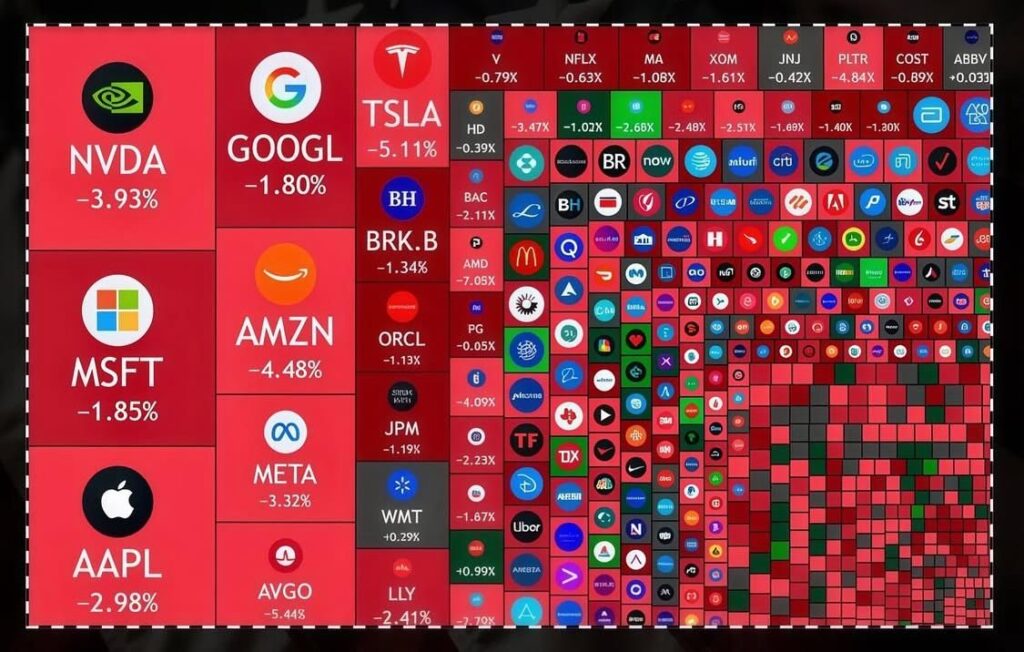
October 11th: Shock and Repricing as Trade Tensions Trigger a Global Market Selloff October 11th marked a sudden and violent repricing across global financial markets. Within minutes, risk assets reacted sharply to the announcement of new 100% U.S. tariffs on Chinese goods, reigniting trade-war fears and triggering a broad-based selloff across equities and cryptocurrencies. The scale and speed of the move highlighted how interconnected and fragile global markets remain when faced with abrupt geopolitical and policy shocks. A Rapid Loss of Market Capitalization The immediate reaction was severe: $1.6–$1.7 trillion wiped out from global equity markets Approximately $250 billion erased from the cryptocurrency market This “Black Friday” moment for markets unfolded within minutes, underscoring the sensitivity of investor sentiment to trade-related developments between the world’s two largest economies. Equity Markets Under Pressure U.S. equity indices recorded their steepest single-day declines in months: S&P 500: -2.7%, the sharpest drop since April Nasdaq Composite: -3.5%, driven by heavy selling in technology stocks Major technology companies led the downturn: Nvidia: -3.93% Amazon: -4.48% Tesla: -5.11% European and Asian markets mirrored the selloff, with indices across Switzerland, Italy, and other major markets closing deeply in negative territory. Crypto Markets: High Beta, High Impact Cryptocurrencies, traditionally sensitive to risk-off environments, experienced sharp declines as investors reduced exposure. The rapid contraction of approximately $250 billion in crypto market value reflected the sector’s vulnerability to macro and geopolitical shocks, particularly during periods of heightened uncertainty. Flight to Quality: Precious Metals Hold Firm In contrast to equities and crypto, gold and silver demonstrated resilience, reinforcing their role as defensive assets. Spot Gold: approximately $4,015–$4,018 per ounce Silver: around $50.6 per ounce This behavior is consistent with a classic flight-to-quality dynamic, as investors sought protection amid escalating volatility. FX Markets: Constructive Signals for EUR/USD Foreign exchange markets ended the week on a more constructive note for EUR/USD. Safe-haven flows and tariff-driven headlines created sharp intraday moves in the U.S. dollar, while demand for the euro improved into the Friday close, highlighting the complex interplay between trade policy and currency markets. Implications for Portfolio Strategy The events of October 11th serve as a clear reminder of the importance of portfolio diversification and robust risk management. The escalation of trade tensions between the United States and China introduces significant uncertainty for the fourth quarter and beyond. In such an environment, strategic asset allocation and disciplined exposure management become critical. Rather than attempting to predict headline-driven moves, resilient portfolios are built to absorb shocks while maintaining the flexibility to respond as conditions evolve. Final Considerations Market shocks of this magnitude are rarely isolated events. They often signal broader shifts in risk perception and investor behavior. For investors, the lesson remains consistent: diversification, disciplined risk management, and a clear strategic framework are essential tools for navigating today’s interconnected global economy. Original LinkedIn post: Read the original market update on LinkedIn INCOME CAPITAL MANAGEMENT
September 2025 Results: Resilience and Performance in a Volatile Market Environment

September 2025 Results: Resilience and Performance in a Volatile Market Environment “Wake me up when September ends…” sang Green Day. For many investors, September 2025 was indeed a month they would have preferred to skip. Global financial markets experienced exceptional turbulence, elevated uncertainty, and volatility at historically high levels. Gold continued its strong upward trajectory, while geopolitical and macroeconomic developments kept investor sentiment fragile throughout the month. Despite these challenging conditions, our strategies delivered solid positive performance, confirming that discipline, diversification, and a structured risk-based approach can transform uncertainty into opportunity. Market Context: A Month Defined by Volatility September unfolded against a backdrop of persistent geopolitical tension, macroeconomic realignment, and heightened sensitivity to policy signals. In such an environment, markets often reward resilience rather than speculation. Short-term reactions can amplify volatility, while structured strategies focused on risk control tend to demonstrate greater stability. Forex Fund Performance – Aggressive Level Even in this highly unstable context, the Forex Fund (Aggressive Level) closed the month with positive results: September 2025: +2.30% Year-to-date (January–September 2025): +28.16% Cumulative since inception (April 2024): +58.21% Since the beginning of August 2025, the strategy has been managed with a more cautious and prudent approach, reflecting the exceptionally high volatility observed across markets. This adjustment highlights the importance of flexibility within a disciplined framework, allowing portfolios to adapt while maintaining clear risk controls. Real Estate Fund Performance The Real Estate Fund also continued to deliver steady growth during September: September 2025: +0.45% Year-to-date (January–September 2025): +6.44% Cumulative since inception (April 2024): +12.64% While summer months typically represent a slowdown for the real estate sector, activity traditionally resumes with the arrival of autumn. Growth continues to be supported by sustained demand for tangible assets, particularly from investors seeking stability amid broader market uncertainty. Physical Gold Allocation Gold remained a central component of portfolio protection strategies throughout September. Purchased in September: 1.6 kg Total gold in custody: 11.6 kg Market value as of 30/09/2025: €1,228,440 (€105.90 per gram) The increase in demand is consistent with investors’ continued search for protection, reinforced by the strengthening of the spot gold price. In periods of elevated uncertainty, physical gold continues to fulfill its role as a strategic store of value. Transparency and Reporting Detailed performance reports are available at the following link: Access detailed reports → Active clients can find comprehensive data for all managed financial instruments in the private area, under the RESULTS section. Final Considerations September 2025 reinforces a key lesson: in times of heightened uncertainty, resilient strategies grounded in diversification and risk discipline make the difference. While markets remain unpredictable, structured investment approaches continue to demonstrate their ability not only to withstand volatility, but to convert it into sustainable performance. Original LinkedIn post: Read the original update on LinkedIn INCOME CAPITAL MANAGEMENT
July 2025: Extreme Volatility and Forex Fund Performance Under Unprecedented Market Stress

July 2025: Extreme Volatility and Forex Fund Performance Under Unprecedented Market Stress July 2025 proved to be one of the most challenging months in recent financial market history, particularly during its final two weeks. A period that is typically characterized by low volatility and reduced trading activity instead delivered extreme and unpredictable market movements, driven by a combination of political tension, speculative positioning, and fragile liquidity conditions. An Unusual Market Environment The month was dominated by escalating tensions over trade tariffs between Europe and the United States. These developments triggered a rapid sequence of events that destabilized the currency markets, particularly the EUR/USD pair. Initially, the European Central Bank intervened to artificially support the Euro, aiming to strengthen the European Commission’s position during ongoing negotiations. This was followed by a swift resurgence of the US Dollar as the dominant global currency. Crucially, these movements occurred against a backdrop of very low trading volumes, amplifying price swings and resulting in levels of volatility that, in certain moments, were unprecedented—even compared to the 2008 financial crisis. EUR/USD: Exceptional Price Swings The EUR/USD exchange rate illustrated the severity of market dislocation: Such rapid reversals within a compressed timeframe underscore the fragility of market sentiment and the risks associated with speculative flows during low-liquidity periods. Geopolitical Escalation and Risk Perception Market instability was further compounded by emerging geopolitical tensions, including the deployment of US submarines. While the prospect of nuclear escalation remains theoretical, even the suggestion of such risk materially affects investor behavior, volatility expectations, and capital allocation decisions. In environments like this, risk perception often outweighs fundamentals, creating conditions where price movements become disconnected from traditional valuation frameworks. Forex Fund Performance Overview Against this exceptionally turbulent backdrop, the Forex Fund (Aggressive Strategy) recorded the following results: While July closed negatively, the broader performance context remains solid, reflecting the strength of the strategy over longer horizons. Capital Protection as a Priority In periods of extreme and irregular volatility, prudence becomes essential. Our primary objective remains capital protection, with profit generation as a secondary goal. While speculative market movements are inherently unpredictable and beyond direct control, our focus is on maintaining vigilance and preserving the ability to act decisively when conditions normalize. This disciplined approach allows us to manage drawdowns while keeping portfolios positioned for recovery when market dynamics become more rational. Transparency and Reporting A detailed monthly return overview is available in the private area: View the full July 2025 performance report → We believe transparent reporting is essential, especially during challenging phases, enabling investors to evaluate performance within its proper market context. Final Considerations July 2025 serves as a reminder that extreme volatility can emerge even during periods traditionally considered stable. In such environments, discipline, risk management, and a long-term perspective remain the most effective tools for navigating uncertainty. INCOME CAPITAL MANAGEMENT
Risk Management and Consistency: The Foundations of Sustainable Investment Results

Risk Management and Consistency: The Foundations of Sustainable Investment Results Investment performance is often judged by returns alone. However, over full market cycles, it is risk management—not return maximization—that ultimately determines the sustainability of results. In an environment characterized by frequent volatility, rapid sentiment shifts, and geopolitical uncertainty, the ability to control downside exposure becomes a decisive competitive advantage. Why Risk Management Comes First Every investment strategy operates within uncertainty. The difference between durable performance and capital erosion lies in how risk is identified, measured, and managed. Effective risk management is not reactive. It is embedded into portfolio construction and execution through: Defined exposure limits aligned with volatility Diversification across instruments and risk drivers Continuous monitoring and adjustment of positions This framework allows portfolios to remain operational even when market conditions deteriorate. Consistency Across Market Cycles Short-term results can be influenced by favorable market phases. Consistency, however, is achieved only through disciplined execution across multiple cycles. Strategies that prioritize repeatability over opportunistic risk-taking are better positioned to deliver stable outcomes over time. Capital Preservation as a Strategic Objective Preserving capital during adverse phases is not a defensive stance—it is a strategic choice that enables long-term participation. By limiting drawdowns and avoiding forced decisions, portfolios maintain the flexibility required to reallocate capital when opportunities emerge. Risk Management and Investor Alignment Transparent risk frameworks also strengthen alignment between investors and portfolio managers. When risk parameters are clearly defined and consistently applied, investors can evaluate performance with a full understanding of the trade-offs involved. Final Considerations In uncertain markets, consistency is rarely accidental. It is the outcome of structured processes, disciplined risk controls, and a long-term perspective that prioritizes durability over short-term excitement. Original LinkedIn post: Read the original discussion on LinkedIn INCOME CAPITAL MANAGEMENT
Managing Volatility in Forex Markets: A Disciplined Investment Framework

Managing Volatility in Forex Markets: A Disciplined Investment Framework Volatility has become a structural feature of global financial markets. In 2025, currency markets in particular have reflected a complex mix of monetary policy divergence, geopolitical tension, and shifting capital flows. For investors, this environment reinforces a simple truth: performance is not driven by prediction, but by process. At INCOME CAPITAL MANAGEMENT, our approach to Forex investing is built around this principle. Rather than reacting to short-term noise, we focus on structured execution, controlled exposure, and continuous risk assessment. The Forex Market in 2025: Complexity, Not Chaos Foreign exchange markets are often perceived as purely speculative. In reality, they are among the most liquid and information-rich markets globally. However, in periods of heightened uncertainty, liquidity alone is not enough. Throughout 2025, FX markets have been influenced by: Diverging interest rate expectations across major economies Persistent geopolitical risk affecting capital allocation Increased correlation between currencies and broader risk assets This backdrop rewards strategies that are adaptive, disciplined, and grounded in measurable risk parameters. A Structured Approach to Forex Exposure Our Forex strategy does not rely on directional bets or discretionary timing. Instead, it is designed to operate through a defined framework that emphasizes: Risk-adjusted positioning, with predefined exposure limits Active management based on evolving market conditions Capital preservation as a core objective, not a secondary consideration Consistency of execution, reducing emotional decision-making This structure allows the strategy to remain operational even when market conditions become less predictable. Why Discipline Matters More Than Direction In volatile markets, attempting to forecast every move often leads to overexposure and inconsistent outcomes. A disciplined framework, by contrast, focuses on managing what can be controlled: risk, position sizing, and execution quality. Our experience confirms that sustainable performance in Forex investing is achieved not by maximizing exposure, but by maintaining flexibility while respecting defined risk constraints. Transparency and Investor Alignment Transparency remains a central pillar of our investment philosophy. Clear reporting, measurable performance, and a well-defined strategy allow investors to understand not only what results are achieved, but how they are generated. In an environment where volatility is likely to persist, clarity and structure become competitive advantages. LinkedIn Source This article is based on the original update published on LinkedIn: View the original LinkedIn post → Looking Forward As global markets continue to evolve, our focus remains unchanged: disciplined execution, robust risk management, and consistent alignment with investor objectives. In Forex markets especially, the ability to navigate volatility with structure—not speculation—will continue to define long-term success. INCOME CAPITAL MANAGEMENT

