Building Resilient Portfolios: Real Assets, Global Structures, and Disciplined Innovation

Building Resilient Portfolios: Real Assets, Global Structures, and Disciplined Innovation In a financial environment defined by volatility, regulatory fragmentation, and rapid technological change, long-term wealth creation increasingly depends on structure rather than speculation. At Income Capital Management, portfolio construction is guided by a multi-dimensional framework that combines real assets, cross-border efficiency, and measured innovation. This approach reflects a simple principle: diversification today is not just about asset classes, but about economic function, legal structure, and risk governance. Infrastructure Investing: Real Assets at the Core of Long-Term Wealth Infrastructure investments — from toll roads and logistics networks to renewable energy grids and utilities — represent some of the most tangible components of the global economy. These assets typically generate predictable cash flows, benefit from long-term contracts, and often provide a natural hedge against inflation. Income Capital Management accesses infrastructure primarily through institutional-grade investment vehicles, allowing clients to participate in assets traditionally reserved for large institutions. Unlike traditional equities, infrastructure returns are driven by usage, regulation, and economic necessity rather than market sentiment alone. Within a diversified portfolio, infrastructure plays a stabilizing role, complementing growth-oriented strategies while anchoring long-term capital in real economic activity. Cross-Border Investment and Tax Optimization: Structure Matters As portfolios become increasingly global, investment performance can no longer be evaluated independently from tax efficiency and regulatory structure. Cross-border investing introduces complexity — but also opportunity — when managed correctly. Income Capital Management supports international investors through careful fund domiciliation, treaty-aware structuring, and disciplined compliance frameworks. The objective is not aggressive tax avoidance, but the legitimate reduction of tax drag through alignment with international agreements and transparent reporting standards. A well-structured investment can materially improve net returns over time, particularly for long-term investors. In this sense, tax optimization becomes a strategic component of portfolio construction rather than an afterthought. Cryptocurrency and Digital Assets: Innovation with Discipline Digital assets and cryptocurrencies continue to attract attention due to their volatility and technological promise. While blockchain technology is reshaping financial infrastructure, cryptocurrencies themselves remain speculative instruments that require careful risk assessment. Income Capital Management approaches digital assets with a clear distinction between innovation and exposure. Rather than pursuing momentum-driven allocations, we evaluate blockchain-related opportunities through a rigorous risk–return lens, focusing on regulated environments, tokenized securities, and infrastructure-level innovation. This measured approach allows participation in technological evolution without compromising portfolio stability or risk discipline. An Integrated Framework for Modern Investors Real assets such as infrastructure provide stability and inflation protection. Cross-border structuring enhances efficiency and transparency. Selective exposure to digital innovation ensures portfolios remain forward-looking without becoming speculative. Together, these elements form a resilient investment framework designed to perform across market cycles, regulatory regimes, and economic conditions. In a world where complexity is unavoidable, clarity of structure becomes a competitive advantage. Conclusion Sustainable wealth is built through disciplined allocation, structural awareness, and prudent innovation. By combining real assets, global investment efficiency, and controlled exposure to emerging technologies, Income Capital Management aims to deliver portfolios that are not only diversified, but structurally resilient. This philosophy reflects our long-term commitment to transparency, risk management, and investor-centric asset management. Related LinkedIn posts: Infrastructure Investing: https://www.linkedin.com/posts/activity-7425274527376375808-skVv Cross-Border Investment Tax Optimization: https://www.linkedin.com/posts/incomecapital_investment-optimization-investing-activity-7422292422941978624-QmKw Cryptocurrency and Digital Assets: https://www.linkedin.com/posts/incomecapital_cryptocurrency-volatile-speculative-activity-7420389889122193408-RvO2
Cryptocurrency and Digital Assets: Income Capital Management’s Measured Approach

Cryptocurrency and Digital Assets: Income Capital Management’s Measured Approach Cryptocurrencies and digital assets continue to attract global attention, oscillating between innovation-driven enthusiasm and periods of extreme volatility. While the sector remains highly speculative, the underlying blockchain technology is undeniably reshaping financial infrastructure, asset ownership models, and transaction efficiency. At Income Capital Management, we approach cryptocurrencies and digital assets with a clear distinction between technological innovation and investable opportunity. Our philosophy is not driven by hype or short-term price movements, but by a disciplined risk–return framework designed to protect capital while selectively capturing long-term value. Volatility and Speculation: Understanding the Risk Profile Digital assets are characterized by sharp price fluctuations, regulatory uncertainty, and evolving market structures. These factors make cryptocurrencies unsuitable as core holdings for many portfolios, particularly when risk tolerance and capital preservation are primary objectives. For this reason, Income Capital Management avoids excessive or unstructured exposure to cryptocurrencies. Instead, we analyze digital assets within the broader context of portfolio construction, assessing their impact on volatility, correlation, liquidity, and drawdown risk. Blockchain Beyond Cryptocurrencies While cryptocurrencies themselves remain speculative, blockchain technology represents a structural innovation with tangible applications. Tokenized securities, decentralized settlement systems, and distributed ledger infrastructure are already influencing how financial markets operate. Our focus extends beyond individual digital currencies to the ecosystem that supports them. This includes evaluating opportunities linked to blockchain infrastructure, regulated tokenization frameworks, and institutional-grade digital asset solutions where transparency, governance, and compliance are clearly defined. A Selective and Disciplined Allocation Income Capital Management integrates digital assets only where they enhance diversification without compromising portfolio stability. Any exposure is carefully sized, continuously monitored, and aligned with each client’s risk profile and long-term objectives. This measured approach allows us to remain engaged with innovation while maintaining strict control over downside risk. Innovation is valuable only when it is supported by structure, discipline, and clear investment rationale. Innovation with Responsibility The future of finance will undoubtedly include digital assets and blockchain-based solutions. However, sustainable wealth creation requires more than technological enthusiasm. It demands robust risk management, regulatory awareness, and a long-term perspective. At Income Capital Management, we believe that innovation and prudence are not opposites — they are complementary pillars of responsible asset management. LinkedIn post: https://www.linkedin.com/feed/update/urn:li:activity:7420389889122193408
PRESS RELEASE – TEARLY RESULTS 2025
Income Capital Management Reports Strong 2025 Performance in a Year of Divergent Global Markets FOR IMMEDIATE RELEASE Date: January 27, 2026 Prague, Czech Republic — Income Capital Management closed 2025 with solid results across its diversified investment strategies, successfully navigating a year marked by sharp divergences between asset classes. The firm enters 2026 with a disciplined, multi-asset approach focused on delivering consistent value to its investors. Market Environment Global markets in 2025 were characterized by pronounced dispersion. Gold emerged as the top-performing major asset class, posting gains of +65.87% and reinforcing its role as a safe-haven asset. Major equity indices, including DAX, NASDAQ, FTSE 100, Euro Stoxx 50, S&P 500, and Dow Jones, recorded positive performances, while Bitcoin declined by -6.35%, reflecting increased volatility and speculative risk. Italy’s FTSE MIB underperformed relative to broader international benchmarks. Key Strategy Performance Income Capital Management’s Forex strategy delivered a standout performance, achieving an annual return of +34.98%. Active currency trading combined with strict risk management allowed the strategy to outperform major traditional benchmarks. The firm’s Real Estate strategy generated stable income-driven returns of +7.71%, supported by premium property assets and consistent cash flow, outperforming several weaker regional equity markets. Additional allocations to global growth and high-yield strategies contributed to overall portfolio diversification and balance. Management Commentary “2025 confirmed that active and diversified strategies are essential in fragmented market conditions,” said Paolo Volpicelli, CEO of Income Capital Management. “Our Forex strategy’s 34.98% return demonstrates how disciplined execution and controlled risk can translate into meaningful performance for our investors.” Nicola Pinchi, CTO of Income Capital Management, added: “By combining high-conviction Forex strategies with stable real estate income and physical gold exposure, we have built portfolios designed to perform across different market cycles rather than simply follow short-term trends.” Strategic Positioning for 2026 Income Capital Management’s multi-asset framework — encompassing Forex for growth, real estate for income, global growth and high-yield strategies for diversification, and physical gold for capital protection — is designed to provide resilience and flexibility in an evolving macroeconomic environment. As the firm enters 2026, this structure aims to balance opportunity and risk, supporting long-term portfolio stability in periods of heightened volatility. About Income Capital Management Income Capital Management is an independent asset management firm specializing in diversified investment solutions across Forex, real estate, global growth, high-yield strategies, and physical asset exposure. The firm focuses on active management, disciplined risk control, and long-term capital preservation and growth. For more information, please visit www.incomecapital.biz or contact the Income Capital Management team directly. LinkedIn press release: https://www.linkedin.com/posts/paolovolpicelli_press-release-tearly-results-2025-activity-7421816797093494784-NoVd
Portfolio Discipline, Diversification and Market Cycles: A Framework for Long-Term Investing

Portfolio Discipline, Diversification and Market Cycles: A Framework for Long-Term Investing Successful investing is rarely the result of a single tactical decision. Over time, consistent results tend to emerge from a disciplined framework that combines portfolio structure, diversification across asset classes, and an informed understanding of market cycles. Three elements in particular play a central role in this process: portfolio rebalancing, multi-asset diversification, and strategic positioning across fixed income markets. While often discussed separately, these components are deeply interconnected and should be approached as parts of a unified investment methodology. Portfolio Rebalancing as a Strategic Discipline Portfolio rebalancing is frequently misunderstood as a purely mechanical adjustment of weights. In reality, it represents a disciplined governance process designed to keep risk exposure aligned with long-term objectives. As markets evolve, assets that perform well naturally increase their weight within a portfolio, while others decline. Without periodic intervention, this drift can lead to unintended concentration risk and a gradual departure from the original investment strategy. A structured rebalancing process is based on predefined allocation ranges, review frequency, and tolerance thresholds. The goal is not to predict markets, but to maintain coherence between strategy and execution, removing emotional bias from decision-making and reinforcing long-term discipline. Diversification in Practice: Lessons from 2025 The year 2025 offered a clear illustration of why diversification remains essential. Asset classes moved in very different directions, creating outcomes that varied significantly depending on portfolio construction. Within a diversified framework, different instruments played complementary roles: Gold acted as a defensive anchor, delivering a return of +65.87%. Forex strategies provided high return potential through active management, closing the year at +34.98%. Real Estate investments contributed stability and income, with a performance of +7.71%. This dispersion of returns highlights an important principle: diversification is not about maximizing performance in every market environment, but about ensuring resilience across changing conditions. A portfolio built on multiple, uncorrelated sources of return is better positioned to absorb volatility and protect capital over time. Understanding Bond Market Cycles and Strategic Positioning Fixed income markets have undergone profound changes in recent years, shaped by inflation dynamics, monetary policy shifts, and evolving yield structures. As yields stabilize, strategic positioning becomes increasingly important for income-focused portfolios. Bond market cycles require investors to balance yield opportunities with duration risk, credit quality, and inflation sensitivity. Government bonds, corporate debt, and emerging market bonds each serve distinct roles depending on the phase of the cycle. Rather than chasing headline yields, effective bond allocation focuses on sustainability, diversification, and alignment with broader portfolio objectives. When integrated thoughtfully, fixed income can once again serve as a stabilizing element within multi-asset portfolios. A Unified Investment Framework Portfolio rebalancing, diversification, and cycle-aware asset allocation should not be treated as isolated concepts. Together, they form a coherent framework that emphasizes structure over speculation and process over prediction. In an increasingly complex global environment, this disciplined approach allows investors to navigate uncertainty while maintaining clarity, control, and long-term strategic alignment. Original LinkedIn posts: Portfolio Rebalancing Insight: https://www.linkedin.com/feed/update/urn:li:activity:7350399901672833024 Diversification and 2025 Portfolio Results: https://www.linkedin.com/posts/incomecapital_confidence-emergingmarkets-debtinvestment-activity-7416403617785577472 Bond Market Cycles and 2026 Outlook: https://www.linkedin.com/feed/update/urn:li:activity:7353302800539205634
Confidence, Emerging Markets and Debt Investment: Navigating Opportunity Through Structure

Confidence, Emerging Markets and Debt Investment: Navigating Opportunity Through Structure In a global financial environment shaped by uncertainty, confidence is not a sentiment — it is the result of structure, discipline, and informed decision-making. Emerging markets continue to attract investor attention, not because they are simple, but because they offer opportunities that are often uncorrelated with traditional developed markets. Within this context, debt investments play a strategic role, combining yield potential with structured risk management when approached correctly. Why Confidence Matters in Emerging Markets Emerging markets are frequently associated with volatility, political risk, and uneven growth cycles. While these factors are real, they also create inefficiencies — and inefficiencies are precisely where disciplined investors can find value. Confidence in this space does not come from speculation. It comes from: Careful jurisdiction and counterparty selection Clear legal and regulatory frameworks Defined risk parameters and exit strategies Continuous monitoring of macroeconomic and geopolitical dynamics When these elements are in place, emerging market exposure becomes a calculated allocation rather than a leap of faith. The Strategic Role of Debt Investment Debt investment represents a different approach compared to pure equity exposure. Instead of relying solely on growth narratives, debt strategies focus on contractual cash flows, capital structure positioning, and downside protection. In emerging markets, this approach can be particularly effective. Well-structured debt instruments may offer: Predictable income streams Priority positioning in the capital structure Lower volatility compared to equity investments Improved portfolio diversification The key lies in rigorous due diligence and conservative structuring — elements that transform complexity into opportunity. From Perceived Risk to Managed Exposure Risk in emerging markets is often misunderstood. The real risk is not volatility itself, but the absence of controls, transparency, and governance. By focusing on structured debt solutions, investors can access emerging market opportunities while maintaining alignment with capital preservation objectives. This approach shifts the narrative from speculative exposure to intentional allocation. Confidence as a Competitive Advantage In periods where global markets oscillate between optimism and fear, confidence becomes a differentiating factor. Not blind confidence, but informed confidence — built on data, structure, and experience. At INCOME CAPITAL MANAGEMENT, confidence is the outcome of method. Our investment philosophy emphasizes clarity over complexity and structure over narratives, particularly when operating in less conventional markets. A Measured Path Forward Emerging markets and debt investments are not designed for short-term speculation. They are components of a broader strategy aimed at diversification, income generation, and long-term resilience. By combining disciplined risk management with selective exposure, it is possible to navigate complexity without compromising on control. INCOME CAPITAL MANAGEMENT s.r.o. 🔗 Related LinkedIn post: Confidence, Emerging Markets and Debt Investment
Annual Investment Report – 2025
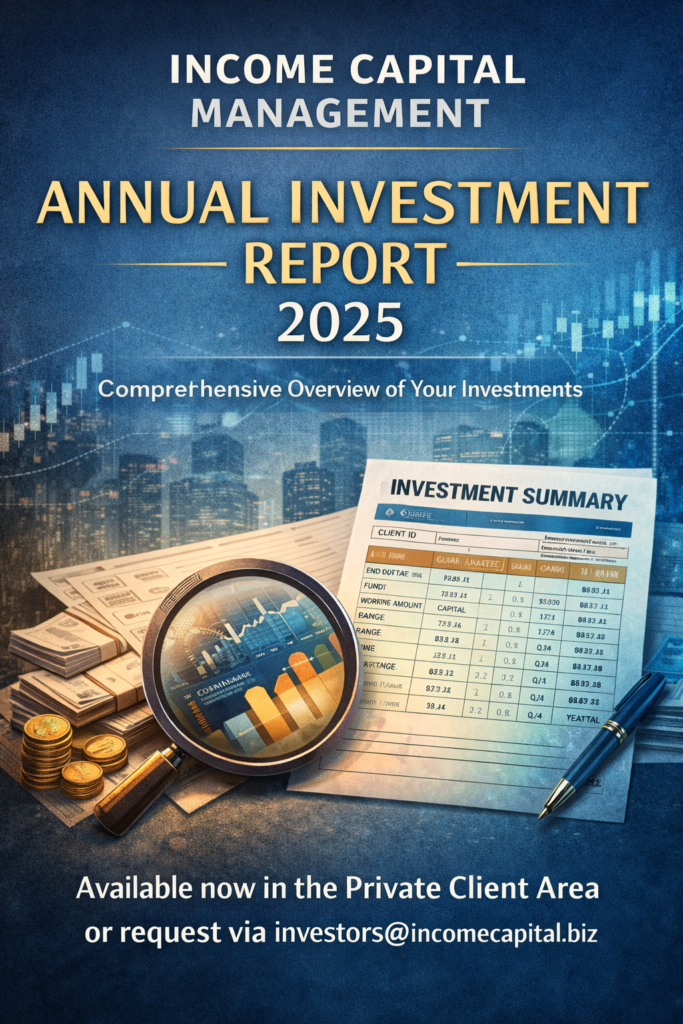
Annual Investment Report – 2025 INCOME CAPITAL MANAGEMENT informs all clients that the Annual Investment Report for the year 2025 is available for consultation and printing directly from the Private Client Area. Within the dedicated investment section, each client can view a comprehensive overview of their positions, including performance data, invested capital, and operational configurations, with information updated according to the reporting frequency applicable to each fund. Formal Annual Report Request Clients who wish to receive the official Annual Investment Report for 2025, formally issued by Income Capital Management s.r.o., are kindly requested to submit their request by email to: 📧 investors@incomecapital.biz Please ensure that the email includes the relevant Client ID (or Client IDs, in the case of multiple investments) for which the report is requested. The document will be prepared and delivered in accordance with internal verification and compliance procedures. Return Update Frequency Investment returns displayed on the investment page are updated according to the following schedule: Weekly for the FOREX FUND Monthly for all other funds (typically by the 4th day of the following month) If an investment did not start at the beginning of a standard quarter (January, April, July, October), returns are calculated and displayed on a pro-rata basis. Explanation of Table Fields Below is a description of the main fields displayed in the investment summary table: CLIENT ID: The client identification number assigned by Income Capital Management s.r.o. Clients with multiple investments will have multiple Client IDs. END DATE: The maturity or expiration date of the investment. FUND: The type of investment subscribed. GUARANTEED CAPITAL: The percentage of capital guaranteed, where applicable. WORKING AMOUNT: The operating capital on which returns are calculated. This amount does not include any reinvested profits. RANGE: The indicative annual return range, reflecting the risk level of the selected investment. Q1, Q2, Q3, Q4: Percentage and monetary value of any profit generated in the respective quarter, if applicable. YEARLY TOTAL: Total annual profit expressed as both a percentage and an amount in EUR. For clients who do not reinvest profits quarterly, this figure is shown only for the current quarter. CAPITAL + INVESTMENT: The total amount in EUR consisting of invested capital plus any profits generated during the year. REINVESTED PROFITS ON QUARTERLY BASIS: Indicates whether quarterly profit reinvestment has been selected. PAC AMOUNT ON QUARTERLY BASIS: Indicates whether a quarterly Capital Accumulation Plan (PAC) is active and the selected contribution amount. Support and Clarifications The team at INCOME CAPITAL MANAGEMENT remains fully available for any clarification or additional information regarding the annual report, investment data, or portfolio configurations. Kind regards, INCOME CAPITAL MANAGEMENT s.r.o.
Lessons in Crisis Management from 2025 Markets

Lessons in Crisis Management from 2025 Markets Periods of market stress are often remembered for their volatility, but their true value lies in the lessons they reveal. The market dynamics experienced throughout 2025 once again demonstrated how crises test not only portfolios, but also decision-making frameworks, risk discipline, and investor behavior. While every market cycle has its own characteristics, the underlying principles of effective crisis management remain remarkably consistent. Volatility as a Stress Test Market volatility is not an anomaly, it is an intrinsic feature of financial systems. During calmer phases, structural weaknesses may remain hidden. In contrast, periods of stress expose how portfolios are constructed and how risk is truly managed. The volatility observed in 2025 served as a real-time stress test, highlighting the importance of diversification, liquidity awareness, and predefined risk controls. Discipline Over Reaction One of the most common challenges during market turbulence is the temptation to react emotionally. Sudden price movements can lead to decisions driven by fear or urgency rather than analysis. Effective crisis management relies on discipline: the ability to adhere to established frameworks even when market signals appear contradictory or unsettling. Portfolios guided by structured allocation rules and risk parameters are better positioned to absorb shocks without compromising long-term objectives. Preparation Happens Before the Crisis Crises are rarely managed successfully in real time without prior preparation. Portfolio resilience is built during stable periods, through thoughtful asset allocation, scenario analysis, and continuous monitoring. Risk management tools, diversification strategies, and liquidity planning play a critical role long before volatility materializes. When uncertainty rises, preparation allows investors to respond with clarity rather than urgency. The Role of Communication During market stress, communication becomes as important as portfolio construction. Transparent and timely dialogue helps align expectations and reduce the risk of reactive decisions. Clear explanations of portfolio positioning, risk exposure, and strategic intent support investor confidence, even in challenging conditions. Adaptability Within a Framework Discipline does not imply rigidity. Effective crisis management balances adherence to core principles with the flexibility to adapt when structural conditions change. Adjustments made within a coherent framework—rather than impulsive shifts—allow portfolios to remain aligned with long-term goals while responding to evolving market dynamics. Conclusion The lessons from the 2025 markets reinforce a fundamental truth: crisis management is not about predicting the next disruption, but about being prepared when it occurs. Structure, discipline, and clear communication remain the cornerstones of resilient investment management across market cycles. Originally published on LinkedIn: Read the original post on LinkedIn This content is provided for informational purposes only and does not constitute investment advice or a solicitation to the public. Past performance is not indicative of future results.
November 2025 – Portfolio Performance Overview
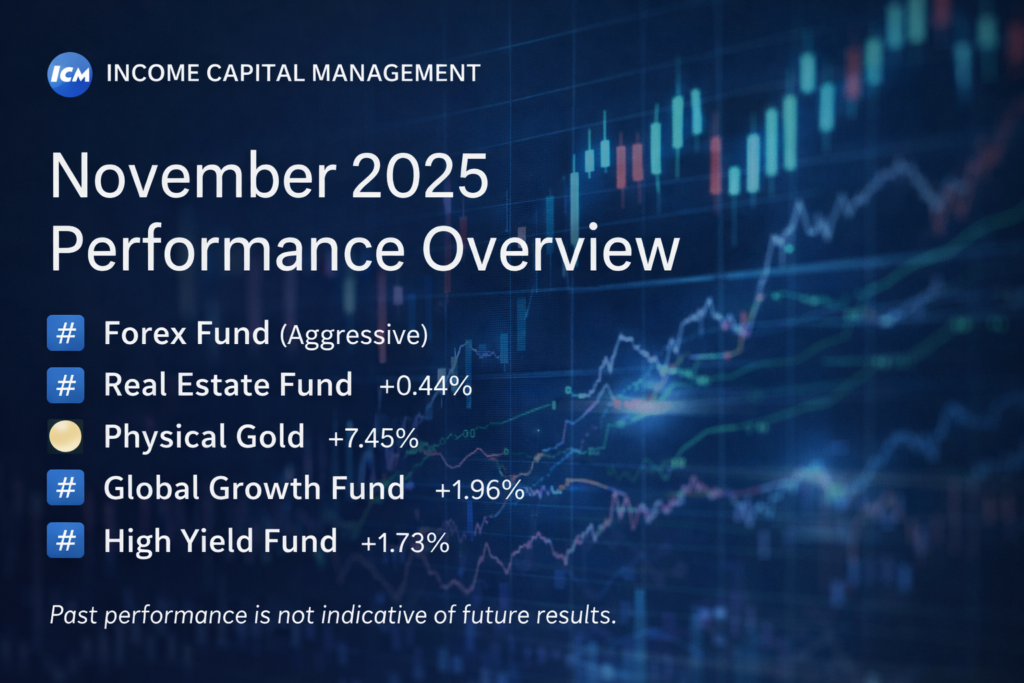
November 2025 – Portfolio Performance Overview Monthly performance reporting is not just about numbers. It is about understanding how different asset classes behave across varying market conditions and how disciplined portfolio construction supports consistency over time. Below is an overview of the performances of the main funds and assets managed by INCOME CAPITAL MANAGEMENT for November 2025, contextualized within the broader market environment. Forex Fund (Aggressive) November 2025: +2.00% January–November 2025: +32.71% Since April 2024: +62.76% In the final part of the year, a prudent and adaptive approach continued to support performance. Exposure was selectively reduced during more delicate market phases, allowing the strategy to remain responsive while protecting accumulated gains. This balance between opportunity and risk control remains a core element of the fund’s positioning. Real Estate Fund November 2025: +0.44% January–November 2025: +7.43% Since April 2024: +13.63% During November, the real estate market experienced a slight slowdown, a dynamic that is typical in periods characterized by reduced tourism and lower transactional activity. Despite this seasonal deceleration, the fund maintained stability thanks to sustained demand for quality properties located in prime areas, confirming the defensive characteristics of well-selected real estate exposure. Physical Gold Gold in custody: 13.45 Kg Market value as of 30/11/2025: €1,556,972 (€115.76 per gram) In November, gold recorded a strong appreciation, rising by more than 7% during the month. Since the beginning of 2025, cumulative growth exceeds 60%, reflecting persistent demand for defensive assets and the role of gold as a long-term store of value during periods of macroeconomic uncertainty. Global Growth Fund Total performance since 15/09/2025: +1.96% The initial months of activity have been positive, supported by selective exposure to innovative companies and high-potential sectors. The strategy focuses on long-term growth drivers while maintaining disciplined allocation criteria. High Yield Fund Total performance since 15/09/2025: +1.73% The fund’s launch phase has been supported by exposure to high-yield corporate bonds and REIT ETFs. Income generation is pursued within a diversified and risk-aware framework, aiming to balance yield opportunities with structural resilience. Final Considerations November’s results reflect a diversified portfolio structure designed to adapt across asset classes and market conditions. Consistency, selective exposure, and disciplined risk management continue to guide portfolio construction and execution. Full details are available in the private area under RESULTS: Access the private results area This content is provided for informational purposes only and does not constitute investment advice or a solicitation to the public. Past performance is not indicative of future results.
High Yield = High Risk? Myth vs. Reality
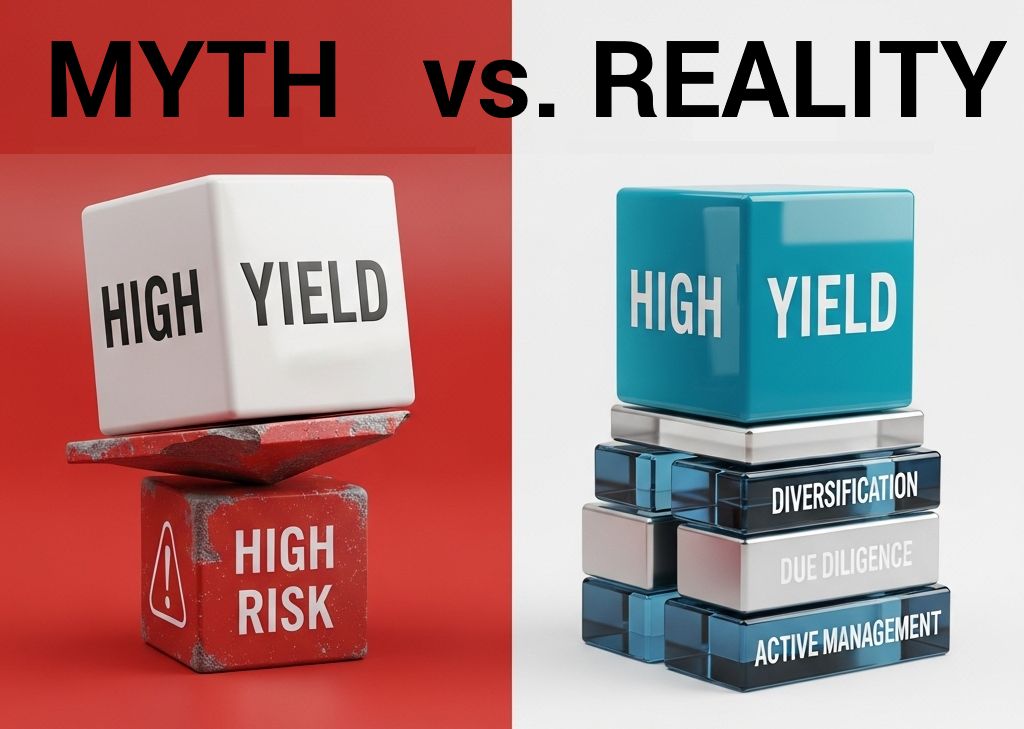
High Yield = High Risk? Myth vs. Reality The idea that higher yield automatically implies higher risk is deeply rooted in financial thinking. While this relationship can hold true in certain situations, it is often oversimplified and, in many cases, misleading. Yield and risk are connected, but not in a linear or absolute way. Understanding how income is generated, how portfolios are constructed, and how risk is managed is far more important than focusing on yield alone. Where the Myth Comes From The perception that “high yield equals high risk” typically originates from poorly structured investment strategies. Excessive leverage, lack of diversification, weak due diligence, or speculative positioning can indeed amplify risk. In such cases, yield becomes a byproduct of fragility rather than a result of disciplined construction. However, these examples reflect flawed implementation—not an inherent property of income-generating strategies. Yield as a Component, Not a Strategy Yield should never be pursued in isolation. In well-designed portfolios, income generation is one component of a broader allocation framework that considers liquidity, diversification, and risk limits. Professional portfolio construction evaluates the sustainability of cash flows, the quality of underlying assets, and the interaction between income-producing instruments and other portfolio elements. This approach transforms yield from a risk amplifier into a stabilizing element. The Role of Risk Management Risk is not eliminated through income strategies—it is managed. Diversification across instruments, issuers, and structures plays a central role in controlling downside exposure. Active monitoring, stress testing, and predefined risk parameters further reduce the likelihood that income generation becomes a source of instability. When these controls are in place, income-oriented allocations can coexist with capital preservation objectives. Income Across Market Cycles Different market environments influence how yield behaves. During periods of volatility, structured income strategies may contribute to portfolio resilience, provided risks are properly assessed and controlled. The distinction lies between disciplined income allocation and uncontrolled yield chasing. Reframing the Question The relevant question is not whether high yield is risky, but whether the strategy generating that yield is robust. Risk emerges from poor structure, not from yield itself. Conclusion High yield does not inherently mean high risk. When supported by diversification, due diligence, and active oversight, income strategies can play a constructive role within balanced portfolios. Understanding the source of yield—and the framework surrounding it—is essential to separating myth from reality. Originally published on LinkedIn: Read the original post on LinkedIn This content is provided for informational purposes only and does not constitute investment advice or a solicitation to the public. Past performance is not indicative of future results.
The Rise of Private Markets: Opportunities Beyond Public Exchanges

The Rise of Private Markets: Opportunities Beyond Public Exchanges Public markets have long represented the primary access point for investors seeking growth, liquidity, and transparency. However, in recent years, private markets have increasingly emerged as a strategic complement within diversified portfolios. This shift is not driven by fashion or short-term trends, but by structural changes in how companies grow, how capital is deployed, and how value is created over time. Why Private Markets Are Gaining Relevance Many of today’s most dynamic businesses remain private for longer periods. As a result, a significant portion of economic growth now takes place outside traditional public exchanges. Private markets allow investors to access these growth dynamics earlier, often with return drivers that differ from those of listed assets. This does not imply that private markets are superior to public ones, but rather that they offer exposure to different phases of the value-creation process. Diversification Beyond Listed Assets One of the primary advantages of private markets lies in diversification. Private equity, private debt, and real estate strategies introduce exposures that are often less correlated with public equities and bonds. This structural diversification can help smooth portfolio behavior across market cycles when allocations are calibrated thoughtfully. Private equity focuses on long-term operational and strategic value creation Private debt may offer predictable cash flows supported by contractual structures Real estate provides exposure to tangible assets with income-generating potential Liquidity, Horizon, and Discipline Accessing private markets requires a clear understanding of liquidity constraints and investment horizons. These strategies are not designed for short-term trading, but for investors willing to commit capital over defined periods. Discipline, due diligence, and alignment with investor objectives are therefore essential. When integrated correctly, private assets can enhance portfolio robustness without compromising strategic coherence. Balancing Public and Private Exposure At Income Capital Management, we view private markets as a complement to public investments rather than a replacement. The objective is to balance liquidity, transparency, and flexibility from public markets with the differentiated return drivers offered by private assets. This integrated approach allows portfolios to benefit from multiple sources of value creation. Private Markets as a Strategic Allocation Private markets are not tactical instruments. They require careful planning, ongoing monitoring, and realistic expectations. When approached with structure and discipline, private assets can represent a meaningful component of long-term portfolio strategy. Conclusion The growing relevance of private markets reflects a broader evolution in global finance. For investors willing to engage with longer horizons and diversified structures, opportunities beyond public exchanges continue to expand. Originally published on LinkedIn: Read the original post on LinkedIn This content is provided for informational purposes only and does not constitute investment advice or a solicitation to the public. Past performance is not indicative of future results.

