Love Your Investments: Building Lasting Relationships with Your Portfolio

Love Your Investments: Building Lasting Relationships with Your Portfolio Valentine’s Day is often associated with romantic symbolism — flowers, promises, and grand gestures. In finance, the word “love” may seem misplaced. Yet the concept of lasting commitment, patience, and mutual understanding has surprising relevance in the world of long-term investing. Portfolios, like relationships, thrive not because of intensity, but because of consistency. The Myth of Instant Attraction in Investing Many investment decisions begin with excitement. A new fund, a promising sector, an emerging market opportunity — each carries the appeal of novelty. Just as in relationships, initial enthusiasm can create a powerful emotional pull. However, history repeatedly shows that sustainable wealth is not built on short-term excitement. It is built on structured commitment. Markets reward patience more reliably than impulsiveness. A portfolio that constantly changes direction in pursuit of the next opportunity rarely develops depth or resilience. Commitment as Strategic Discipline Commitment in investing does not mean blind loyalty to underperforming assets. It means adhering to a structured allocation framework through market cycles. At Income Capital Management, disciplined commitment manifests in: Defined asset allocation ranges. Regular review processes. Transparent communication during volatility. Measured rebalancing rather than emotional repositioning. This approach mirrors a long-term partnership. Both sides understand that fluctuations occur, but structure provides stability. Trust Between Advisor and Client In relationships, trust is cumulative. It develops through transparency and shared expectations. The same principle governs advisor-client dynamics. Clients who understand the purpose of each allocation — Forex, Real Estate, Physical Gold, Global Growth, High Yield — are less vulnerable to fear-driven decisions. Trust reduces reactive behavior. It creates psychological resilience. Regular Engagement Prevents Drift Relationships deteriorate when communication fades. Portfolios suffer similarly when left unattended. Periodic portfolio reviews serve multiple purposes: Reaffirming long-term goals. Adjusting for life changes. Rebalancing allocations to maintain strategic alignment. Reassessing risk tolerance. Without engagement, portfolios drift from original objectives — not because markets fail, but because circumstances evolve. Understanding Volatility as Emotional Testing Volatility is the emotional test of every investor. Market drawdowns feel personal. Headlines amplify uncertainty. Yet volatility is not betrayal. It is a structural feature of capital markets. When investors internalize this reality, they stop perceiving temporary underperformance as failure. Instead, they evaluate whether the original thesis remains intact. Mutual Responsibility Successful advisory relationships are collaborative. Advisors provide structure, analysis, and risk frameworks. Clients provide clarity regarding goals, time horizon, and liquidity needs. When both roles are respected, outcomes improve. Long-Term Wealth Is Emotional Stability Beyond financial metrics, disciplined portfolio relationships cultivate psychological stability. Investors who trust their framework experience less anxiety during market turbulence. Emotional stability enhances decision quality. Love the Process, Not the Outcome Focusing exclusively on short-term performance is analogous to evaluating a relationship solely on daily mood fluctuations. Long-term investing requires appreciation of process — risk management, diversification, scenario analysis — rather than obsession with quarterly returns. The Role of Patience Compounding requires time. Time requires patience. Patience requires conviction. Conviction arises from understanding. When investors fully understand their portfolio structure, patience becomes rational rather than forced. Conclusion: Stability Through Commitment Lasting wealth is built through sustained engagement, structured discipline, and trusted partnership. Just as enduring relationships are grounded in respect and shared values, enduring portfolios are grounded in clarity, risk awareness, and long-term alignment. In investing, as in life, love is not intensity. It is commitment sustained over time. LinkedIn Post: https://www.linkedin.com/posts/incomecapital_portfolio-commitment-investments-activity-7427985167228579840-Pg5d
Entrepreneurship and Finance: Lessons from Building Income Capital Management

Entrepreneurship and Finance: Lessons from Building Income Capital Management When people think about finance, they often imagine numbers, models, and capital markets. When they think about entrepreneurship, they imagine innovation, ambition, and risk-taking. In reality, these two disciplines are deeply interconnected. Building Income Capital Management has reinforced a conviction I now hold with certainty: serious investing is an entrepreneurial act. An investment firm is not simply a vehicle for deploying capital. It is an enterprise built on vision, execution, regulatory structure, human relationships, and disciplined risk management. The parallels between launching a company and constructing resilient portfolios are more profound than they appear at first glance. Vision Is the First Allocation Decision Every entrepreneurial journey begins with a vision. In finance, that vision must extend beyond returns. It must define purpose. When we designed the foundations of Income Capital Management, the initial question was not “How do we outperform this year?” but rather “What type of institution do we want to be ten or twenty years from now?” That framing changed every subsequent decision. Vision in finance determines: The type of clients you serve. The jurisdictions you operate in. The level of regulatory compliance you adopt. The risk profile you are willing to manage. The balance between innovation and prudence. Without a long-term institutional vision, short-term performance can become dangerously seductive. Entrepreneurs learn that misaligned growth can destroy stability. Investors face the same reality. Execution Is Where Trust Is Built Ideas are abundant in financial markets. Execution is scarce. Launching a Forex strategy, structuring a Real Estate vehicle, integrating Physical Gold custody, implementing High Yield allocations, building Global Growth frameworks — none of these are inherently complex ideas. What differentiates sustainable institutions from temporary ones is execution discipline. Execution in finance includes: Risk management protocols. Transparent reporting. Regulatory adherence. Liquidity monitoring. Client communication standards. Entrepreneurship taught me that credibility is operational. In wealth management, operational weakness translates directly into reputational risk. Regulatory Expansion as Strategic Maturity One of the most underestimated lessons in financial entrepreneurship is the importance of regulatory evolution. Expanding into new jurisdictions, adapting to cross-border frameworks, and strengthening compliance infrastructure are not bureaucratic burdens — they are strategic investments. Each regulatory milestone required capital, time, and organizational adaptation. But every expansion strengthened the institutional foundation and enhanced client confidence. Entrepreneurship in finance is not about avoiding structure. It is about building robust structure. Adaptability Without Instability Markets evolve. Economic regimes shift. Monetary cycles reverse. Technology transforms distribution channels. Regulation tightens. An investment firm must adapt — but adaptation must not compromise identity. Over time, we adjusted risk limits, refined asset allocation models, expanded into additional strategies and improved data integration. Yet the core philosophy remained intact: disciplined diversification, transparent advisory, and long-term alignment. Entrepreneurs face a similar tension: adapt to survive, but do not drift without direction. Client Obsession as Institutional Strategy In many industries, “customer focus” is a marketing phrase. In wealth management, it is existential. Capital is mobile. Trust is fragile. Performance alone does not secure loyalty. Clients remain committed when they understand what they own, why they own it, and how it behaves under stress. This requires: Clear risk explanation. Scenario transparency. Alignment between portfolio design and life goals. Honest communication during drawdowns. Entrepreneurial growth followed when clients felt understood, not impressed. Resilience as a Core Asset No serious entrepreneur avoids downturns. Likewise, no serious investor avoids volatility. The early years of building an investment firm are characterized by limited margin for error. Every drawdown feels amplified. Every operational challenge tests conviction. Resilience became not just a psychological trait, but a structural design principle. Diversification across strategies was not simply a client benefit — it was an institutional safeguard. Timing and Optionality Entrepreneurs rarely possess perfect information. Decisions are made under uncertainty. The same is true in investing. Waiting for perfect clarity often results in missed opportunity. Acting without preparation leads to unnecessary risk. The balance lies in optionality — maintaining liquidity, flexible structures, and scenario-tested frameworks that allow participation without overcommitment. Growth as a Controlled Process Scaling an investment firm resembles scaling a business. Rapid expansion without infrastructure can destabilize operations. We deliberately prioritized controlled growth. Technology upgrades preceded distribution expansion. Risk systems evolved before asset size increased materially. In investing, position sizing plays the same role. Growth must be proportionate to risk capacity. The Entrepreneurial Mindset in Portfolio Construction Every investor is, in effect, managing a financial enterprise. Asset allocation mirrors strategic planning. Liquidity resembles operational cash flow. Risk tolerance parallels competitive positioning. When investors begin to see their portfolio as a business rather than a collection of products, decision quality improves. Long-Term Value Creation Over Excitement Financial markets reward patience more reliably than excitement. Entrepreneurship reinforced that sustainable institutions are built quietly. Similarly, sustainable portfolios are constructed through disciplined processes rather than dramatic moves. The lessons from building Income Capital Management extend beyond corporate structure. They reveal that finance, at its highest level, is entrepreneurship applied to capital. Vision, execution, adaptability, discipline, and client alignment — these principles govern both worlds. And in both worlds, longevity is the ultimate measure of success. LinkedIn Post: https://www.linkedin.com/posts/paolovolpicelli_finance-investment-vision-activity-7427282770026070016-4rkS
PRESS RELEASE – TEARLY RESULTS 2025
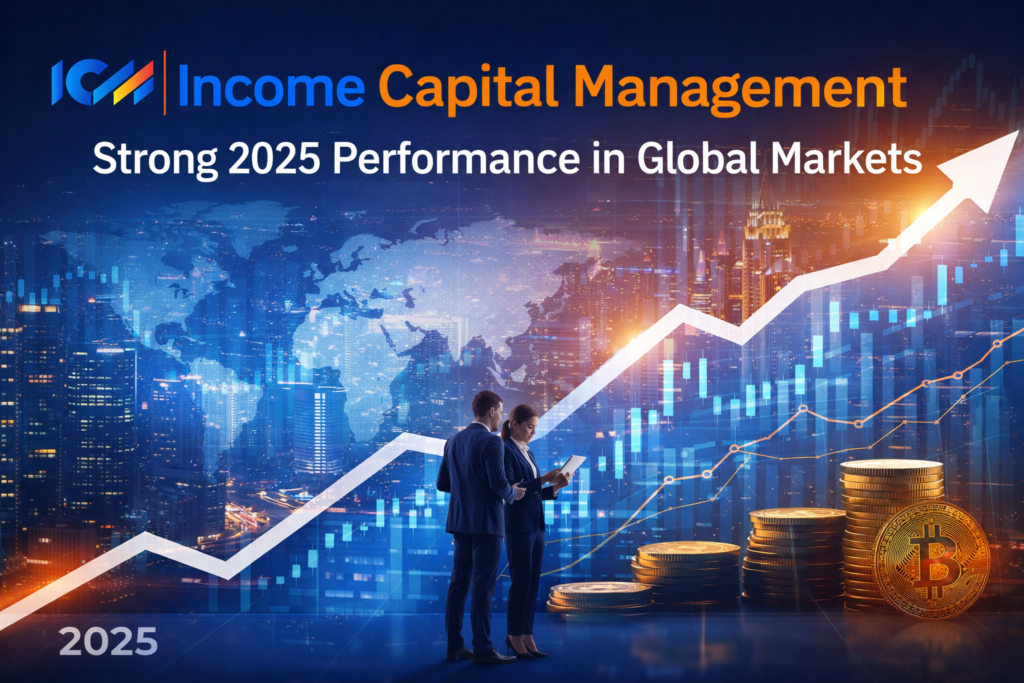
Income Capital Management Reports Strong 2025 Performance in a Year of Divergent Global Markets FOR IMMEDIATE RELEASE Date: January 27, 2026 Prague, Czech Republic — Income Capital Management closed 2025 with solid results across its diversified investment strategies, successfully navigating a year marked by sharp divergences between asset classes. The firm enters 2026 with a disciplined, multi-asset approach focused on delivering consistent value to its investors. Market Environment Global markets in 2025 were characterized by pronounced dispersion. Gold emerged as the top-performing major asset class, posting gains of +65.87% and reinforcing its role as a safe-haven asset. Major equity indices, including DAX, NASDAQ, FTSE 100, Euro Stoxx 50, S&P 500, and Dow Jones, recorded positive performances, while Bitcoin declined by -6.35%, reflecting increased volatility and speculative risk. Italy’s FTSE MIB underperformed relative to broader international benchmarks. Key Strategy Performance Income Capital Management’s Forex strategy delivered a standout performance, achieving an annual return of +34.98%. Active currency trading combined with strict risk management allowed the strategy to outperform major traditional benchmarks. The firm’s Real Estate strategy generated stable income-driven returns of +7.71%, supported by premium property assets and consistent cash flow, outperforming several weaker regional equity markets. Additional allocations to global growth and high-yield strategies contributed to overall portfolio diversification and balance. Management Commentary “2025 confirmed that active and diversified strategies are essential in fragmented market conditions,” said Paolo Volpicelli, CEO of Income Capital Management. “Our Forex strategy’s 34.98% return demonstrates how disciplined execution and controlled risk can translate into meaningful performance for our investors.” Nicola Pinchi, CTO of Income Capital Management, added: “By combining high-conviction Forex strategies with stable real estate income and physical gold exposure, we have built portfolios designed to perform across different market cycles rather than simply follow short-term trends.” Strategic Positioning for 2026 Income Capital Management’s multi-asset framework — encompassing Forex for growth, real estate for income, global growth and high-yield strategies for diversification, and physical gold for capital protection — is designed to provide resilience and flexibility in an evolving macroeconomic environment. As the firm enters 2026, this structure aims to balance opportunity and risk, supporting long-term portfolio stability in periods of heightened volatility. About Income Capital Management Income Capital Management is an independent asset management firm specializing in diversified investment solutions across Forex, real estate, global growth, high-yield strategies, and physical asset exposure. The firm focuses on active management, disciplined risk control, and long-term capital preservation and growth. For more information, please visit www.incomecapital.biz or contact the Income Capital Management team directly. LinkedIn press release: https://www.linkedin.com/posts/paolovolpicelli_press-release-tearly-results-2025-activity-7421816797093494784-NoVd
INCOME CAPITAL MANAGEMENT Shines in H1 2025: Performance, Discipline, and Conviction
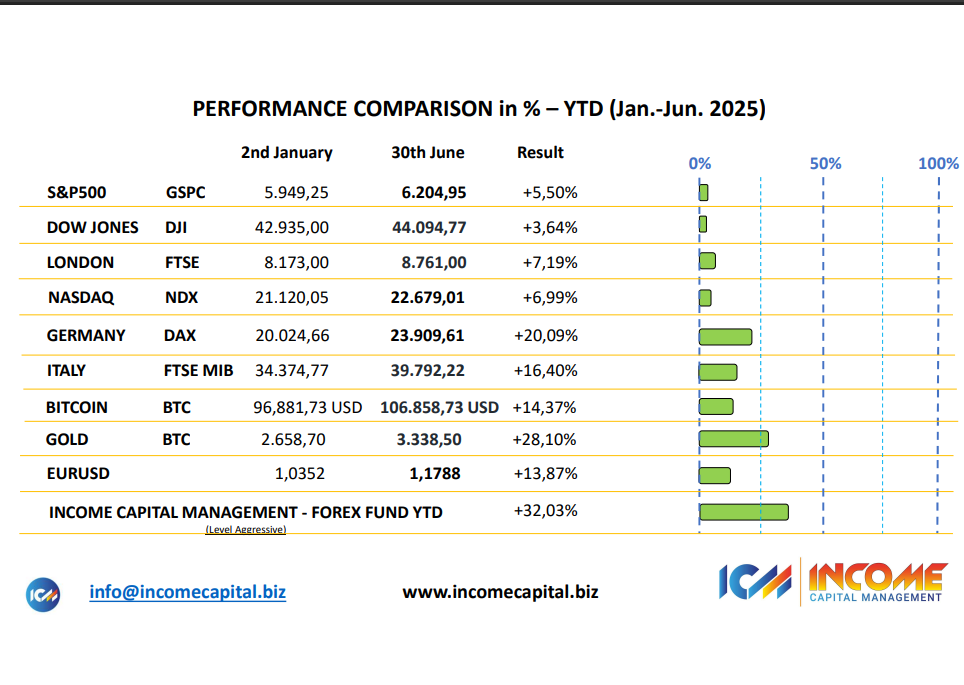
INCOME CAPITAL MANAGEMENT Shines in H1 2025: Performance, Discipline, and Conviction The first half of 2025 has been anything but simple for global financial markets. Persistent geopolitical tensions, fluctuating monetary policies, and ongoing macroeconomic uncertainty have created an environment where consistency and discipline matter more than bold predictions. Against this backdrop, INCOME CAPITAL MANAGEMENT delivered a solid and measurable result, confirming the robustness of its investment framework and the effectiveness of its risk-controlled execution. 📊 Strong Performance in a Challenging Environment During the first half of 2025, our Aggressive Investment Level achieved: +32.03% cumulative return (H1 2025) +62.08% cumulative return since April 2024 These figures are not the result of isolated market events or short-term positioning. They reflect a structured and repeatable investment process built around: Disciplined FX strategy execution Dynamic exposure management Continuous risk monitoring and adjustment Data-driven decision-making Past performance refers to the Aggressive Investment Level and is not indicative of future results. 📌 Structure Over Speculation As highlighted by our Founder & CEO, Paolo Volpicelli, performance is not driven by luck: “Our edge is not luck — it is structure, conviction, and execution.” At INCOME CAPITAL MANAGEMENT, we do not attempt to predict markets. Instead, we focus on understanding them, adapting to changing conditions, and maintaining a disciplined framework that prioritizes capital preservation alongside growth. In an environment where many strategies struggle to remain consistent, our approach continues to demonstrate resilience through methodical positioning and controlled risk exposure. 🔍 Transparency and Measurable Results We believe that performance should always be: Measurable – backed by real data Transparent – clearly reported and accessible Consistent – aligned with a defined investment process Our results reflect not only market opportunities but also the strength of a framework designed to operate effectively during both expansionary and volatile phases. 🔗 Further Insights For the original update and additional context, you can view the LinkedIn article here: View the original LinkedIn post → 🧠 Looking Ahead The first half of 2025 reinforces a key principle: in complex markets, conviction and consistency outperform noise and reaction. As we move into the second half of the year, our focus remains unchanged — protecting capital, managing risk intelligently, and delivering sustainable performance through disciplined execution. INCOME CAPITAL MANAGEMENT continues to build results through structure, not shortcuts.
INCOME CAPITAL FOREX FUND – Questions & Answers (April 2024)
INCOME CAPITAL FOREX FUND – Questions & Answers (April 2024) What is the INCOME CAPITAL FOREX Fund? The INCOME CAPITAL FOREX Fund is an investment fund managed by INCOME CAPITAL MANAGEMENT s.r.o. that operates in the global foreign exchange (FX) market. Its objective is capital appreciation through active currency trading using a structured and risk-controlled approach. What does the Fund invest in? The Fund trades major currency pairs, primarily: EUR/USD EUR/GBP GBP/USD Trading activity is focused on liquid FX markets, allowing efficient execution and continuous risk monitoring. What is the investment objective of the Fund? The objective is to generate returns through active forex trading while applying disciplined risk management. The Fund does not aim to guarantee profits and does not eliminate market risk. What type of strategy does the Fund use? The Fund adopts an active trading strategy with a scalping-oriented approach, meaning it takes advantage of short-term price movements in the currency markets. Investment decisions are supported by: Fundamental analysis (macroeconomic data, interest rates, geopolitical events) Technical analysis (price patterns, market behavior) Technology-supported execution systems Does the Fund use Artificial Intelligence? Yes. The Fund uses AI and algorithmic tools to support market analysis and trade execution. AI is used to: Analyze large datasets of historical and live market data Identify patterns and market signals Support decision-making and execution efficiency AI does not operate independently and is always subject to human oversight and risk controls. Who manages the Fund? The Fund is managed by professional fund managers supported by financial analysts, automated trading systems (Expert Advisors), and risk management and compliance teams. Human supervision remains central to the investment process. What is the risk level of the Forex Fund? The Forex Fund has a medium-to-high risk profile. Foreign exchange markets are volatile, and losses can occur, including partial or total loss of invested capital depending on the investment level chosen. What are the main risks involved? Key risks include: Market and volatility risk Currency risk Liquidity risk Technological and system risk Operational and regulatory risk Investors should carefully assess their risk tolerance before investing. How does the Fund manage risk? Risk management measures include position sizing rules, stop-loss mechanisms, continuous monitoring of market exposure, diversification of trading positions, and compliance with regulatory standards. Risk is actively managed but cannot be eliminated. Are there different investment levels? Yes. The Fund offers four investment levels: Conservative – lower risk, partial capital protection, lower return range Mild-Conservative – balanced approach between risk and protection Mild-Aggressive – higher risk with higher potential returns Aggressive – highest risk and highest return potential Each level has a defined expected return range and capital protection structure, where applicable. Is capital guaranteed? Capital protection depends on the selected investment level. Some levels offer partial capital protection, while others are fully exposed to market risk. Capital is never fully guaranteed. How often are returns updated? Returns are updated weekly for the Forex Fund. Performance is calculated based on the working amount invested. Returns may vary depending on market conditions. What fees apply to the Forex Fund? There are no entry fees and no fixed management fees. A performance fee is applied only on realized net profits. Compliance-related onboarding costs (KYC/AML) are borne by the investor. Can an investor exit before maturity? Yes. Early exit is possible under predefined conditions. Fees or penalties may apply depending on the investment level, duration of the investment, and timing of the withdrawal. Details are specified in the official documentation. Who can invest in the Forex Fund? The Fund is intended for investors who understand financial markets and FX trading risks, are comfortable with medium-to-high risk investments, and have a medium to long-term investment horizon. The Fund may not be suitable for all investors. Is the Fund regulated? Yes. INCOME CAPITAL MANAGEMENT s.r.o. operates under the supervision of the Czech National Bank, in accordance with applicable regulations. All investors are subject to KYC, AML, and PEP checks. How is transparency ensured? Transparency is ensured through regular performance reporting, access to investment data via the private client area, dedicated investor support, and clear documentation outlining risks, fees, and strategy. Where can investors find official documentation? Official documentation, including the KID, is provided during onboarding and is available upon request from INCOME CAPITAL MANAGEMENT. Is this information investment advice? No. This information is provided for educational and informational purposes only and does not constitute investment advice. Investors should seek independent professional advice before making any investment decision.

