The Structure Behind a Professional Forex Fund

The Structure Behind a Professional Forex Fund Ask a retail trader what makes a good forex operation and the answer will usually involve signals, timing, or a proprietary method for reading the market. Ask an institutional allocator the same question and the answer changes completely: they will talk about limits, processes, and what happens when things go wrong. That difference in perspective is the subject of this article. A professional forex fund structure is not built on trading signals. It is built on risk frameworks, exposure limits, drawdown control, and systematic decision rules, and the quality of that structure determines outcomes more reliably than the quality of any individual trade. Why the currency market rewards structure over instinct The foreign exchange market is the largest and most liquid market in the world. According to the Bank for International Settlements, turnover in FX markets averaged 9.5 trillion US dollars per day in April 2025. That depth is a genuine advantage for a professionally managed fund: positions can be built and unwound at scale without moving prices, and liquidity remains available even when other markets thin out. The same characteristics, however, punish improvisation. Currency prices respond to interest rate differentials, macro data, central bank policy, and flows that no participant fully observes. Leverage is widely available and cuts in both directions. A market this deep and this fast does not forgive structural weaknesses; it finds them. This is why the operations that survive across market regimes are rarely the ones with the best market calls. They are the ones where every decision that matters was made before the market forced it. The mandate: deciding what the fund does not do Structure begins with the mandate, and a serious mandate is defined as much by exclusions as by objectives. Which currency pairs are in scope and which are not. Which instruments the strategy may use. What maximum leverage is permitted, under which conditions. What the fund explicitly will not do, regardless of how attractive an opportunity appears. The exclusions matter because pressure to deviate always arrives dressed as opportunity. A strategy drifts one exception at a time: an unusual pair because the setup looked compelling, extra leverage because conviction was high, a new instrument because a competitor was using it. Each deviation seems reasonable in isolation. Together they produce a portfolio whose risk profile no longer matches anything the investor agreed to. A written mandate, enforced without exceptions, is the first and cheapest control a fund can have. Exposure limits: the core of a forex fund structure Inside the mandate sits the risk framework, and its core instrument is the exposure limit. A professional forex fund structure defines, in advance, how much exposure is acceptable at several levels at once: per currency pair, per position, per directional theme, and for the portfolio in aggregate. The layering is deliberate. Individual position limits prevent any single trade from dominating outcomes. Aggregate limits prevent a collection of individually reasonable positions from quietly becoming one large bet. Thematic limits address the subtler problem of correlated exposure: three positions in different pairs can amount to a single view on the dollar, and a framework that only counts positions will miss it. This is the same correlation logic that governs portfolio construction more broadly, which we examined in our article on correlation risk and diversification: what matters is not how many exposures you hold, but how they behave together under stress. Position sizing completes the framework. Size is a function of the limit structure and the volatility of the pair, not of conviction. Conviction-based sizing grows with confidence, and confidence grows with recent success, which is precisely how risk concentrates at the worst possible moment. Drawdown control: the rules that act before judgment does Every strategy, without exception, goes through periods of loss. What distinguishes a structured fund is that the response to those periods is specified in advance and executes independently of anyone’s mood. Drawdown control operates on thresholds. At defined levels of loss, exposure is reduced according to pre-set rules. At deeper levels, the strategy de-risks further or pauses entirely while the process is reviewed. The thresholds and the responses are written down before the first trade, because a drawdown is the single worst environment in which to design a response: judgment is impaired, incentives push toward recovery bets, and every instinct argues for one more exception. The arithmetic behind drawdown discipline is unforgiving and worth restating. A 20% loss requires a 25% gain to recover; a 50% loss requires 100%. Deep drawdowns cost time as much as money, and they push strategies toward the forced decisions that convert temporary losses into permanent ones. Keeping drawdowns shallow is not caution for its own sake. It is what makes long-term compounding arithmetically possible. Systematic decision rules: removing the moment from the decision The fourth pillar is the decision framework: the rules that govern how positions are opened, managed, and closed. In a structured fund, entries and exits follow defined criteria. Reviews happen on a schedule, not when someone feels the need. Changes to the process itself go through a deliberate procedure rather than being improvised mid-drawdown. None of this eliminates judgment. Markets change, and a process that never evolves is a different kind of risk. The point is that judgment operates on the process, calmly and on schedule, rather than inside individual trades under pressure. The behavioral case for this separation is one we made at length in our article on investment discipline: most damage in markets comes not from lack of knowledge but from inconsistency in execution, and consistency cannot be left to willpower. It has to be engineered. Consistency across regimes, not performance spikes The objective of all this structure is easy to misread. It is not to maximize returns in any given month. It is to produce behavior that remains consistent across market regimes: trending and ranging markets, high and low volatility, calm conditions and stressed ones. Performance spikes are cheap to generate. Concentrate
Inside Our Forex Fund: Discipline Over Speculation

Inside Our Forex Fund: Discipline Over Speculation The foreign exchange market is often misunderstood. For many observers, Forex trading is associated with speculation, high leverage, and short-term bets driven by market sentiment. Media coverage and retail trading platforms have reinforced this perception, presenting currency markets as environments where rapid gains and equally rapid losses dominate the narrative. However, this simplified view fails to capture how professional investors actually approach currency markets. In institutional portfolio management, Forex is not merely a speculative arena. Instead, it can become a powerful strategic tool for diversification, risk control, and portfolio efficiency. At Income Capital Management, our Forex Fund is designed around a fundamentally different philosophy. Rather than chasing volatility or reacting emotionally to short-term movements, the strategy focuses on discipline, risk management, and systematic decision-making. In this framework, currency markets are not a casino. They are a structured financial environment where disciplined strategies can create stable opportunities while supporting broader portfolio objectives. Why Forex Markets Matter in Global Portfolios The foreign exchange market is the largest and most liquid financial market in the world. Every day, trillions of dollars are exchanged between currencies as governments, corporations, financial institutions, and investors conduct international transactions. This massive scale creates a unique investment landscape. Unlike equity markets, which depend on corporate performance, or bond markets, which are tied closely to interest rates and credit conditions, currency markets are influenced by a complex combination of macroeconomic forces. Interest rate differentials, monetary policy decisions, economic growth expectations, geopolitical developments, and trade balances all contribute to currency movements. For global investors with exposure to multiple currencies such as the euro, US dollar, or other major international currencies, these fluctuations can have a meaningful impact on overall portfolio performance. Rather than ignoring currency risk, professional investors seek to manage it. Moving Beyond the Speculation Narrative The idea that Forex trading is inherently speculative often arises from the behavior of retail market participants. High leverage, emotional trading decisions, and a lack of structured risk management frequently result in unpredictable outcomes. Professional Forex strategies operate very differently. Institutional approaches prioritize discipline, risk limits, and systematic processes. The objective is not to predict every short-term market movement, but to capture opportunities while maintaining strict control over potential losses. This disciplined structure is what transforms Forex from speculation into a legitimate portfolio management tool. The Core Principles of a Disciplined Forex Strategy The Forex Fund at Income Capital Management operates according to several fundamental principles that guide every trading decision. These principles are designed to ensure that the strategy remains aligned with long-term portfolio stability rather than short-term speculation. The key elements include: Strict risk management frameworks Carefully calibrated position sizing Continuous monitoring of market exposure Drawdown control mechanisms Scenario-based portfolio analysis Each of these components plays a specific role in maintaining the overall stability of the strategy. Position Sizing: Controlling Exposure Position sizing is one of the most important elements of professional trading. Rather than placing large bets on individual market views, disciplined Forex strategies distribute exposure across multiple positions with carefully calculated size limits. This approach ensures that no single trade can significantly damage portfolio performance. Even when market conditions become volatile, controlled position sizing allows the strategy to remain stable and resilient. Drawdown Control and Capital Preservation Another critical element of institutional trading is drawdown control. Every investment strategy will experience periods of underperformance. Markets move unpredictably, and even well-structured strategies cannot avoid temporary losses. However, the key to long-term success lies in limiting those losses. Drawdown control mechanisms establish predefined thresholds that restrict how much capital can be exposed to risk at any given time. When these thresholds are reached, exposure is reduced automatically. This systematic discipline helps ensure that temporary volatility does not evolve into structural portfolio damage. Continuous Monitoring of Currency Markets The global currency market operates twenty-four hours a day, five days a week. Economic events in one region can influence currency movements across the entire world. For this reason, professional Forex strategies rely on continuous monitoring. Market conditions are analyzed constantly, incorporating macroeconomic developments, central bank communications, and geopolitical changes. This ongoing evaluation allows portfolio managers to adapt positioning when necessary while maintaining strict adherence to risk frameworks. Scenario Analysis and Strategic Preparation Another essential component of disciplined Forex management is scenario analysis. Rather than focusing solely on the most likely market outcome, professional investors prepare portfolios for multiple potential scenarios. These scenarios may include changes in interest rate policies, shifts in global growth expectations, currency interventions by central banks, or geopolitical disruptions. By stress-testing portfolios against different environments, investors can better understand how currency exposures may behave under varying conditions. This preparation significantly reduces the risk of unexpected market shocks. Forex as a Diversification Tool One of the most valuable characteristics of Forex strategies is their potential diversification benefit. Currency markets often behave differently from traditional asset classes such as equities or real estate investments. Because currencies respond primarily to macroeconomic forces, they can provide portfolio exposure to different risk factors. This diversification effect can help smooth overall portfolio volatility. For investors with international financial exposure, currency management becomes an essential element of overall portfolio stability. Supporting International Investors Many global investors hold assets denominated in multiple currencies. European investors may hold US dollar investments, while American investors may maintain exposure to European or emerging market currencies. These currency exposures create additional layers of risk that must be managed carefully. Our Forex Fund helps address this challenge by providing a structured approach to currency management. By actively managing currency exposure, investors can reduce volatility while maintaining access to international investment opportunities. From Volatility to Opportunity Currency fluctuations often create uncertainty for investors. Rapid movements in exchange rates can influence international investment returns and introduce unexpected volatility. However, when approached with discipline and professional risk management, currency volatility can also create opportunity. A structured Forex strategy can convert market fluctuations into potential return sources while maintaining strict control over risk exposure. The Importance of Discipline in
What Clients Really Ask About Investing: Trust, Clarity and Financial Decisions
What Clients Really Ask About Investing After many years working with international investors, entrepreneurs, and families managing significant financial assets, one observation becomes very clear: the questions clients ask are rarely about financial products themselves. Most people assume that conversations with investment professionals revolve around technical topics such as portfolio allocation, specific funds, derivatives, or market forecasts. In reality, the questions that truly matter are much deeper and more personal. Clients are not primarily concerned with the mechanics of a Forex strategy, the duration of a bond portfolio, or the precise structure of a real estate fund. Instead, their questions revolve around three fundamental themes: trust, clarity, and outcomes. Behind every portfolio discussion lies a much more important conversation about financial security, life goals, and long-term peace of mind. After working with investors across Europe, the United States, and the Middle East through Income Capital Management, certain questions appear again and again. They reflect universal concerns that transcend markets, asset classes, and economic cycles. The Real Questions Behind Investment Decisions When clients begin a conversation about investing, they rarely start with technical language. Instead, they ask questions like: “Will I be able to retire comfortably?” “Can I protect my family if markets turn?” “Am I making the right financial choices today?” These questions may appear simple, but they carry enormous weight. They reflect the responsibility investors feel toward their families, their future lifestyle, and the legacy they hope to build. Investing, at its core, is not about beating an index or chasing the highest possible returns. It is about designing a financial strategy that allows individuals to live the lives they want while maintaining confidence that their capital is being managed responsibly. This is why the role of a financial advisor is far broader than simply selecting investments. It involves translating complexity into clarity. Trust: The Foundation of Every Investment Relationship Trust is the single most important element in wealth management. Markets fluctuate, strategies evolve, and economic environments change. However, trust between an investor and their advisor must remain constant. Without it, even the most sophisticated portfolio structure becomes meaningless. Investors trust advisors with more than just capital. They entrust them with years of hard work, entrepreneurial success, family inheritance, and future financial stability. This responsibility requires transparency, discipline, and intellectual honesty. At Income Capital Management, building trust means maintaining clear communication about both opportunities and risks. It means avoiding unrealistic promises and focusing instead on structured, long-term strategies. Clients should always understand not only what they are investing in, but why. Clarity in a Complex Financial World The modern financial landscape is more complex than ever. Investors are confronted daily with an overwhelming flow of information: market commentary, social media speculation, economic predictions, and endless financial products promising superior returns. While access to information has increased dramatically, true clarity has become more difficult to achieve. Many investors feel overwhelmed by financial jargon and technical terminology. They encounter discussions about derivatives, volatility structures, algorithmic strategies, or macroeconomic hedging mechanisms that seem unnecessarily complicated. In many cases, complexity is mistaken for sophistication. However, successful investing does not require confusion. It requires understanding. The role of a professional advisor is therefore to simplify financial decision-making without oversimplifying the underlying risks. Clarity means explaining how each component of a portfolio contributes to an investor’s long-term goals. Translating Financial Tools into Real Decisions At Income Capital Management, we work with a diversified framework that includes several asset classes and strategies: Forex investment strategies Real estate income opportunities High yield and global growth allocations Physical gold holdings Non-discretionary advisory portfolio structures Each of these tools serves a specific purpose within a broader portfolio architecture. Forex strategies can provide return potential through disciplined trading models and systematic execution. Real estate investments often provide stability and recurring income, acting as a foundation within the portfolio. High yield and global growth strategies introduce exposure to broader economic expansion and credit opportunities. Physical gold adds an element of tangible asset protection and often performs differently from traditional financial markets during periods of macroeconomic stress. However, none of these strategies are meaningful if they remain abstract financial concepts. The real objective is to translate them into clear, practical decisions that investors understand and feel comfortable implementing. The Emotional Dimension of Investing Financial markets are often described in mathematical or economic terms. Yet the emotional dimension of investing is equally important. Fear, uncertainty, and overconfidence can influence investor behavior far more than data or analysis. During periods of market volatility, even experienced investors can feel tempted to abandon long-term strategies in favor of reactive decisions. This is why disciplined portfolio construction is essential. A well-structured portfolio does not attempt to predict every market movement. Instead, it prepares for a wide range of possible outcomes. Investors who understand the role of each asset class within their portfolio are less likely to make emotional decisions during periods of stress. Confidence in the strategy reduces the temptation to react impulsively. Outcomes Matter More Than Products Ultimately, investors do not measure success based on how sophisticated their portfolios appear. They measure success through outcomes. Can the portfolio support long-term financial independence? Does it provide sufficient protection during economic downturns? Is it structured to generate consistent growth while controlling risk? These questions are far more meaningful than discussions about specific financial instruments. For this reason, the conversation with clients always returns to the same central theme: aligning investment strategy with life objectives. The Role of the Advisor: Partner, Not Provider The relationship between an investor and an advisor should not resemble a simple commercial transaction. An advisor should not act merely as a provider of financial products. Instead, the advisor should serve as a long-term partner in financial decision-making. This partnership involves ongoing dialogue, periodic portfolio review, and continuous adaptation to changing economic conditions. Markets evolve, regulations change, and personal circumstances develop over time. A portfolio strategy must evolve accordingly. By maintaining a disciplined advisory approach, investors gain the benefit of professional insight without surrendering
Annual Investment Report – 2025
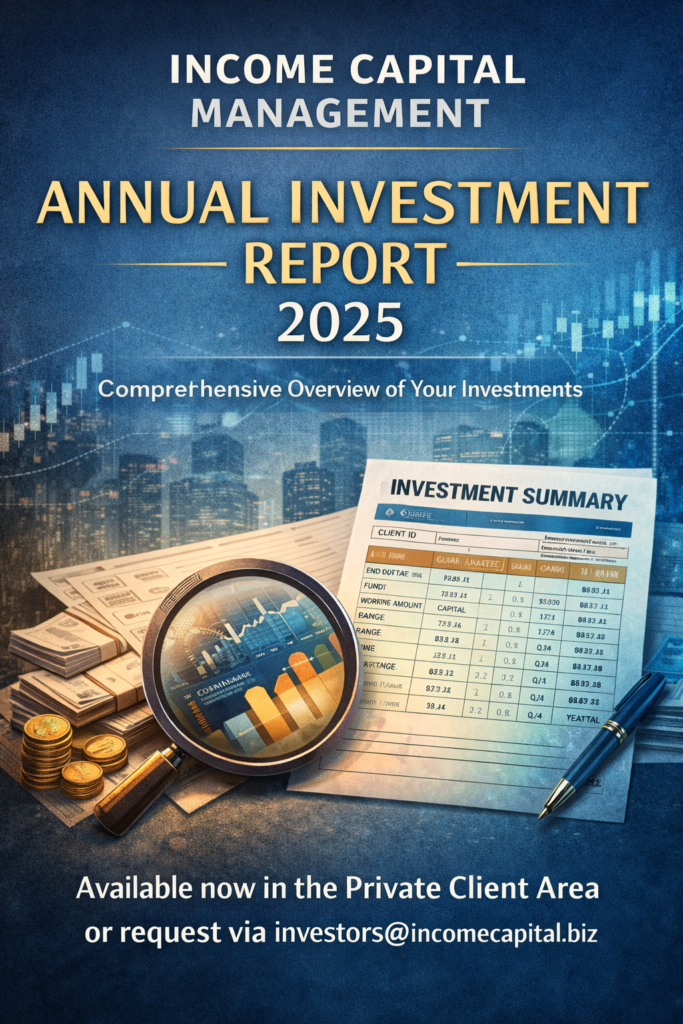
Annual Investment Report – 2025 INCOME CAPITAL MANAGEMENT informs all clients that the Annual Investment Report for the year 2025 is available for consultation and printing directly from the Private Client Area. Within the dedicated investment section, each client can view a comprehensive overview of their positions, including performance data, invested capital, and operational configurations, with information updated according to the reporting frequency applicable to each fund. Formal Annual Report Request Clients who wish to receive the official Annual Investment Report for 2025, formally issued by Income Capital Management s.r.o., are kindly requested to submit their request by email to: 📧 investors@incomecapital.biz Please ensure that the email includes the relevant Client ID (or Client IDs, in the case of multiple investments) for which the report is requested. The document will be prepared and delivered in accordance with internal verification and compliance procedures. Return Update Frequency Investment returns displayed on the investment page are updated according to the following schedule: Weekly for the FOREX FUND Monthly for all other funds (typically by the 4th day of the following month) If an investment did not start at the beginning of a standard quarter (January, April, July, October), returns are calculated and displayed on a pro-rata basis. Explanation of Table Fields Below is a description of the main fields displayed in the investment summary table: CLIENT ID: The client identification number assigned by Income Capital Management s.r.o. Clients with multiple investments will have multiple Client IDs. END DATE: The maturity or expiration date of the investment. FUND: The type of investment subscribed. GUARANTEED CAPITAL: The percentage of capital guaranteed, where applicable. WORKING AMOUNT: The operating capital on which returns are calculated. This amount does not include any reinvested profits. RANGE: The indicative annual return range, reflecting the risk level of the selected investment. Q1, Q2, Q3, Q4: Percentage and monetary value of any profit generated in the respective quarter, if applicable. YEARLY TOTAL: Total annual profit expressed as both a percentage and an amount in EUR. For clients who do not reinvest profits quarterly, this figure is shown only for the current quarter. CAPITAL + INVESTMENT: The total amount in EUR consisting of invested capital plus any profits generated during the year. REINVESTED PROFITS ON QUARTERLY BASIS: Indicates whether quarterly profit reinvestment has been selected. PAC AMOUNT ON QUARTERLY BASIS: Indicates whether a quarterly Capital Accumulation Plan (PAC) is active and the selected contribution amount. Support and Clarifications The team at INCOME CAPITAL MANAGEMENT remains fully available for any clarification or additional information regarding the annual report, investment data, or portfolio configurations. Kind regards, INCOME CAPITAL MANAGEMENT s.r.o.
INCOME CAPITAL MANAGEMENT Shines in H1 2025: Performance, Discipline, and Conviction
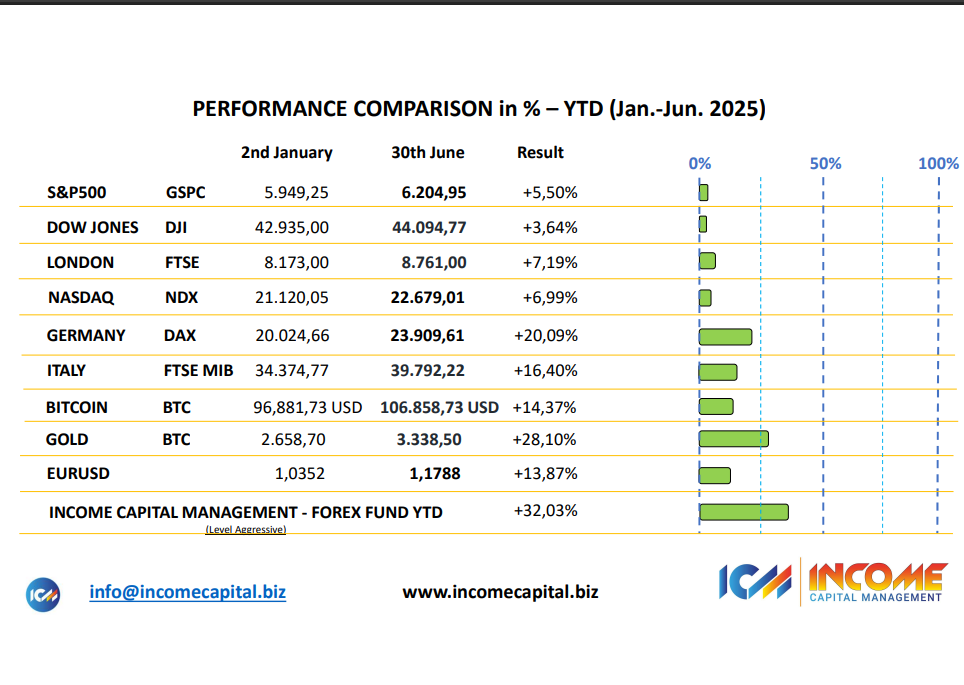
INCOME CAPITAL MANAGEMENT Shines in H1 2025: Performance, Discipline, and Conviction The first half of 2025 has been anything but simple for global financial markets. Persistent geopolitical tensions, fluctuating monetary policies, and ongoing macroeconomic uncertainty have created an environment where consistency and discipline matter more than bold predictions. Against this backdrop, INCOME CAPITAL MANAGEMENT delivered a solid and measurable result, confirming the robustness of its investment framework and the effectiveness of its risk-controlled execution. 📊 Strong Performance in a Challenging Environment During the first half of 2025, our Aggressive Investment Level achieved: +32.03% cumulative return (H1 2025) +62.08% cumulative return since April 2024 These figures are not the result of isolated market events or short-term positioning. They reflect a structured and repeatable investment process built around: Disciplined FX strategy execution Dynamic exposure management Continuous risk monitoring and adjustment Data-driven decision-making Past performance refers to the Aggressive Investment Level and is not indicative of future results. 📌 Structure Over Speculation As highlighted by our Founder & CEO, Paolo Volpicelli, performance is not driven by luck: “Our edge is not luck — it is structure, conviction, and execution.” At INCOME CAPITAL MANAGEMENT, we do not attempt to predict markets. Instead, we focus on understanding them, adapting to changing conditions, and maintaining a disciplined framework that prioritizes capital preservation alongside growth. In an environment where many strategies struggle to remain consistent, our approach continues to demonstrate resilience through methodical positioning and controlled risk exposure. 🔍 Transparency and Measurable Results We believe that performance should always be: Measurable – backed by real data Transparent – clearly reported and accessible Consistent – aligned with a defined investment process Our results reflect not only market opportunities but also the strength of a framework designed to operate effectively during both expansionary and volatile phases. 🔗 Further Insights For the original update and additional context, you can view the LinkedIn article here: View the original LinkedIn post → 🧠 Looking Ahead The first half of 2025 reinforces a key principle: in complex markets, conviction and consistency outperform noise and reaction. As we move into the second half of the year, our focus remains unchanged — protecting capital, managing risk intelligently, and delivering sustainable performance through disciplined execution. INCOME CAPITAL MANAGEMENT continues to build results through structure, not shortcuts.
Navigating Storms, Delivering Solid Results: Our First Half of 2025
Navigating Storms, Delivering Solid Results: Our First Half of 2025 The first half of 2025 has tested investors worldwide. Geopolitical tensions, persistent inflationary pressures, and volatile global markets have created an environment where consistency has been difficult to achieve and true outperformance even harder. Yet it is precisely during these phases that disciplined investment strategies reveal their value. A Market Environment Defined by Complexity The past six months can reasonably be described as a period of global instability. Financial markets have had to absorb overlapping shocks — from geopolitical uncertainty and shifting monetary policies to sudden changes in risk sentiment. In such an environment, remaining invested is not enough. Navigating volatility requires clarity of process, disciplined execution, and the ability to distinguish noise from structural opportunity. Performance That Reflects Method, Not Momentum At Income Capital Management, we do not aim to react to markets — we aim to understand them, structure around them, and outperform them through disciplined strategy. As we close the first half of 2025, the results of this approach are clearly visible: June 2025: +3.45% Q2 2025: +12.00% Year-to-Date (Jan–Jun 2025): +32.03% Cumulative since April 2024: +62.08% These figures refer to the Aggressive Investment Level of our flagship Forex strategy. As always, it is important to note that past performance is not indicative of future results. Why These Results Matter Outperformance in a strong market can be attributed to momentum. Outperformance in a fragile and uncertain market, however, reflects structure, risk control, and execution. Our results are the outcome of: A proprietary FX strategy built on active market analysis Disciplined risk management and exposure control Flexibility in adapting to rapidly changing market conditions Continuous focus on capital protection alongside return generation While many investors struggled to remain invested amid volatility, our strategy maintained coherence and direction. Conviction Over Noise Periods dominated by political headlines, central bank speculation, and short-term market reactions often tempt investors to abandon strategy in favor of emotion. We believe the opposite approach is required. In complex environments, capital seeks conviction, consistency, and process — not narratives. This philosophy has guided our decisions throughout the first half of 2025 and continues to shape our outlook for the months ahead. A Message to Investors To our investors, we extend our sincere appreciation for your continued trust. Your confidence allows us to execute strategies with discipline and long-term perspective. For those observing from the sidelines, this period serves as a reminder that sustainable performance is built through method, not speculation. A performance comparison chart related to this update is available on LinkedIn at the following link: View the performance update on LinkedIn As markets continue to evolve, our commitment remains unchanged: protecting capital, managing risk, and delivering consistent, transparent results.
Investment Returns: €10,000 Then vs Now — A 10-Year Comparison
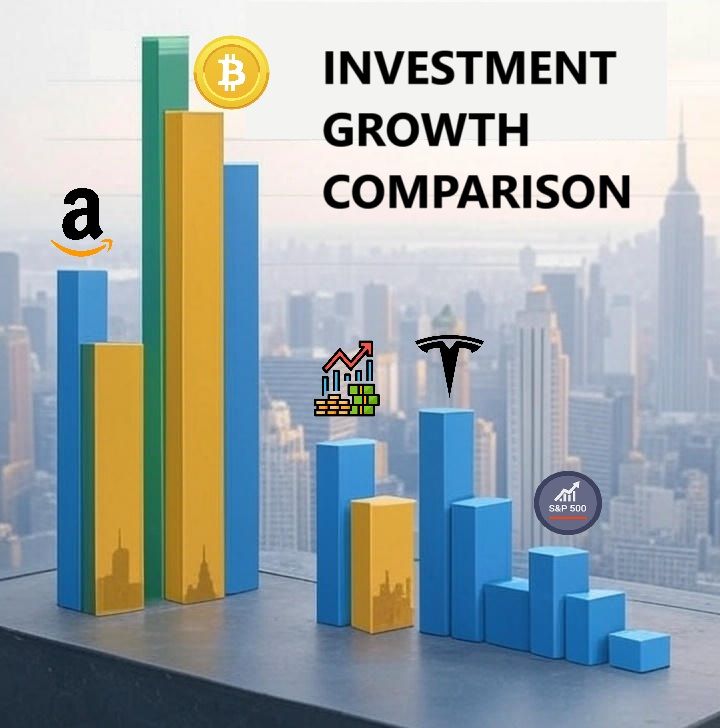
Investment Returns: €10,000 Then vs Now — A 10-Year Comparison Time is one of the most powerful variables in investing. Looking back over the past decade, the difference between asset classes becomes striking when performance is measured over a full market cycle rather than short-term movements. This analysis addresses a simple but fundamental question: What would €10,000 invested ten years ago be worth today? The comparison below highlights how different assets have behaved over time, illustrating the impact of growth, volatility, and risk management. Stock Market Indices Equity markets delivered solid long-term growth, with notable differences between regions. NASDAQ Composite: approximately +261% over 10 years S&P 500: approximately +170% over 10 years FTSE 100 (London): approximately +45% over 10 years FTSE MIB (Milan): approximately +50% over 10 years The data confirms the structural outperformance of U.S. markets, largely driven by technology and innovation-led growth. Individual Stocks Selecting individual equities amplified returns significantly, while also increasing volatility and concentration risk. Amazon: approximately +1,561% over 10 years Apple: approximately +1,193% over 10 years Microsoft: approximately +1,334% over 10 years Alphabet (Google): approximately +872% over 10 years Tesla: approximately +13,895% over 10 years These outcomes highlight the power of innovation — and the importance of managing downside risk when exposure is concentrated. Bitcoin Bitcoin represents the most extreme example of asymmetric risk and return. Bitcoin: approximately +39,800% over 10 years Such performance came with extreme volatility, sharp drawdowns, and regulatory uncertainty — factors that require careful sizing within a diversified portfolio. Gold Gold continued to serve as a long-term store of value and defensive asset. Gold: approximately +126% total return over 10 years While returns were lower than equities, gold provided stability during periods of inflation and market stress. Real Estate (Value Appreciation) Property markets delivered mixed results depending on geography and local fundamentals. New York: approximately +35% over 10 years London: approximately +40% over 10 years Milan: approximately +25% over 10 years Dubai: approximately +90% over 10 years Dubai stands out for its strong appreciation, supported by international capital flows and favorable economic policies. The Income Capital Forex Fund Perspective Based on historical assumptions, a €10,000 investment in the Income Capital Forex Fund over the same ten-year horizon would have generated approximately +500%. This performance would place the strategy: Above traditional equity indices Well ahead of gold and most real estate markets Below high-volatility assets such as Bitcoin The differentiating factor remains a disciplined framework combining active management, structured risk control, and consistent execution. Key Takeaways High Risk, High Reward: Crypto and select equities delivered exceptional returns, but with extreme volatility. Technology Leadership: Innovation-driven companies reshaped long-term equity performance. Stability vs Growth: Gold and real estate offered resilience rather than explosive growth. Diversification Matters: Balanced portfolios reduce volatility while preserving long-term opportunity. Final Consideration Investment success is not about chasing the best-performing asset, but about constructing a portfolio that aligns risk, time horizon, and objectives. Consistency, diversification, and discipline remain the foundations of long-term capital growth. Original LinkedIn post: View the discussion on LinkedIn
INCOME CAPITAL FOREX FUND – Questions & Answers (April 2024)

INCOME CAPITAL FOREX FUND – Questions & Answers (April 2024) What is the INCOME CAPITAL FOREX Fund? The INCOME CAPITAL FOREX Fund is an investment fund managed by INCOME CAPITAL MANAGEMENT s.r.o. that operates in the global foreign exchange (FX) market. Its objective is capital appreciation through active currency trading using a structured and risk-controlled approach. What does the Fund invest in? The Fund trades major currency pairs, primarily: EUR/USD EUR/GBP GBP/USD Trading activity is focused on liquid FX markets, allowing efficient execution and continuous risk monitoring. What is the investment objective of the Fund? The objective is to generate returns through active forex trading while applying disciplined risk management. The Fund does not aim to guarantee profits and does not eliminate market risk. What type of strategy does the Fund use? The Fund adopts an active trading strategy with a scalping-oriented approach, meaning it takes advantage of short-term price movements in the currency markets. Investment decisions are supported by: Fundamental analysis (macroeconomic data, interest rates, geopolitical events) Technical analysis (price patterns, market behavior) Technology-supported execution systems Does the Fund use Artificial Intelligence? Yes. The Fund uses AI and algorithmic tools to support market analysis and trade execution. AI is used to: Analyze large datasets of historical and live market data Identify patterns and market signals Support decision-making and execution efficiency AI does not operate independently and is always subject to human oversight and risk controls. Who manages the Fund? The Fund is managed by professional fund managers supported by financial analysts, automated trading systems (Expert Advisors), and risk management and compliance teams. Human supervision remains central to the investment process. What is the risk level of the Forex Fund? The Forex Fund has a medium-to-high risk profile. Foreign exchange markets are volatile, and losses can occur, including partial or total loss of invested capital depending on the investment level chosen. What are the main risks involved? Key risks include: Market and volatility risk Currency risk Liquidity risk Technological and system risk Operational and regulatory risk Investors should carefully assess their risk tolerance before investing. How does the Fund manage risk? Risk management measures include position sizing rules, stop-loss mechanisms, continuous monitoring of market exposure, diversification of trading positions, and compliance with regulatory standards. Risk is actively managed but cannot be eliminated. Are there different investment levels? Yes. The Fund offers four investment levels: Conservative – lower risk, partial capital protection, lower return range Mild-Conservative – balanced approach between risk and protection Mild-Aggressive – higher risk with higher potential returns Aggressive – highest risk and highest return potential Each level has a defined expected return range and capital protection structure, where applicable. Is capital guaranteed? Capital protection depends on the selected investment level. Some levels offer partial capital protection, while others are fully exposed to market risk. Capital is never fully guaranteed. How often are returns updated? Returns are updated weekly for the Forex Fund. Performance is calculated based on the working amount invested. Returns may vary depending on market conditions. What fees apply to the Forex Fund? There are no entry fees and no fixed management fees. A performance fee is applied only on realized net profits. Compliance-related onboarding costs (KYC/AML) are borne by the investor. Can an investor exit before maturity? Yes. Early exit is possible under predefined conditions. Fees or penalties may apply depending on the investment level, duration of the investment, and timing of the withdrawal. Details are specified in the official documentation. Who can invest in the Forex Fund? The Fund is intended for investors who understand financial markets and FX trading risks, are comfortable with medium-to-high risk investments, and have a medium to long-term investment horizon. The Fund may not be suitable for all investors. Is the Fund regulated? Yes. INCOME CAPITAL MANAGEMENT s.r.o. operates under the supervision of the Czech National Bank, in accordance with applicable regulations. All investors are subject to KYC, AML, and PEP checks. How is transparency ensured? Transparency is ensured through regular performance reporting, access to investment data via the private client area, dedicated investor support, and clear documentation outlining risks, fees, and strategy. Where can investors find official documentation? Official documentation, including the KID, is provided during onboarding and is available upon request from INCOME CAPITAL MANAGEMENT. Is this information investment advice? No. This information is provided for educational and informational purposes only and does not constitute investment advice. Investors should seek independent professional advice before making any investment decision.

