Discipline Beats Intelligence: The Behavioral Side of Managing Money

Discipline Beats Intelligence: The Behavioral Side of Managing Money Intelligence helps you understand markets. Discipline helps you survive them. Most investment mistakes do not come from lack of knowledge. The information needed to avoid the classic errors, from overconcentration to performance chasing to panic selling, has been publicly available for decades, and the people who make these mistakes are frequently the ones best equipped to explain why they are mistakes. The gap is behavioral rather than analytical: it is the distance between what an investor knows and what an investor consistently does. Investment discipline is what closes that gap. Where returns are actually lost Long-term results are rarely destroyed by one catastrophic call. They erode through repeated small errors: adding to a position because it just performed well, cutting one because a headline was frightening, drifting from the strategy in month eight because month seven was uncomfortable. Each individual deviation looks minor. Compounded across years, the sequence of small inconsistencies routinely costs more than any single bad investment. This is why consistency is itself a strategy. A merely good process applied without exception tends to beat a brilliant process applied selectively, because the brilliant process applied selectively has stopped being a process at all. It has become a series of moods with a framework attached. Overconfidence: the quietest risk in the portfolio Among behavioral risks, overconfidence deserves special attention because it grows silently and feeds on success. It makes good investors too aggressive, too concentrated, and too dismissive of warning signs, and it becomes strongest exactly when recent results seem to justify it. The market environment that most rewards a strategy is also the one that most inflates its manager’s confidence, which is how risk quietly concentrates at the top of a cycle. Overconfidence cannot be removed by self-awareness alone; nobody feels overconfident from the inside. It has to be countered structurally: objective data instead of narrative, scenario checks that ask what happens if the thesis is wrong, and scheduled portfolio reviews that happen on the calendar rather than when someone feels the need. Confidence is useful only when it is supported by evidence. Without that support, it is a blind spot with good posture. What clients should actually expect from advice The same logic extends to the relationship between a manager and a client. Good financial advice creates clarity, not excitement. When a client leaves a conversation calmer, more focused and more aware of the trade-offs involved, the advice has probably done its job. Urgency, by contrast, is a sales instrument. Markets full of noise reward the professionals who sell it briefly, and the clients who ignore it permanently. A strong client relationship in finance rests on three things. Honesty: saying what the risk really is, including when the honest answer is unwelcome. Consistency: being available and dependable across market conditions, not only in good quarters. Relevance: advice matched to the client’s actual life, meaning cash flow needs, time horizon and obligations, rather than to a generic model portfolio. Trust in this business comes from many clear meetings, not from one good one. Cash flow deserves particular emphasis, because it is where portfolio theory meets daily life. A strategy that looks optimal on paper but cannot support the client’s income needs, reinvestment goals and unexpected expenses will eventually be abandoned at the worst possible moment, and an abandoned strategy returns whatever the panic exit produced. When money has a defined purpose, decisions become cleaner and risk becomes genuinely easier to manage, because the question of how much risk the client can afford finally has a concrete answer. Process as the bridge between knowing and doing The common solution to every problem in this article is the same: move decisions out of the moment and into the process. Rules for position sizing decided before the position exists. Review dates set before performance makes them comfortable or uncomfortable. Risk limits defined when nobody is afraid, so they are available when everybody is. Discipline, framed this way, is less a personality trait than an engineering choice: the deliberate construction of an environment in which the right behavior is the default and the wrong behavior requires effort. Intelligent investors who build that environment keep their intelligence usable under stress. Intelligent investors who rely on willpower discover, at the worst moment, that willpower is the first casualty of a drawdown. The structural side of that environment, from stressed correlations to explicit risk budgets, is covered in our article on correlation risk and diversification. This article expands on a recent LinkedIn post by Paolo Volpicelli on why discipline outperforms intelligence in markets. This article is provided for informational and educational purposes only. It does not constitute investment advice, an offer, or a solicitation to invest in any product or service. Income Capital Management s.r.o. is registered under §15 of the Czech Act on Investment Companies and Investment Funds (ZISIF). Past performance is not indicative of future results.
When Diversification Fails: Correlation, Stress, and the Architecture of Capital Protection
When Diversification Fails: Correlation, Stress, and the Architecture of Capital Protection Most portfolios are designed in calm markets and tested in difficult ones. The gap between those two environments is where most investment damage happens, and it rarely comes from a single bad position. It comes from structure: assets that were supposed to behave independently start moving together, liquidity that was supposed to be available disappears, and decisions that were supposed to be optional become forced. This article looks at portfolio construction through the lens of correlation risk: what risk actually is, which signals tend to precede market moves, how risk budgets discipline allocation, why currency exposure has to be managed, and why capital protection is a structural choice before anything else. It complements our complete guide to portfolio risk management. What risk really means inside a portfolio Risk is often treated as a synonym for volatility. Volatility is visible, easy to measure and easy to report, so it dominates the conversation. But volatility is a symptom, and a portfolio can have low volatility while carrying serious risk underneath. Real risk takes three main forms. The first is permanent loss of capital: a drawdown from which the portfolio cannot recover within the investor’s time horizon. The second is liquidity stress: positions that cannot be exited at a reasonable price when exit becomes necessary. The third is forced decisions at the wrong time: situations where margin calls, redemption pressure or cash flow needs push the investor to sell exactly when prices are worst. A portfolio should be analyzed less for its short-term movement and more for its structural weaknesses under stress. A fund can post smooth monthly returns for years while holding concentrated, illiquid or highly correlated exposures. When conditions turn, the structure decides the outcome, and the smoothness of the past says very little about it. Managing risk, in practice, means controlling how exposure behaves rather than avoiding exposure altogether: knowing in advance what each position can do to the portfolio in an adverse scenario, and making sure that no single scenario can force decisions the strategy was never designed to take. Correlation risk: the hidden structure beneath diversification Diversification is the most repeated idea in portfolio construction and one of the most misunderstood. The number of assets you own matters far less than whether those assets behave differently under stress. During stable markets, almost any collection of assets looks diversified. Prices move for idiosyncratic reasons, correlations stay moderate, and the portfolio’s aggregate volatility sits comfortably below the sum of its parts. The problem is that this picture describes exactly the environment in which diversification is least needed. Under stress, correlations rise. Equities, credit and many alternatives that seemed independent begin responding to the same variables: liquidity conditions, risk appetite, forced selling. The protection that diversification was supposed to provide shrinks precisely when it is needed most. The practical consequence is that correlation analysis has to be done on stressed data. What matters in risk management are the extremes, not the averages. The relevant question for any pair of exposures is how they moved together in the worst months of the last fifteen years, not how they moved together on average over the last three. Real diversification is built before stress appears. It cannot be improvised during it. This is also why managing correlation risk is a process rather than a checklist. Correlation structure changes with the macro environment, with rate regimes, inflation dynamics and liquidity cycles, so the analysis has to be repeated over time rather than archived. Three stress episodes and what they revealed The abstract argument becomes concrete when tested against the last two decades of market history. Three episodes in particular show, each in a different way, how portfolio structure decided the outcome. In 2008, a typical institutional allocation went into the crisis holding equities across regions, corporate credit, commodities, listed real estate and a layer of hedge fund strategies. On paper, five or six asset classes; in the crisis, essentially one position. As leverage unwound and liquidity vanished, correlations across risk assets converged toward one. Global equities fell together regardless of region, credit spreads blew out alongside them, commodities collapsed in the second half of the year, and many hedge fund strategies that had marketed themselves as uncorrelated turned out to be short liquidity, the very factor driving everything else. The assets that actually protected capital, principally government bonds, were the ones many portfolios had reduced because their expected returns looked unattractive. The lesson was structural: those portfolios had diversified their line items, but they had never diversified their risk. March 2020 compressed a full cycle of stress into three weeks and added a harsher lesson. In the most acute phase, the dash for cash was so violent that even long-dated US Treasuries and gold, the textbook safe havens, sold off alongside equities for several sessions, as leveraged holders liquidated whatever still had a bid. Market depth in instruments normally considered among the most liquid in the world deteriorated sharply, and bid-ask spreads widened to levels that made repositioning expensive at precisely the moment repositioning was most needed. The episode demonstrated that liquidity is a property of the environment, not of the asset, and that a crisis plan cannot assume the ability to transact anywhere near last quoted prices. The third episode, 2022, involved no crash and no panic, which makes it the most instructive. For two decades, the negative correlation between equities and government bonds had been the load-bearing assumption of the classic 60/40 portfolio: when stocks fell, bonds rallied, and the blend smoothed the ride. In 2022, an inflation-driven tightening cycle broke that relationship. Stocks and bonds fell together. US equities lost roughly a fifth of their value while aggregate bond indices posted double-digit losses, producing one of the worst years for balanced portfolios in half a century. Nothing exotic failed; the correlation regime simply changed with the macro environment, exactly as it had in earlier inflationary decades. Investors whose risk models
Real Estate as a Portfolio Stabilizer: A Complete Guide to Diversification with Property

Most investors understand, at least in theory, that putting everything into a single asset class is a mistake. Yet when you look at how private portfolios are actually constructed, you find something curious: real estate tends to be treated as an afterthought, a parallel world that operates separately from the main investment strategy. It sits in its own mental category, governed more by instinct, local familiarity or a broker’s recommendation than by any coherent portfolio logic. This disconnect is costly, and it persists largely because real estate portfolio diversification is one of the most discussed but least rigorously applied concepts in wealth management. What follows is a serious attempt to address that gap. This article is not a general case for property investment. It is a detailed examination of how real estate, when properly selected and integrated, changes the behavior of a multi-asset portfolio in ways that few other asset classes can replicate. We will cover the mechanics of diversification, the role of income generation, the importance of quality and location, the specific challenges that international investors face, and the discipline required to manage liquidity and risk within a real estate allocation. Throughout, the emphasis is on substance over simplicity: real estate portfolio diversification is a precise practice, not a general principle. What Portfolio Stabilization Actually Means Before examining real estate specifically, it is worth clarifying what stabilization means in a portfolio context. Many investors use the term loosely, treating it as a synonym for safety or capital preservation. In practice, stabilization refers to something more specific: the reduction of portfolio-level volatility without a corresponding reduction in expected return, achieved by combining assets that do not move in lockstep with each other. The mathematical foundation of this idea is correlation. When two assets have a correlation of 1.0, they move perfectly together, and combining them offers no diversification benefit. When their correlation is negative or close to zero, their movements offset each other, smoothing the overall portfolio trajectory. The stabilizing power of any asset depends not just on its individual return characteristics but on how those characteristics interact with everything else in the portfolio. Real estate occupies an interesting position in this framework. Its correlation with equities is moderate rather than negligible, meaning it does not completely decouple from stock market movements, particularly in periods of severe stress. But over normal market cycles, property returns follow a path driven by different forces: rental income, local supply and demand dynamics, tenant creditworthiness, interest rate levels, and the specific economic conditions of the sectors and geographies involved. These forces create a return stream that complements equities, fixed income, and other asset classes in ways that measurably improve portfolio efficiency. Understanding this is the difference between adding real estate to a portfolio as a diversifier and adding it as a separate bet. A diversifier is chosen for what it does to the whole. A standalone bet is chosen for what it is expected to do on its own. The former is a portfolio decision. The latter is speculation dressed up in respectable language. The Historical Case for Real Estate in Multi-Asset Portfolios Decades of data across multiple countries and property types support the inclusion of real estate as a structural element in diversified portfolios. In developed markets, commercial real estate has historically delivered long-term total returns in the range of six to nine percent annually, combining income yields of four to six percent with modest capital appreciation. These returns have been achieved with lower volatility than equities and with patterns of drawdown that, while significant in downturns like 2008 to 2009, tend to recover over longer cycles than many investors expect. The income component deserves particular attention. Unlike equities, where dividends are discretionary and can be suspended, real estate typically generates contractual cash flows through lease agreements. Commercial leases in particular often have durations of three, five, or ten years, creating an income stream that is more predictable than almost anything available in public markets at comparable yield levels. This predictability has significant value for investors with defined cash flow needs, including family offices, pension-like structures, and high-net-worth individuals funding ongoing expenditures. During periods of rising inflation, real estate has historically maintained its purchasing power better than most financial assets. Property values and rents tend to rise with general price levels, often with contractual provisions for annual rent escalation built directly into lease agreements. The result is an asset that provides a degree of inflation protection that bonds, in particular, are unable to offer. This characteristic becomes especially relevant in the current environment, where investors who rely too heavily on fixed income face real return erosion that is difficult to recover. The historical evidence also shows that real estate’s return cycle is genuinely different from that of equities. Property values do not recalibrate daily in response to earnings announcements or central bank statements. They respond to physical supply and demand, to construction cycles that take years to play out, and to economic conditions that affect businesses’ need for space. This slower dynamic creates periods when real estate performs well precisely when equity markets struggle, and vice versa, which is exactly what a portfolio stabilizer should do. Understanding Real Estate’s Correlation Behavior One of the most important and least understood aspects of real estate portfolio diversification is the way correlation between property and other assets changes depending on market conditions. This phenomenon, sometimes called correlation instability, affects virtually all asset classes but has specific implications for real estate. Under normal conditions, direct real estate, meaning physical property held directly or through private vehicles, exhibits correlations with equity markets that are low to moderate, typically ranging from 0.2 to 0.4 depending on the measurement period and the specific property types involved. This is a meaningful diversification benefit. A portfolio that is sixty percent equities and twenty percent direct real estate behaves substantially differently from a pure equity portfolio when markets are in normal mode. During severe crises, correlations tend to rise across most
Scenario Planning: Preparing Portfolios for Multiple Futures

Scenario Planning: Preparing Portfolios for Multiple Futures Uncertainty is not an exception in financial markets. It is the baseline condition. What changes from one decade to another is not whether volatility will occur, but what form it will take: inflationary spirals, deflationary recessions, geopolitical fragmentation, technological disruption, liquidity shocks or unexpected growth acceleration. At Income Capital Management, we do not attempt to predict a single future. Instead, we prepare portfolios for multiple plausible futures through structured scenario planning. Preparedness is not pessimism. It is discipline. Why Scenario Planning Matters More Today Over the past twenty years, global markets have experienced: Financial crises and banking collapses Zero interest rate regimes Quantitative easing cycles Inflation resurgence Geopolitical realignments Commodity supercycles Digital asset emergence Traditional static allocation models assume historical averages will repeat. Scenario planning acknowledges structural shifts. Instead of asking “What will happen?”, we ask: “If this happens, how exposed are we?” The Core Scenarios We Model 1. Inflationary Expansion Persistent inflation driven by supply constraints, wage growth or fiscal stimulus. Key stress points: Duration risk in bonds Margin compression in equities Currency depreciation pressure Portfolio response: Selective real assets exposure Shorter duration credit positioning Currency diversification via Forex strategies Gold allocation as inflation hedge 2. Deflationary Slowdown Demand contraction, falling prices, tightening credit. Stress points: Corporate earnings compression High-yield default risk Commodity weakness Portfolio response: Quality bias in equities Higher liquidity buffers Selective sovereign duration exposure Reduced cyclical positioning 3. Geopolitical Fragmentation Trade barriers, capital controls, currency volatility. Stress points: Emerging market capital flows Commodity supply disruption FX volatility spikes Portfolio response: Active currency management Physical gold allocation Diversified regional exposure Reduced concentration risk 4. Growth Acceleration and Technological Expansion Productivity gains, capital expenditure cycle, innovation-driven growth. Stress points: Overvaluation risk Liquidity mispricing Speculative excess Portfolio response: Disciplined growth allocation Profit-taking rules Rebalancing discipline Scenario Planning Is Not Forecasting Forecasting attempts to identify the most likely outcome. Scenario planning accepts that multiple outcomes are plausible. The difference is philosophical: Forecasting seeks precision. Scenario planning builds resilience. Markets punish overconfidence more than uncertainty. Stress Testing in Practice For each client portfolio, we simulate: Interest rate shocks Equity drawdowns Credit spread widening Currency realignments Commodity spikes We measure: Expected drawdown Liquidity resilience Recovery time estimates Correlation shifts This transforms abstract risk into tangible visibility. Multi-Asset Integration Scenario planning only works when portfolios are genuinely diversified. Our framework integrates: Forex strategies for currency adaptability Real Estate exposure for income stability High Yield for calibrated income generation Global Growth for capital appreciation Physical Gold for tail-risk mitigation Each engine behaves differently under stress. The objective is not perfection in any single environment. It is durability across environments. The Psychological Advantage of Preparedness Investors often panic when markets fall because they have not visualized downside scenarios beforehand. When clients have already seen modeled stress cases, volatility becomes contextual, not catastrophic. Confidence grows from preparation. Adaptive Rebalancing Scenario planning is dynamic. As macro signals shift: Inflation expectations adjust Central bank trajectories evolve Growth indicators accelerate or contract We recalibrate exposure incrementally, not reactively. Why This Matters for Long-Term Wealth Long-term compounding depends more on avoiding large losses than chasing maximum gains. A 40% drawdown requires a 67% recovery. Scenario discipline reduces catastrophic exposure. Flexibility as a Strategic Asset Flexibility does not mean constant change. It means optionality: Liquidity to act Currency hedging tools Asset allocation agility Rigid portfolios break under structural change. Adaptive portfolios adjust. Preparing for What We Cannot See The next crisis will not look like the previous one. But structural preparation remains consistent: Diversification Liquidity discipline Risk transparency Scenario modeling Conclusion Uncertainty is constant. Preparedness is a choice. Scenario planning transforms fear of the unknown into structured readiness. At Income Capital Management, we do not attempt to control the future. We prepare portfolios to survive and adapt within it. LinkedIn Post: https://www.linkedin.com/feed/update/urn:li:activity:7431616318816182272
Confidence, Emerging Markets and Debt Investment: Navigating Opportunity Through Structure

Confidence, Emerging Markets and Debt Investment: Navigating Opportunity Through Structure In a global financial environment shaped by uncertainty, confidence is not a sentiment — it is the result of structure, discipline, and informed decision-making. Emerging markets continue to attract investor attention, not because they are simple, but because they offer opportunities that are often uncorrelated with traditional developed markets. Within this context, debt investments play a strategic role, combining yield potential with structured risk management when approached correctly. Why Confidence Matters in Emerging Markets Emerging markets are frequently associated with volatility, political risk, and uneven growth cycles. While these factors are real, they also create inefficiencies — and inefficiencies are precisely where disciplined investors can find value. Confidence in this space does not come from speculation. It comes from: Careful jurisdiction and counterparty selection Clear legal and regulatory frameworks Defined risk parameters and exit strategies Continuous monitoring of macroeconomic and geopolitical dynamics When these elements are in place, emerging market exposure becomes a calculated allocation rather than a leap of faith. The Strategic Role of Debt Investment Debt investment represents a different approach compared to pure equity exposure. Instead of relying solely on growth narratives, debt strategies focus on contractual cash flows, capital structure positioning, and downside protection. In emerging markets, this approach can be particularly effective. Well-structured debt instruments may offer: Predictable income streams Priority positioning in the capital structure Lower volatility compared to equity investments Improved portfolio diversification The key lies in rigorous due diligence and conservative structuring — elements that transform complexity into opportunity. From Perceived Risk to Managed Exposure Risk in emerging markets is often misunderstood. The real risk is not volatility itself, but the absence of controls, transparency, and governance. By focusing on structured debt solutions, investors can access emerging market opportunities while maintaining alignment with capital preservation objectives. This approach shifts the narrative from speculative exposure to intentional allocation. Confidence as a Competitive Advantage In periods where global markets oscillate between optimism and fear, confidence becomes a differentiating factor. Not blind confidence, but informed confidence — built on data, structure, and experience. At INCOME CAPITAL MANAGEMENT, confidence is the outcome of method. Our investment philosophy emphasizes clarity over complexity and structure over narratives, particularly when operating in less conventional markets. A Measured Path Forward Emerging markets and debt investments are not designed for short-term speculation. They are components of a broader strategy aimed at diversification, income generation, and long-term resilience. By combining disciplined risk management with selective exposure, it is possible to navigate complexity without compromising on control. INCOME CAPITAL MANAGEMENT s.r.o. 🔗 Related LinkedIn post: Confidence, Emerging Markets and Debt Investment
Annual Investment Report – 2025

Annual Investment Report – 2025 INCOME CAPITAL MANAGEMENT informs all clients that the Annual Investment Report for the year 2025 is available for consultation and printing directly from the Private Client Area. Within the dedicated investment section, each client can view a comprehensive overview of their positions, including performance data, invested capital, and operational configurations, with information updated according to the reporting frequency applicable to each fund. Formal Annual Report Request Clients who wish to receive the official Annual Investment Report for 2025, formally issued by Income Capital Management s.r.o., are kindly requested to submit their request by email to: 📧 investors@incomecapital.biz Please ensure that the email includes the relevant Client ID (or Client IDs, in the case of multiple investments) for which the report is requested. The document will be prepared and delivered in accordance with internal verification and compliance procedures. Return Update Frequency Investment returns displayed on the investment page are updated according to the following schedule: Weekly for the FOREX FUND Monthly for all other funds (typically by the 4th day of the following month) If an investment did not start at the beginning of a standard quarter (January, April, July, October), returns are calculated and displayed on a pro-rata basis. Explanation of Table Fields Below is a description of the main fields displayed in the investment summary table: CLIENT ID: The client identification number assigned by Income Capital Management s.r.o. Clients with multiple investments will have multiple Client IDs. END DATE: The maturity or expiration date of the investment. FUND: The type of investment subscribed. GUARANTEED CAPITAL: The percentage of capital guaranteed, where applicable. WORKING AMOUNT: The operating capital on which returns are calculated. This amount does not include any reinvested profits. RANGE: The indicative annual return range, reflecting the risk level of the selected investment. Q1, Q2, Q3, Q4: Percentage and monetary value of any profit generated in the respective quarter, if applicable. YEARLY TOTAL: Total annual profit expressed as both a percentage and an amount in EUR. For clients who do not reinvest profits quarterly, this figure is shown only for the current quarter. CAPITAL + INVESTMENT: The total amount in EUR consisting of invested capital plus any profits generated during the year. REINVESTED PROFITS ON QUARTERLY BASIS: Indicates whether quarterly profit reinvestment has been selected. PAC AMOUNT ON QUARTERLY BASIS: Indicates whether a quarterly Capital Accumulation Plan (PAC) is active and the selected contribution amount. Support and Clarifications The team at INCOME CAPITAL MANAGEMENT remains fully available for any clarification or additional information regarding the annual report, investment data, or portfolio configurations. Kind regards, INCOME CAPITAL MANAGEMENT s.r.o.
New Year, New Horizons: Income Capital’s Vision for 2026

New Year, New Horizons – Income Capital’s Vision for 2026 The beginning of a new year is never just a symbolic milestone. In finance, it represents a moment of recalibration: a time to assess what has worked, what has not, and how to move forward in an environment that continues to evolve at increasing speed. As we enter 2026, global financial markets remain shaped by multiple overlapping forces—technological acceleration, geopolitical uncertainty, shifting monetary policies, and changing investor behavior. These dynamics do not simply create volatility; they redefine how capital is managed, protected, and grown over time. At Income Capital Management, we view this phase not as a challenge to react to, but as an opportunity to reinforce structure, discipline, and long-term perspective. Lessons from 2025: Structure Over Speed The past year has once again demonstrated that resilience is not built through rapid reactions or short-term positioning. Markets rewarded preparation, clarity, and disciplined execution far more than tactical opportunism. Periods of volatility highlighted a fundamental truth: portfolios that are built on coherent frameworks, risk awareness, and transparent decision-making are better equipped to navigate uncertainty without compromising long-term objectives. This experience continues to shape our strategic outlook for 2026. A Vision Grounded in Core Principles Our vision for the year ahead remains anchored in three foundational pillars that guide both our investment philosophy and our advisory activities: Innovation — not as an end in itself, but as a tool to enhance analytical depth, portfolio construction, and monitoring capabilities Transparency — as the cornerstone of trust, accountability, and durable client relationships Client success — defined not by short-term performance, but by consistency, capital protection, and alignment of interests These principles act as a filter through which every strategic decision is evaluated, particularly in complex or uncertain market phases. Technology as an Enabler, Not a Replacement Technology continues to play an increasingly central role in modern investment management. Advanced analytics, automation, and data integration allow for faster insights and more efficient processes. However, technology alone does not generate sustainable outcomes. It must be embedded within a disciplined framework and guided by experience, judgment, and accountability. At Income Capital Management, technological tools are used to support decision-making—not to replace it. Human expertise remains at the core of portfolio oversight, risk assessment, and strategic allocation. Expanding Capabilities in a Changing Landscape Investor needs are evolving alongside markets. As capital allocation becomes more complex, the demand for structured guidance, clarity, and adaptability continues to grow. In 2026, our focus is on expanding capabilities while strengthening strategic partnerships. This allows us to remain flexible across asset classes, investment horizons, and market regimes, without compromising discipline. Rather than pursuing short-term trends, our approach emphasizes preparation, selectivity, and long-term value creation. Looking Ahead with Intention New horizons do not emerge by chance. They are the result of deliberate choices, consistent execution, and continuous learning. As we move into 2026, our commitment remains clear: to navigate complexity with clarity, to manage risk with discipline, and to build sustainable outcomes over time. Originally published on LinkedIn: Read the original post on LinkedIn This content is provided for informational purposes only and does not constitute investment advice or a solicitation to the public. Past performance is not indicative of future results.
The Role of Technology in Enhancing Client Advisory Services

The Role of Technology in Enhancing Client Advisory Services Technology has profoundly reshaped the way financial advisory services are delivered. Yet, despite rapid innovation, the essence of effective advisory work remains unchanged: understanding client objectives, managing risk responsibly, and supporting informed decision-making over time. In today’s financial landscape, technology does not replace advisory relationships, it strengthens them. When applied with discipline and intent, digital tools enhance clarity, efficiency, and transparency, allowing advisors to focus on what truly matters. From Data to Meaningful Insight Modern advisory services operate in an environment defined by data abundance. Markets generate vast amounts of information every second, ranging from price movements to macroeconomic indicators and portfolio-level metrics. Technology enables this data to be collected, processed, and analyzed efficiently. Advanced analytics support deeper insight into portfolio behavior, risk exposure, and correlations across asset classes, capabilities that were once accessible only to large institutions. However, data alone does not create value. Its interpretation, contextualization, and translation into actionable guidance remain fundamentally human responsibilities. Technology as a Support for Better Decisions Digital tools enhance advisory services by improving the quality and timeliness of information available to both advisors and clients. Real-time monitoring, scenario analysis, and structured reporting allow for clearer discussions around portfolio positioning and risk trade-offs. This supports more informed decisions, particularly during periods of market stress or heightened uncertainty. Technology, in this sense, acts as a decision-support framework, reducing noise while improving visibility. Strengthening Transparency and Trust Transparency is a cornerstone of long-term advisory relationships. Clients increasingly expect not only results, but also clarity around how decisions are made and how risks are managed. Technology facilitates this transparency by enabling consistent reporting, traceability of decisions, and clear communication of portfolio dynamics. When clients understand both the rationale behind strategies and the risks involved, trust becomes more resilient, especially during volatile market phases. Human Expertise Remains Central Despite technological progress, advisory services cannot be automated in their entirety. Experience, judgment, and empathy remain essential components of effective client relationships. Technology amplifies human expertise by removing inefficiencies and improving analytical depth, but it does not replace professional responsibility. The strongest advisory outcomes emerge when technology and human insight operate together within a disciplined framework. Conclusion The role of technology in client advisory services is not to redefine relationships, but to enhance them. By supporting analysis, transparency, and communication, technology allows advisors to deliver clearer guidance and more resilient strategies, while keeping client objectives at the center of every decision. Originally published on LinkedIn: Read the original post on LinkedIn This content is provided for informational purposes only and does not constitute investment advice or a solicitation to the public.
Lessons in Crisis Management from 2025 Markets

Lessons in Crisis Management from 2025 Markets Periods of market stress are often remembered for their volatility, but their true value lies in the lessons they reveal. The market dynamics experienced throughout 2025 once again demonstrated how crises test not only portfolios, but also decision-making frameworks, risk discipline, and investor behavior. While every market cycle has its own characteristics, the underlying principles of effective crisis management remain remarkably consistent. Volatility as a Stress Test Market volatility is not an anomaly, it is an intrinsic feature of financial systems. During calmer phases, structural weaknesses may remain hidden. In contrast, periods of stress expose how portfolios are constructed and how risk is truly managed. The volatility observed in 2025 served as a real-time stress test, highlighting the importance of diversification, liquidity awareness, and predefined risk controls. Discipline Over Reaction One of the most common challenges during market turbulence is the temptation to react emotionally. Sudden price movements can lead to decisions driven by fear or urgency rather than analysis. Effective crisis management relies on discipline: the ability to adhere to established frameworks even when market signals appear contradictory or unsettling. Portfolios guided by structured allocation rules and risk parameters are better positioned to absorb shocks without compromising long-term objectives. Preparation Happens Before the Crisis Crises are rarely managed successfully in real time without prior preparation. Portfolio resilience is built during stable periods, through thoughtful asset allocation, scenario analysis, and continuous monitoring. Risk management tools, diversification strategies, and liquidity planning play a critical role long before volatility materializes. When uncertainty rises, preparation allows investors to respond with clarity rather than urgency. The Role of Communication During market stress, communication becomes as important as portfolio construction. Transparent and timely dialogue helps align expectations and reduce the risk of reactive decisions. Clear explanations of portfolio positioning, risk exposure, and strategic intent support investor confidence, even in challenging conditions. Adaptability Within a Framework Discipline does not imply rigidity. Effective crisis management balances adherence to core principles with the flexibility to adapt when structural conditions change. Adjustments made within a coherent framework—rather than impulsive shifts—allow portfolios to remain aligned with long-term goals while responding to evolving market dynamics. Conclusion The lessons from the 2025 markets reinforce a fundamental truth: crisis management is not about predicting the next disruption, but about being prepared when it occurs. Structure, discipline, and clear communication remain the cornerstones of resilient investment management across market cycles. Originally published on LinkedIn: Read the original post on LinkedIn This content is provided for informational purposes only and does not constitute investment advice or a solicitation to the public. Past performance is not indicative of future results.
November 2025 – Portfolio Performance Overview
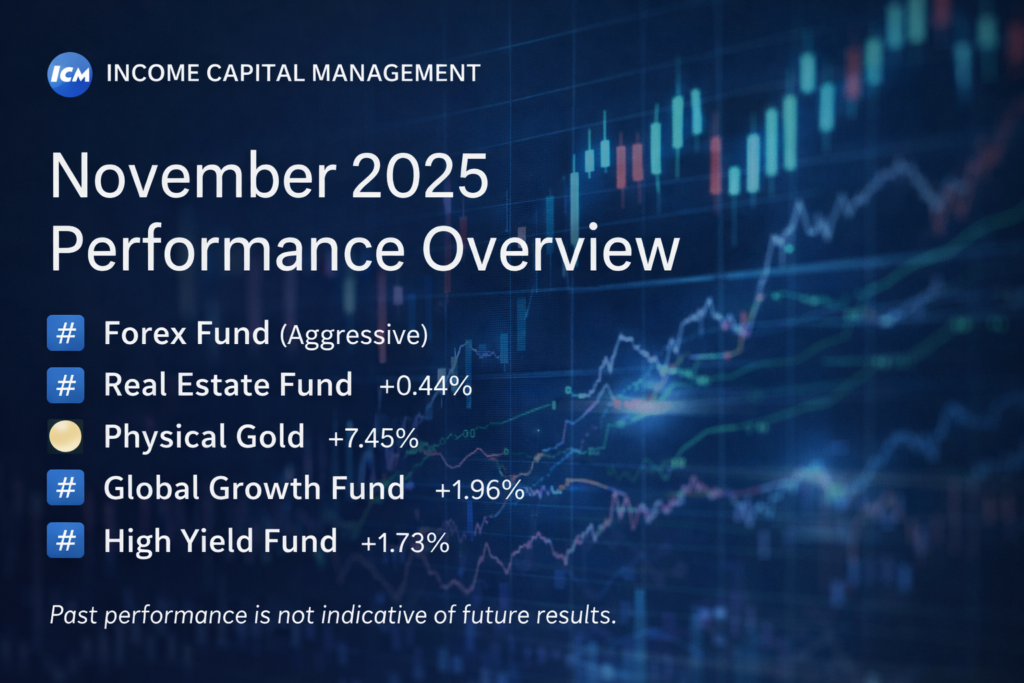
November 2025 – Portfolio Performance Overview Monthly performance reporting is not just about numbers. It is about understanding how different asset classes behave across varying market conditions and how disciplined portfolio construction supports consistency over time. Below is an overview of the performances of the main funds and assets managed by INCOME CAPITAL MANAGEMENT for November 2025, contextualized within the broader market environment. Forex Fund (Aggressive) November 2025: +2.00% January–November 2025: +32.71% Since April 2024: +62.76% In the final part of the year, a prudent and adaptive approach continued to support performance. Exposure was selectively reduced during more delicate market phases, allowing the strategy to remain responsive while protecting accumulated gains. This balance between opportunity and risk control remains a core element of the fund’s positioning. Real Estate Fund November 2025: +0.44% January–November 2025: +7.43% Since April 2024: +13.63% During November, the real estate market experienced a slight slowdown, a dynamic that is typical in periods characterized by reduced tourism and lower transactional activity. Despite this seasonal deceleration, the fund maintained stability thanks to sustained demand for quality properties located in prime areas, confirming the defensive characteristics of well-selected real estate exposure. Physical Gold Gold in custody: 13.45 Kg Market value as of 30/11/2025: €1,556,972 (€115.76 per gram) In November, gold recorded a strong appreciation, rising by more than 7% during the month. Since the beginning of 2025, cumulative growth exceeds 60%, reflecting persistent demand for defensive assets and the role of gold as a long-term store of value during periods of macroeconomic uncertainty. Global Growth Fund Total performance since 15/09/2025: +1.96% The initial months of activity have been positive, supported by selective exposure to innovative companies and high-potential sectors. The strategy focuses on long-term growth drivers while maintaining disciplined allocation criteria. High Yield Fund Total performance since 15/09/2025: +1.73% The fund’s launch phase has been supported by exposure to high-yield corporate bonds and REIT ETFs. Income generation is pursued within a diversified and risk-aware framework, aiming to balance yield opportunities with structural resilience. Final Considerations November’s results reflect a diversified portfolio structure designed to adapt across asset classes and market conditions. Consistency, selective exposure, and disciplined risk management continue to guide portfolio construction and execution. Full details are available in the private area under RESULTS: Access the private results area This content is provided for informational purposes only and does not constitute investment advice or a solicitation to the public. Past performance is not indicative of future results.

