Why We Prepare Portfolios Instead of Predicting Markets
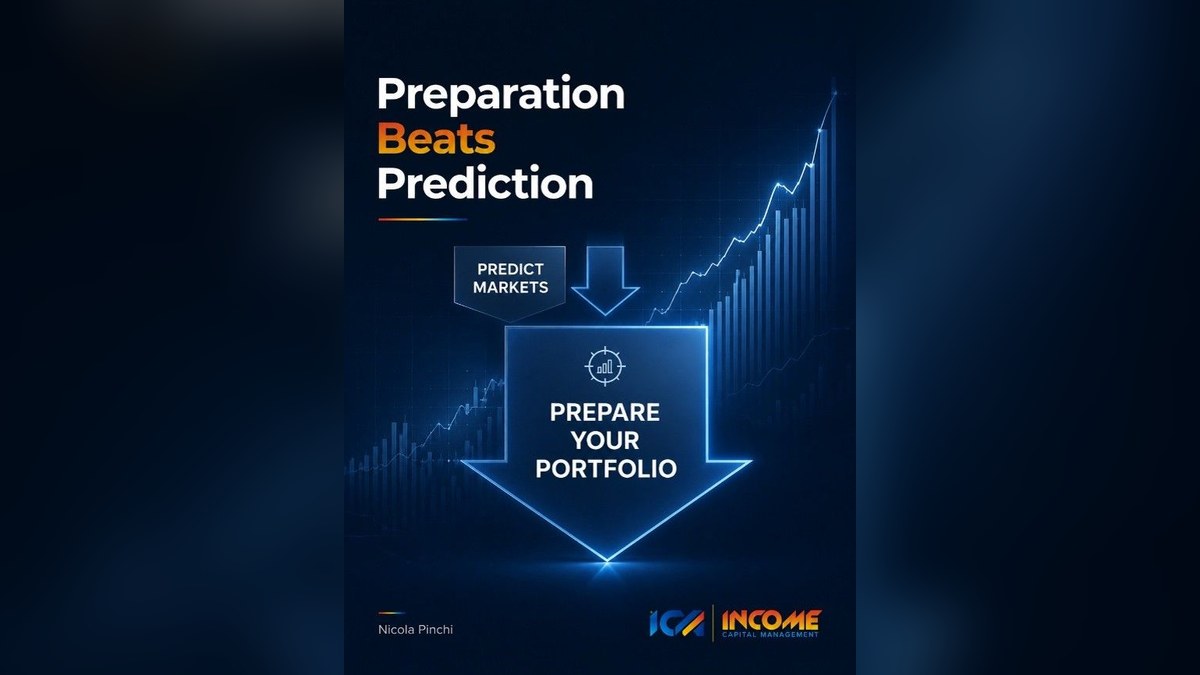
Most conversations about investing begin with the same question: where is the market going? It is the question analysts are paid to answer, the question that fills financial television, and the question many investors believe they must resolve before committing capital. At Income Capital Management we have come to believe it is the wrong place to start. A far more useful question is quieter and less comfortable: is my portfolio prepared if I am wrong?
The difference between these two questions is not academic. It separates two entirely different ways of managing money. One depends on being right about the future. The other accepts that nobody is right often enough, and builds a process that can survive and function across many possible futures. In this article we explain why we organise our work around the second approach.
The Allure of Market Predictions
Market predictions are attractive for understandable reasons. They offer a feeling of control in an environment defined by uncertainty. They compress a complex world into a single, actionable statement. And when a forecast happens to work, the reward is immediate and visible, which makes the memory of it far stronger than the memory of the forecasts that failed.
The problem is the base rate. Markets are shaped by millions of participants reacting to information, to each other, and to events that are unknowable in advance. Even a correct view about fundamentals can produce a losing position if the timing is wrong, if positioning is crowded, or if an unrelated shock arrives first. Every experienced investor has been right about the story and wrong about the trade. That experience is not bad luck. It is the normal consequence of acting on point forecasts in a system that does not owe anyone precision.
A Better Question to Ask
Asking whether a portfolio is prepared for being wrong changes the work in a fundamental way, because unlike a forecast, it can actually be answered. A view about next quarter cannot be verified today. The resilience of a portfolio can. It can be examined position by position, scenario by scenario, on paper, before any of it happens.
Preparation reframes uncertainty from a threat into a design input. Instead of asking which scenario will occur, we ask what each plausible scenario would do to the portfolio: a sharp rise in volatility, a reversal in a crowded trade, a liquidity squeeze, a correlation shift that weakens diversification exactly when it is needed. The goal is not to assign probabilities with false confidence. The goal is to make sure that no single outcome, including the ones we consider unlikely, can do unacceptable damage.
What Preparation Looks Like in Practice
Preparation is not a slogan. In our day-to-day work it rests on a small number of concrete disciplines, each of which exists precisely because forecasts fail.
- Scenario work before capital is committed. We examine how positions behave under adverse conditions, including conditions in which the usual relationships between assets break down. This is the purpose of the framework we described in our article on stress testing in real portfolios: to find vulnerabilities on paper before markets find them in practice.
- Sizing that assumes error. If every position is sized on the assumption that the underlying view might be wrong, no single mistake can define the year. We wrote about this discipline in detail in our article on position sizing, which in our view is the decision that matters more than the trade itself.
- Predefined loss limits. Deciding in advance how much can be lost, at the position and portfolio level, removes the most dangerous element from stressed markets: improvisation. This is the core of what we described in our note on drawdown management.
- Regular positioning reviews. Preparation decays. A portfolio aligned with its risk limits in one quarter may drift away from them in the next, which is why we treat periodic positioning reviews as maintenance rather than reaction.
None of these habits requires knowing the future. All of them improve what happens when the future surprises us, which it reliably does.
Preparation Changes How Losses Behave
The practical payoff of this approach appears on the difficult days, not the easy ones. A portfolio built around a single forecast experiences an adverse surprise as a crisis: the thesis is broken, the losses are unbounded by design, and decisions must be made under pressure, which is precisely when decision quality is lowest.
A prepared portfolio experiences the same surprise as a scenario it has already met on paper. The loss was contemplated, the limits were set, the response was decided in calm conditions. The event is still unwelcome, but it is survivable by construction. Over long horizons this difference compounds quietly, because capital preserved in bad periods is what funds the opportunities that follow them.
Does Prediction Have Any Place at All?
We are not arguing that views about markets are worthless. Research, analysis and macro understanding inform every decision we make. The distinction we draw is between holding views and depending on them. A view held with humility is an input: it shapes where we look for opportunity and how we weigh risk. A view held with certainty becomes a structural weakness, because everything downstream of it inherits its fragility.
In practice this means our views are allowed to influence positioning, but they are never allowed to override the disciplines above. No thesis, however convincing, earns an exemption from sizing limits, loss limits or scenario review. The process is senior to the opinion.
Prediction Is Interesting. Preparation Is Profitable
There is one more reason we prefer preparation, and it is almost psychological. An investor whose results depend on forecasts is condemned to a permanent state of anxiety about the next data release, the next policy meeting, the next headline. An investor whose portfolio is built for multiple outcomes can observe the same events with interest rather than fear, because no single one of them carries the power to break the plan.
Markets will continue to surprise everyone, including us. We do not consider that a problem to be solved by better forecasting. We consider it the permanent condition of investing, and the entire reason disciplined preparation exists. Prediction is interesting. Preparation, over time, is what allows a strategy to keep showing up.
This article is provided for informational and educational purposes only. It does not constitute investment advice, an offer, or a solicitation to invest in any product or service. Income Capital Management s.r.o. is registered under §15 of the Czech Act on Investment Companies and Investment Funds (ZISIF). Past performance is not indicative of future results. Investing involves risk, including the possible loss of capital.


