VPS Monitoring and Hosting Reliability: Why Infrastructure Providers Must Do Better
Modern businesses depend on digital infrastructure. Websites, trading systems, financial dashboards, APIs, and internal tools rely on servers running continuously in the background. In this environment, VPS hosting providers play a critical role in ensuring that services remain online and accessible.
Yet one of the most basic expectations of infrastructure providers is still frequently overlooked: reliable monitoring and proactive support when a server goes down.
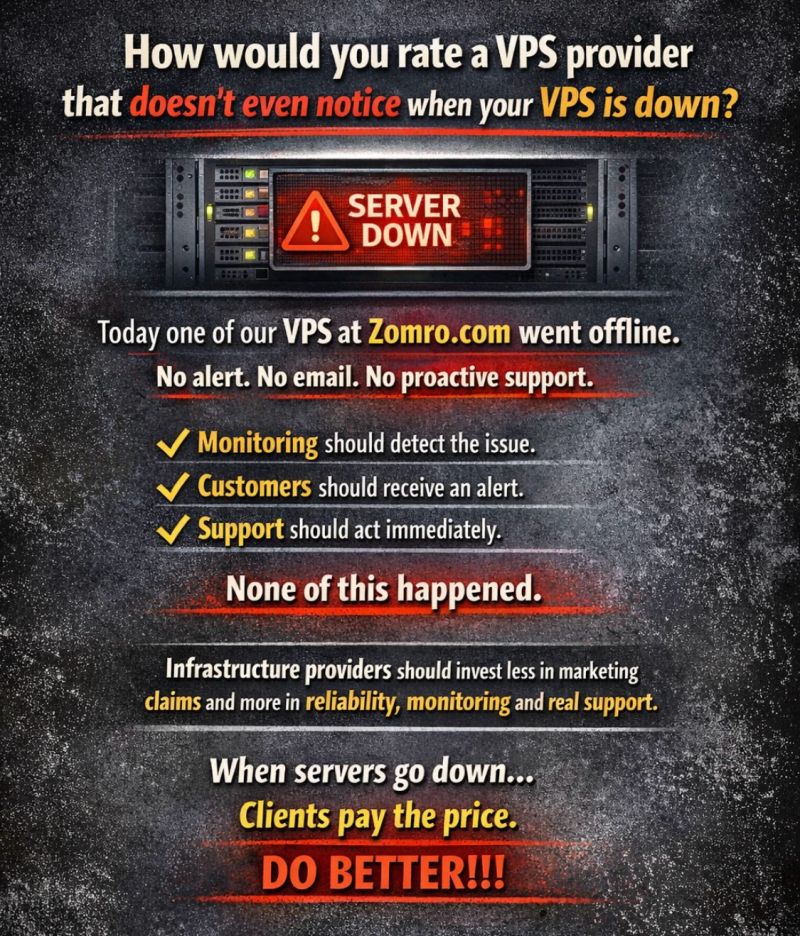
Recently, one of our VPS servers hosted with Zomro.com went offline. The issue itself was not extraordinary — hardware failures, network interruptions and system crashes are realities of operating digital infrastructure.
What was surprising, however, was something else entirely: no alert, no email notification, and no proactive response from the hosting provider.
For companies that sell remote infrastructure services, this should be the absolute minimum standard.
The Minimum Standard for VPS Infrastructure Providers
Professional infrastructure providers are expected to deliver more than server rental. They are responsible for maintaining systems that businesses depend on for their daily operations.
At the very least, three elements should always be present in any VPS hosting environment:
- Automated uptime monitoring
- Immediate alerts when servers become unavailable
- Rapid response support teams capable of investigating outages
Without these basic safeguards, customers are left discovering failures themselves — often after websites, applications or financial services have already stopped working.
Why Monitoring Is Not Optional
In the world of cloud infrastructure and modern DevOps environments, monitoring is not a luxury feature. It is a fundamental requirement.
Monitoring systems track key indicators such as:
- Server uptime
- Network availability
- CPU load
- Memory usage
- Disk health
- Application responsiveness
When any of these metrics cross critical thresholds, alerts should be triggered automatically. This allows infrastructure teams to respond before the issue escalates into a full outage.
Most modern hosting providers claim to offer monitoring, but the quality and reliability of these systems varies widely.
In practice, many providers rely on reactive support models where customers are expected to report problems themselves. This approach may reduce operational costs, but it shifts risk entirely onto the customer.
The Cost of Downtime
Server downtime is not merely an inconvenience. For many businesses, it directly translates into lost revenue, damaged reputation, and operational disruption.
Consider the consequences when critical infrastructure fails unexpectedly:
- Websites become inaccessible
- Financial platforms stop processing transactions
- APIs break integrations with external services
- Client dashboards go offline
- Internal tools stop functioning
Even a short interruption can cascade into larger operational problems. This is why professional hosting providers invest heavily in site reliability engineering (SRE), redundancy, and monitoring systems.
What Good VPS Providers Actually Do
High-quality hosting companies operate under a different philosophy: they treat infrastructure reliability as a core product feature.
The best VPS providers implement:
- Real-time monitoring systems
- Automatic outage detection
- Multi-channel alerting (email, SMS, dashboard notifications)
- 24/7 support teams
- incident response procedures
- post-incident analysis
In well-run infrastructure environments, outages are not hidden problems waiting to be discovered. They are events that trigger immediate investigation and communication.
The Responsibility of Infrastructure Providers
Hosting providers operate the backbone of the modern internet. From startups to global enterprises, organizations depend on reliable infrastructure for everything from financial services to e-commerce.
Because of this responsibility, infrastructure companies should invest less in marketing claims and more in the systems that actually matter:
- reliability engineering
- monitoring infrastructure
- support operations
- network resilience
When servers go down, clients are the ones who pay the price. The impact is felt not only technically but financially and operationally.
Why Independent Monitoring Is Essential
One lesson every experienced infrastructure user eventually learns is this: never rely solely on your hosting provider to detect outages.
Independent monitoring tools such as UptimeRobot, Better Uptime, Pingdom, and other uptime monitoring services allow organizations to track server availability from external locations.
These tools can provide:
- external uptime verification
- independent alerting
- performance history
- downtime reports
For businesses running critical systems, independent monitoring should always be part of the infrastructure strategy.
Infrastructure Reliability Is the Real Product
The hosting market is highly competitive, and many providers focus their messaging on low prices, high performance hardware, or unlimited bandwidth.
However, the true product of a hosting company is not disk space or CPU power. It is reliability.
Clients do not purchase servers simply to own infrastructure. They purchase the assurance that their digital systems will remain operational when needed.
Without reliable monitoring and responsive support, that assurance disappears.
Final Thoughts
Server outages will always happen. Hardware fails, networks experience disruptions, and software crashes.
What separates professional infrastructure providers from mediocre ones is not the absence of problems, but how quickly those problems are detected and addressed.
Monitoring should detect the issue.
Customers should receive alerts.
Support teams should respond immediately.
These are not premium features. They are the foundation of modern infrastructure services.
Because when servers go down, the consequences extend far beyond a single machine.
And infrastructure providers should always remember that.
Original LinkedIn Post:
Read the original discussion on LinkedIn


